
Quick Summary
Diamond fluorescence is the visible glow a diamond gives off under ultraviolet light, caused by trace elements and structural features in the crystal. It matters mainly when it makes a stone look hazy in daylight or affects price, so the stone should be viewed in the lighting you will actually use.
- Fluorescence grades run from none through faint, medium, strong and very strong, and blue is the most common colour.
- The grade measures the UV reaction, not transparency, so it cannot by itself show whether a stone will look hazy.
- Check the specific stone in daylight-balanced light, indoor lighting, and a UV torch, comparing against a non-fluorescent stone.
- Strong blue fluorescence in higher colour grades is more likely to be discounted, while in lower grades it may be neutral.
- Fluorescence usually moves price less than cut quality, carat weight and clarity, so treat it as one comparison factor.
Table of Contents
- What Diamond Fluorescence Is and Where It Comes From
- How Ultraviolet Light Makes a Diamond Glow
- Fluorescence Grades: From None to Very Strong
- Does Diamond Fluorescence Make a Stone Look Cloudy?
- Does Diamond Fluorescence Affect Price and Value?
- Reading Fluorescence on a Grading Report and Checking It Yourself
- Choosing a Diamond With Fluorescence in Mind
- Frequently Asked Questions
What Diamond Fluorescence Is and Where It Comes From
Last Updated: November 6, 2026
Diamond fluorescence is the visible glow a diamond gives off when it is exposed to ultraviolet light. Fluorescence is a standard part of every diamond report, yet many buyers are unsure whether it should change their decision.
The effect comes from trace elements and structural features within the crystal. When ultraviolet energy strikes these features, the diamond re-emits that energy as visible light, most often in a blue tone. Gemological laboratories generally treat this as a property of the stone itself rather than a flaw, and assess it separately from colour and clarity.
Fluorescence is not the same as the sparkle a diamond shows in ordinary daylight. Brilliance and fire come from how light is reflected and refracted by the cut. Fluorescence only becomes noticeable under specific lighting, which is why a stone can look unremarkable in a shop window yet show a clear blue cast under a UV lamp.
How Ultraviolet Light Makes a Diamond Glow
Ultraviolet light is the trigger. Diamonds that fluoresce absorb invisible UV wavelengths and release them as longer, visible wavelengths. Gemologists usually test this under long-wave UV, though the result depends on the lamp and the stone's own properties.
Because the reaction happens only under UV, a diamond's fluorescence is invisible in most everyday settings. Sunlight contains some UV, so a stone can glow faintly outdoors, but the effect is subtle compared with a dedicated test lamp.
Fluorescence Grades: From None to Very Strong
Grading laboratories describe fluorescence on a scale that runs from none through faint, medium, strong and very strong. A "none" grade means the stone shows no visible reaction to UV, while a "very strong" grade means the glow is clearly visible to the naked eye.
Blue is the most common colour. Blue is the most common colour of fluorescence, though other colours can occur. The grade on a report tells you how intense the reaction is, not whether the stone is good or bad.
The article describes the fluorescence scale and its most common colour, which can be summarised as follows.
| Grade | What it means | Visibility |
|---|---|---|
| None | No visible reaction to UV | No glow |
| Faint | Weak reaction | Hard to see |
| Medium | Moderate reaction | Visible under UV |
| Strong | Clear reaction | Visible to the naked eye |
| Very strong | Intense reaction | Clearly visible to the naked eye |
Does Diamond Fluorescence Make a Stone Look Cloudy?
This is the most debated question about fluorescence, and the honest answer is that it depends on the individual stone, but the reasons are more specific than most buying guides admit. The concern is that a strongly fluorescent diamond can appear hazy, oily or milky in daylight. That effect, when it occurs, is not the glow itself. It is light scattering inside the stone.
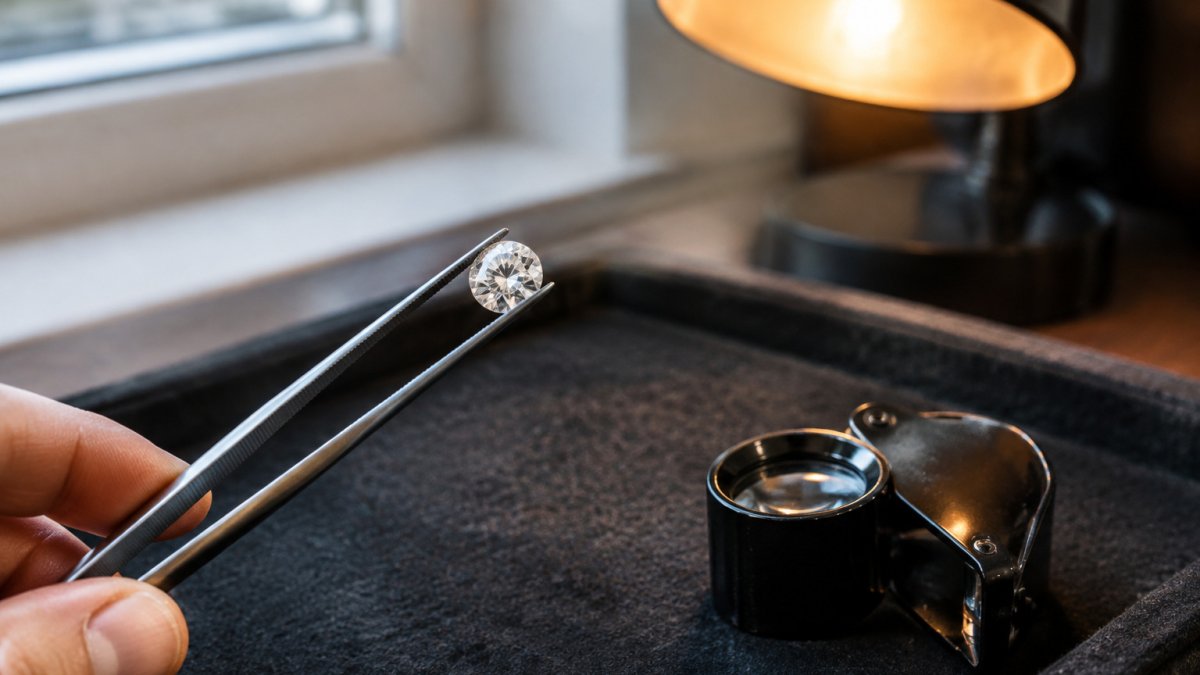
A diamond's fluorescence comes from trace elements and structural features in the crystal. In a small minority of stones, those same internal features, often described as graining or internal structure, scatter light in a way that reduces transparency. Under daylight, which contains ultraviolet, the stone can look slightly milky rather than crisp. The fluorescence grade on a report measures the intensity of the UV reaction; it does not measure transparency, and it cannot tell you whether a particular stone will look hazy. Two stones graded 'strong blue' can behave completely differently.
The risk of a visible haze appears to be concentrated in a few combinations, such as strong fluorescence paired with lower colour grades and certain clarity characteristics, while a well-cut stone in higher colour grades is generally less likely to look hazy. Broad rules such as 'avoid strong fluorescence' can be unreliable because they ignore the individual stone.
A practical viewing checklist is more useful than any grade alone. Ask to see the specific diamond under three conditions:
- Daylight-balanced light (near a window, not direct sun). Look at the stone face-up and from the side. Does it look crisp, or does it have a milky or oily sheen? Compare it against a non-fluorescent stone of similar colour and cut if one is available.
- Indoor lighting (the lighting you will actually live with, office, kitchen, restaurant). Fluorescence is usually invisible here, but haze, if present, can still show as a slight dullness.
- A UV torch in a dim room. This confirms the reaction and its colour, but it tells you nothing about haze. Do not judge a stone by its UV glow alone.
Watch out: a stone that looks hazy under a jeweller's strong spotlight may look fine in daylight, and a stone that looks fine under spotlight may look milky outdoors. Always compare the same stone across all three conditions before deciding.
It also helps to separate fluorescence from the optical effects buyers often confuse it with. Brilliance is the return of white light from the cut; fire is the dispersion of light into spectral colours; phosphorescence is a continued glow after the UV source is removed (rare in diamond and not what a fluorescence grade describes). Fluorescence is none of these, it is a UV-triggered emission, and in ordinary lighting it is usually invisible.
Finally, treat the appearance debate with appropriate caution. Research on fluorescence and appearance is generally reported to find little measurable effect on beauty for most stones, though individual stones can differ. The only reliable test is viewing the specific stone in the lighting you will wear it in. If you cannot see a difference, there is no difference to worry about.
Does Diamond Fluorescence Affect Price and Value?
Fluorescence can affect price, as a market response that varies by colour grade, stone size, cut quality and current demand. Generally, strong blue fluorescence in the higher colour grades is more likely to be discounted, while in lower colour grades it may be treated as neutral.
Any single percentage for a fluorescence discount should be treated with caution, as it depends on the stone, the seller and the moment. The more useful approach is to ask for a clear breakdown of how the stone's price compares with a non-fluorescent stone of the same colour, clarity, cut and carat weight. If the seller cannot or will not show that comparison, that is itself information.
Because pricing is uneven, fluorescence creates a genuine value trade-off, and whether it is worth taking depends on your priorities. A simple decision framework:
- You are colour-sensitive and buying in the top colour grades (D-F). Prioritise a none or faint grade. The price saving from strong fluorescence is usually small relative to the risk of a visible blue cast, and the resale market is less forgiving.
- You are buying in the middle colour grades (G-J) and want maximum size for budget. A faint or medium blue fluorescent stone can be a sensible value choice, provided you have viewed it in daylight and see no haze. You are effectively getting a slightly whiter-looking stone for less.
- You are buying a lower colour grade (K and below) or a warm-toned stone. Strong blue fluorescence is often a positive: it can neutralise warmth face-up. Judge it in daylight, not under a UV lamp.
- You are buying for investment or resale. Be conservative. The market discounts strong fluorescence in high colour grades, and a future buyer may apply the same discount. A none or faint grade is the safer store of value.
- You have seen the stone and love it in daylight. The grade matters less than the stone. If the price reflects the fluorescence and the stone looks right to you, the trade-off is working in your favour.
Watch out: do not accept a fluorescence discount as proof of a bargain. The discount exists because some buyers will not pay full price for the stone, if you later resell, you may face the same discount. Buy fluorescence as a value trade-off only when you have seen the stone and are comfortable with how it looks.
Finally, keep fluorescence in proportion. Cut quality, carat weight and clarity usually move price more than fluorescence does, and a poorly cut stone will not be rescued by a favourable fluorescence grade. Use fluorescence as one line in the comparison, not the deciding one.
Reading Fluorescence on a Grading Report and Checking It Yourself
A grading report lists fluorescence as a separate entry, usually alongside colour, clarity, cut and carat weight. Read it as a description of the reaction under UV, not as a verdict on the stone. Check that the report number matches the stone and that the certificate comes from a recognised laboratory. Our guide on how to verify diamond certification reports explains the steps.
To check fluorescence yourself, view the stone under a UV torch in a dim room, then compare it under daylight-balanced light. Note whether the glow is visible in normal conditions and whether the stone looks different to you. Our step-by-step authenticity checks cover further verification.
Choosing a Diamond With Fluorescence in Mind
Fluorescence matters most when you are comparing stones of similar colour and clarity. If the price difference is clear and the stone looks right to you in daylight, a fluorescent diamond can be a sensible choice. If you want a stone that looks identical under every light, a non-fluorescent or faintly fluorescent grade is the safer option.
Shape and setting also play a role, because the cut changes how light moves through the stone. Our comparison of cushion and princess cuts explains how shape affects the way a diamond looks. For a broader view of value, our guide to clarity grades and overall value is a useful starting point, and if you are weighing natural against lab-grown options, our lab-grown diamond guide compares how each behaves under UV.
Watch out: Do not assume a fluorescent stone is flawed. Ask to see it under both UV and daylight before you decide.
Frequently asked: Does fluorescence matter for an engagement ring? For most buyers, it matters less than colour and cut, but seeing the stone in your intended lighting is the best guide.
Explore our diamond collection and bespoke options at Morgan Banks, or visit us in Kendal to see stones in person. Our team can help you read a grading report and choose a diamond that suits your priorities.
Frequently Asked Questions
What is diamond fluorescence?
Diamond fluorescence is a visible glow a diamond gives off when it is exposed to ultraviolet light. Blue is the most common colour of fluorescence in natural diamonds, although other colours can appear. The effect is caused by trace elements and structural features within the stone. It is not visible in ordinary daylight or indoor lighting with no UV component, so it only shows up when the diamond is viewed under a UV source such as a black light. Gemological laboratories grade the strength of fluorescence separately from the colour and clarity grades on a report.
Does diamond fluorescence affect how it looks?
Research generally suggests fluorescence has little to no effect on a diamond's sparkle or beauty. Its effect on appearance depends on the individual stone, its colour grade and how it looks in real life. Strong blue fluorescence can sometimes make a near-colourless diamond look slightly milky in certain lighting, which is why the appearance question is debated. Viewing the specific diamond in the lighting you expect to wear it in is the most reliable way to judge its look.
Does fluorescence make a diamond look cloudy?
It can, in some stones, but this is not guaranteed. Strong fluorescence is sometimes blamed for a hazy or oily look, particularly in higher colour grades where the stone should appear very clear. Whether a diamond looks cloudy depends on how it is cut, its clarity and the intensity of the fluorescence, so two diamonds with the same grade can look different. Compare the stone visually under normal daylight and indoor light before deciding, rather than relying on the grade alone.
