
Table of Contents
- Cushion Cut vs Princess Cut: Key Differences at a Glance
- Shape, Silhouette and Face-Up Appearance Compared
- Sparkle and Brilliance: How Each Cut Reflects Light
- Durability, Corner Protection and Everyday Wear
- Popular Engagement Ring Setting Styles for Both Cuts
- How to Choose a Diamond Shape: Price, Carat and Value
- Which Cut Suits Your Style: Modern or Vintage Appeal?
- Conclusion: Making the Right Choice for Your Ring
- Frequently Asked Questions
Last Updated: September 5, 2026
Choosing between a cushion cut vs princess cut diamond is one of the most common dilemmas for engagement ring buyers. The short answer is that a princess cut offers a sharp, modern square silhouette with exceptional sparkle, while a cushion cut delivers a softer, romantic look with a vintage character and a dreamier, more subtle glow. The decision usually comes down to personal style versus a preference for brilliance.
Cushion Cut vs Princess Cut: Key Differences at a Glance
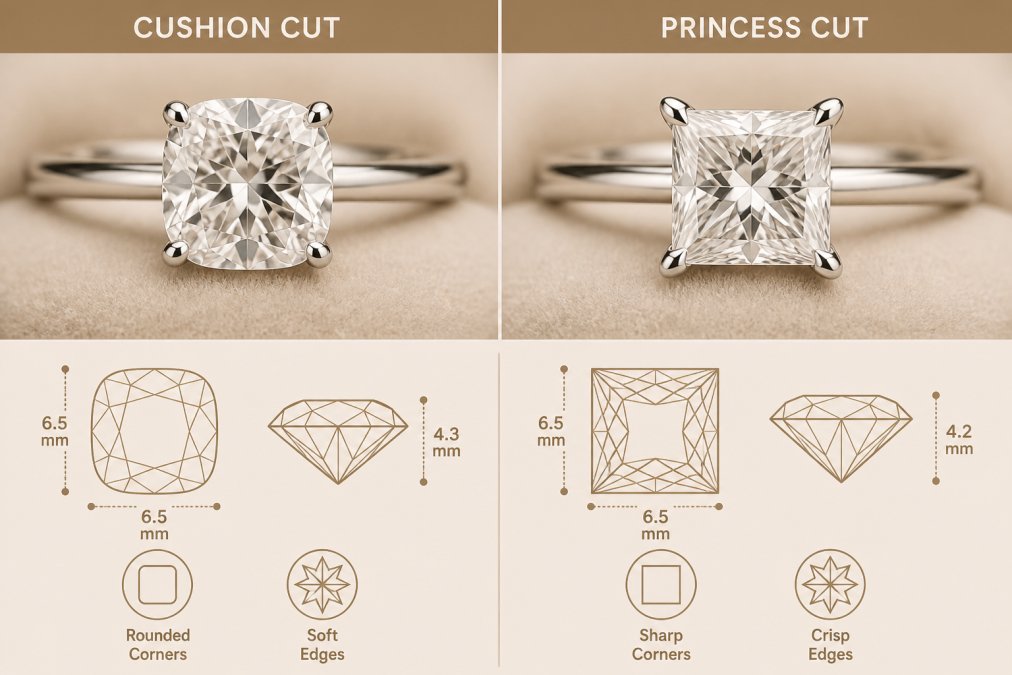
The core difference lies in the outline and the light performance. A cushion cut diamond is a square or rectangular fancy shape with rounded corners and larger facets that create a soft, romantic glow, often described as a “crushed ice” effect. A princess cut diamond is a sharp-cornered square shape cut for maximum brilliance and fire, offering a more geometric and modern aesthetic.

| Feature | Cushion Cut | Princess Cut |
|---|---|---|
| Silhouette | Square with rounded corners | Square with sharp corners |
| Brilliance | Soft, romantic glow | High sparkle and fire |
| Facet Style | Larger facets, crushed ice effect | Step-like, brilliant cut pattern |
| Durability | Rounded corners resist chipping | Sharp corners need prong protection |
| Aesthetic | Vintage-inspired, romantic | Modern, geometric, clean |
| Best For | Halo and solitaire settings | Solitaire and three-stone rings |
Shape, Silhouette and Face-Up Appearance Compared
A cushion cut diamond presents a pillow-like shape, which is where it gets its name. Its rounded corners and larger facets give it a softer, more romantic face-up appearance that many couples find flattering on the hand. In contrast, a princess cut diamond is a perfect square with sharp corners, creating a crisp, modern line that maximises the stone's face-up size for its carat weight.

The face-up appearance matters more than carat weight for most buyers. Because a princess cut is cut shallow, it often looks larger than a cushion cut of the same carat weight. The cushion cut, with its deeper pavilion, tends to face up smaller but can hold its colour better, making it a forgiving choice if you are choosing between G and H colour grades.
Sparkle and Brilliance: How Each Cut Reflects Light
Most comparisons stop at saying the princess cut is 'sparkly' and the cushion is 'glowy'. To make an informed choice, it helps to understand the optical mechanisms behind those impressions.

The Princess Cut: Engineered for Scintillation
The princess cut is a brilliant-style square, typically with 57 to 58 facets arranged in a pattern derived from the round brilliant. Its pavilion is cut with steep angles and a high crown, which creates strong contrast between bright and dark facets. This contrast is what produces the sharp, frequent flashes of white light, known as scintillation, that make the stone appear lively in motion.
A well-cut princess diamond will display a balanced pattern of light and dark, not a uniform glow. When you tilt the stone under a point light source, you should see distinct, crisp flashes across the table and crown. The trade-off is that this brilliance is more directional: the princess cut performs best under direct, focused light, such as spotlights or daylight, and can appear slightly darker in diffuse or low-light environments.
The Cushion Cut: Two Distinct Light Personalities
The term 'cushion cut' covers two very different facet arrangements, and they do not sparkle the same way.
The Modified Brilliant Cushion (Crushed Ice): This is the most common modern cushion. It features a modified brilliant facet pattern with an extra set of pavilion facets that break up the light into many small, overlapping reflections. The result is a continuous, shimmering effect often called 'crushed ice'. The stone never goes dark; it glows softly from within, even in gentle ambient light. However, it produces less distinct fire and fewer sharp flashes than a princess cut. Some buyers find the crushed ice effect dreamy and romantic; others feel it looks hazy or milky compared to a crisp brilliant cut.
The Old Mine / Old European Cushion: This is the vintage style, with a higher crown, a smaller table, and larger, fewer facets. It produces broad, chunky flashes of light and a warmer, more candlelit glow. It has significantly less brilliance by modern metrics but offers a unique, romantic character that modern cuts cannot replicate.
Light Performance: What the Numbers Say
Independent gemmological laboratories, such as the Gemological Institute of America (GIA), do not issue light-performance grades for fancy shapes the way they do for round brilliants. However, optical modelling software used by cutters shows measurable differences. A well-executed princess cut typically returns 70-80% of incident light to the eye under ideal conditions, while a modified brilliant cushion returns 60-75%, depending on the depth and facet precision. The cushion's lower peak return is offset by its more forgiving nature: it is less sensitive to slight misalignment in the setting, and it holds its brightness better under overcast skies or indoor tungsten lighting.
A Practical Test You Can Do
When comparing stones side by side, ask your jeweller to dim the overhead lights and hold each diamond under a single desk lamp. Move the stones slowly in a figure-eight motion. The princess cut will flash in sharp, distinct bursts; the cushion will shimmer continuously. Then, turn off the lamp and hold the stones under a soft, warm ceiling light. The princess may go dark between flashes; the cushion will maintain a steady, soft glow.
Durability, Corner Protection and Everyday Wear
When it comes to everyday wear, the princess cut has a notable vulnerability: its sharp corners. These corners are the most fragile part of any diamond and are prone to chipping if struck hard. To protect them, a princess cut must be set in a sturdy prong setting that covers each corner, or in a bezel setting that shields the entire perimeter.
Cushion cut diamonds, with their rounded corners, are inherently more durable for daily wear. The absence of sharp points means there is less risk of chipping, making them a practical choice for an active lifestyle. However, the table of a cushion cut is often larger and flatter, which can show smudges and dirt more readily, so regular cleaning is essential to maintain its glow.
Popular Engagement Ring Setting Styles for Both Cuts
Both cuts pair beautifully with classic engagement ring setting styles, but each has a natural affinity. The princess cut shines in a solitaire setting, where its geometric shape and brilliance are the sole focus. It also works well in a three-stone setting, where the sharp corners of the centre stone contrast with round side stones.
The cushion cut is a favourite for halo settings, where a ring of smaller diamonds frames the soft, rounded corners, enhancing its face-up size and overall sparkle. A vintage-inspired halo setting complements the cushion cut’s romantic, old-world charm.
How to Choose a Diamond Shape: Price, Carat and Value
Price per carat is a significant factor in the cushion cut vs princess cut decision. Princess cut diamonds are generally more affordable than round brilliants of the same carat weight, but the price can vary based on the quality of the cut and the precision of the corners. Cushion cuts can offer excellent value, as they are often cut from the rough diamond with less waste than a princess cut, but the premium depends on the specific facet arrangement and proportions.
To illustrate the real-world value at a fine jewellery house, consider a few examples from our current collection at Morgan Banks. A Platinum Princess Cut Diamond 0.30ct with shoulder diamonds is available at £2,100, offering a brilliant entry point. For a more substantial centre stone, the Platinum Princess Cut Diamond Ring 0.52ct F VS1 is priced at £4,200. If you are drawn to the cushion cut, the Platinum Cushion Cut Diamond 0.50ct with a halo provides a romantic, vintage look at £2,800.
The value equation always comes back to the length-to-width ratio and face-up size. A well-cut princess cut will face up larger than a cushion cut of the same carat weight, giving you more visual presence for your budget. A cushion cut, however, holds its colour better, allowing you to select a slightly lower colour grade without visible warmth.
The Hidden Cost of Maintenance
Beyond the purchase price, consider the lifetime cost of ownership. The princess cut's sharp corners are its greatest vulnerability. If a corner chips, the stone will likely need to be re-cut, which can reduce its carat weight and incur a cost depending on the lapidary and the complexity of the recut. Many jewellers recommend an annual inspection for princess cuts, specifically to check the integrity of the corner prongs.
The cushion cut, with its rounded corners, is significantly more forgiving. The risk of chipping is minimal, and the main maintenance concern is the larger, flatter table, which shows smudges, lotion, and dust more readily. A cushion cut will require more frequent cleaning, roughly every two to three weeks with a gentle jewellery cleaner, to maintain its soft glow (gsa.gov).
Resale Value: A Realistic Outlook
The resale market for both shapes is thinner than for round brilliants. Round diamonds are the most liquid, with trade-in values typically at 50-70% of the original retail price (gsa.gov). Princess cuts, being the second most popular shape, retain slightly better liquidity than cushions, with trade-in values around 40-60% of retail. Cushion cuts, particularly the modified brilliant 'crushed ice' variety, are less liquid, with trade-in values often at 35-50% of retail. The exception is a well-cut old mine cushion with desirable proportions, which can attract vintage collectors willing to pay a premium.
If you are considering a stone as an investment or anticipate upgrading in the future, the princess cut is the safer choice. If you are buying for a lifetime of wear and are less concerned about future trade-in, the cushion cut's durability and lower maintenance risk may offer better overall value.
Which Cut Suits Your Style: Modern or Vintage Appeal?
Your personal style is the deciding factor. The princess cut is the definitive choice for a modern aesthetic. Its clean lines, geometric precision, and sharp corners appeal to those who favour contemporary design and maximum sparkle.
The cushion cut is for the romantic at heart. Its rounded corners and soft, glowing light return evoke a vintage-inspired feel, reminiscent of the Edwardian and Art Deco eras. If you are drawn to heirloom pieces, intricate halo detailing, or a stone that looks beautiful in soft, warm lighting, the cushion cut is your match.
Conclusion: Making the Right Choice for Your Ring
Selecting between a cushion cut and a princess cut ultimately hinges on whether you prioritise brilliance and modern geometry or a soft, romantic glow. The princess cut offers the most fire per carat and a larger face-up appearance, while the cushion cut provides durability, colour retention, and a vintage soul.
Our team at Peter George banks trading as Morgan Banks has guided couples through this decision since 1935, offering expert guidance and bespoke jewellery services tailored to your vision. Whether you prefer the sharp elegance of a princess cut or the romantic charm of a cushion, we can help you find or design the perfect ring. Explore our curated collection of engagement rings and experience the heritage and quality of a trusted jeweller.
Frequently Asked Questions
Which is better, cushion cut or princess cut diamond?
Neither is objectively better; it depends on your priorities. Princess cuts deliver more brilliance and fire due to their step-like facet arrangement, while cushion cuts offer a softer, romantic glow with a vintage-inspired feel. Try both face-up to see which silhouette and sparkle you prefer on your hand.
Are princess cut diamonds more durable than cushion cut diamonds?
Princess cut diamonds have sharp corners that are more prone to chipping if struck directly. Cushion cut diamonds, with their rounded corners, are generally more durable for daily wear. A protective setting, such as a four-prong V-shaped setting or a bezel, helps safeguard both shapes.
Why might you choose a cushion cut over a princess cut?
Choose a cushion cut if you prefer a romantic, vintage-inspired aesthetic with a softer, more understated sparkle. The rounded corners and larger facets create a subtle glow rather than the intense brilliance of a princess cut. Cushion cuts also suit halo settings beautifully, making the centre stone appear larger. If you value a modern, geometric look with maximum fire, a princess cut is the stronger choice.
What is the main difference in sparkle between cushion and princess cuts?
Princess cuts produce a brilliant, fiery sparkle with strong flashes of light, similar to a round brilliant. Cushion cuts, with their larger facets and softer proportions, create a more subdued, romantic glow with broader flashes. The princess cut's higher brilliance makes it a popular choice for those wanting maximum scintillation, while the cushion cut appeals to those who prefer elegance over intensity.
Choosing the right diamond shape is a personal journey, and understanding the trade-offs between sparkle, durability, and style is the first step. At Morgan Banks, we combine fine craftsmanship with honest, expert advice to help you find a ring you will treasure for a lifetime. Get started with Morgan Banks and discover the perfect diamond for your engagement ring.