
Table of Contents
- How to Choose a Diamond Clarity Grade: The Practical Method
- The Diamond Clarity Scale Explained
- What Eye-Clean Diamond Meaning Means for Your Choice
- VS1 vs VS2 Diamond: Which Grade Should You Pick?
- Diamond Inclusions to Avoid: What Actually Matters
- How Shape, Carat and Setting Change What You See
- How Diamond Clarity Affects Price and Value
- Frequently Asked Questions
Last Updated: October 15, 2026
How to Choose a Diamond Clarity Grade: The Practical Method
Most buyers assume the highest clarity grade is always the right one. It isn't.
At Peter George banks trading as Morgan Banks, we've guided couples through engagement ring choices since 1935. Here's the short version: diamond clarity is the measure of how free a stone is from internal flaws and surface marks.
The Gemological Institute of America's clarity grading guide defines how graders assess these marks. Below, we'll show you exactly how to pick a grade that looks right and fits your budget.
The Diamond Clarity Scale Explained
The diamond clarity scale runs from Flawless (FL) down to Included (I), with six main grades in between. A gemologist sets the grade under 10x magnification, not with the naked eye (gia.edu).
Here's how the grades break down:
- Flawless (FL): No inclusions or blemishes visible at 10x magnification
- Internally Flawless (IF): No internal flaws, tiny surface blemishes only
- Very Very Slightly Included (VVS1 and VVS2): Flaws so small even a grader struggles to spot them
- Very Slightly Included (VS1 and VS2): Minor flaws, hard to see at 10x
- Slightly Included (SI1 and SI2): Noticeable flaws at 10x, often invisible to the eye
- Included (I1, I2, I3): Flaws visible at 10x and often to the naked eye
Two terms matter here. An inclusion is an internal characteristic, like a tiny crystal or feather trapped inside the stone. A blemish is an external one, such as a scratch or nick on the surface.
What Eye-Clean Diamond Meaning Means for Your Choice
An eye-clean diamond shows no inclusions to the naked eye, even though a grading report may list some. This is the single most useful concept in clarity buying, and the one most guides leave vague. "Eye-clean" is not a grade.
A repeatable inspection protocol
Use the same method every time so you can compare stones fairly:
- View face-up first. Look straight down through the table, not from the side. This is how the stone is seen when worn.
- Use normal indoor lighting. A desk lamp or window light is fine. Avoid jeweller's spotlights, which flatter every stone, and avoid direct sunlight, which hides flaws in glare.
- Hold at 25-30cm. Roughly the distance between your eye and your hand when you gesture. Closer than that exaggerates flaws you will never see in normal use.
- Rotate slowly through 360°. Some inclusions only catch the light at certain angles. A stone that looks clean in one position may not in another.
- Check the girdle edge. Run your eye around the outer rim, where feathers and chips most often sit.
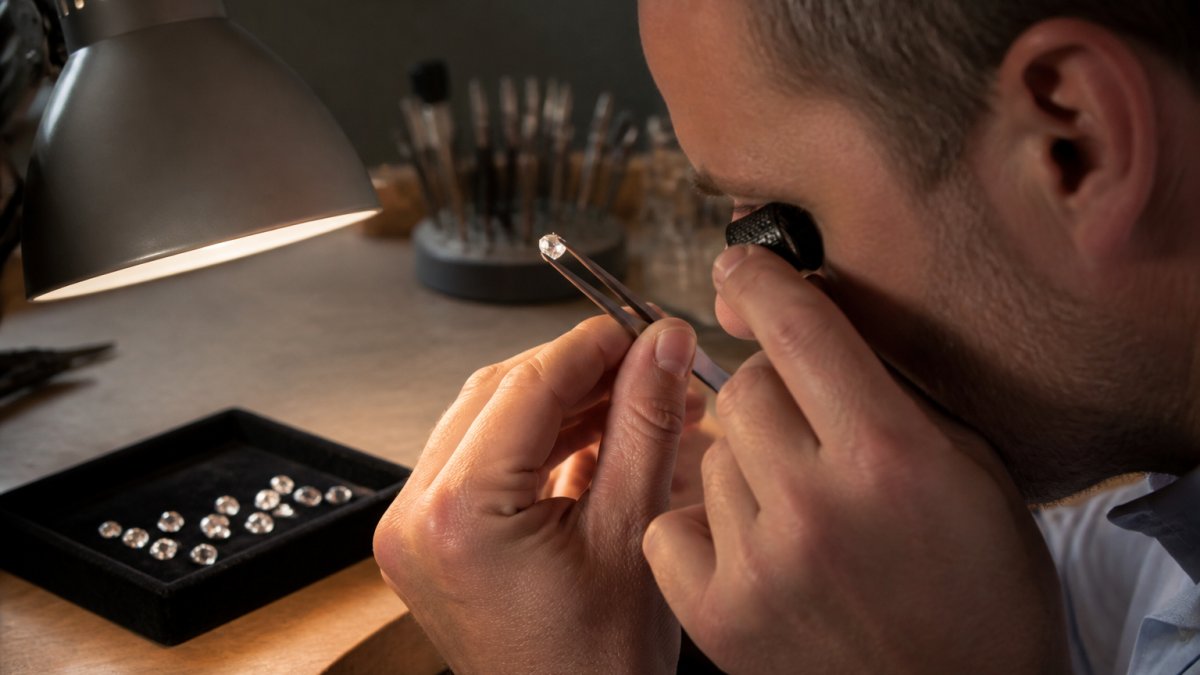
- Then use magnification. A 10x loupe or a magnified listing image confirms what you saw, it does not replace the naked-eye test.
A common pattern is that buyers who skip step 1 and go straight to magnification talk themselves out of stones that would have looked perfect on the hand.
Why magnification alone misleads
Grading is done at 10x magnification because that is the standard for consistency, not because 10x reflects real viewing. At 10x, a VS2 stone can look busy. At arm's length, it looks identical to a VVS1. If you buy on the loupe view alone, you pay for flaws no one will ever see.
The variables that decide eye-cleanliness
Five factors determine whether a listed inclusion actually shows:
- Size, a 0.10mm crystal is invisible; a 0.40mm one under the table is not.
- Number, one faint inclusion is fine; a cluster can create haze.
- Nature, a white feather often disappears; a dark crystal stands out.
- Location, under the table is worst; near the girdle or under a prong is best.
- Relief, how much the inclusion contrasts with the surrounding stone. Low relief hides; high relief shows.
Where the grade stops predicting the look
A VS2 with a dark crystal dead-centre can look worse than an SI1 with a faint feather at the edge. This is why two stones with the same grade can look completely different, and why the grade alone is a starting point, not a verdict. When you compare listings, read the plot on the grading report, not just the letters.
VS1 vs VS2 Diamond: Which Grade Should You Pick?
For most buyers, VS2 is the smarter pick. The difference between VS1 and VS2 is one small step on the scale, and it rarely shows to the eye.
A VS1 stone has minor inclusions that are hard to find at 10x magnification. A VS2 has slightly more or slightly larger ones, still minor. Both usually look identical in a finished ring.
Where VS1 earns its premium:
- Larger stones, where flaws have more room to show
- Step cuts like emerald and asscher, which reveal flaws more easily
- Buyers who want extra reassurance
Where VS2 wins:
- Brilliant cuts like round and princess, which hide flaws well
- Tighter budgets where the saving buys a better cut or colour
Diamond Inclusions to Avoid: What Actually Matters
Not all inclusions are equal. Some sit quietly out of sight. Others weaken the stone or spoil its sparkle.
Watch for these:
- Large feathers near the girdle: can affect durability
- Big clouds: can make the stone look hazy or milky
- Chips on the girdle: a blemish that can worsen with wear
- Inclusions dead-centre under the table: the most visible spot of all
Location and relief decide how much an inclusion matters. A dark crystal under the table is far worse than a faint one near the edge.
Platinum Emerald Cut Diamond .72ct D IF IGL SV5859 →
How Shape, Carat and Setting Change What You See
The same clarity grade looks different depending on the cut. Brilliant cuts break up light and hide flaws. Step cuts don't.
Emerald and asscher cuts have large, open facets. Flaws show up fast, so these shapes reward a higher grade. Round, oval, and pear cuts mask flaws better.
Carat size matters too. A flaw in a 0.50ct stone stays small.
Settings help as well. A bezel or halo covers the edges where many inclusions sit. A simple solitaire leaves more of the stone on show.
| Factor | Hides Flaws | Shows Flaws |
|---|---|---|
| Brilliant cuts | Yes | No |
| Step cuts | No | Yes |
| Larger carat | No | Yes |
| Bezel or halo setting | Yes | No |
How Diamond Clarity Affects Price and Value
Clarity drives price, but not evenly. The jump from SI2 to VS2 costs far less than the jump from VS1 to VVS1, even though the eye sees no difference. Understanding why helps you decide where to stop paying.
Why the price curve is not linear
Higher grades are rarer, and rarity sets the price. But rarity is not the same as visible beauty. As you climb the scale, each step removes inclusions that were already too small to see. You are paying for a grading distinction, not a visual one.
A common pattern in the trade is that the largest price steps sit between SI2 and VS2, and again between VS1 and VVS1. The first step buys a meaningful visual improvement. The second buys reassurance.
Illustrative price steps
Exact figures move with carat, cut, colour, shape, and market conditions, so treat any number as a shape, not a rule. As a rough guide for comparable round brilliants of the same carat, colour, and cut:
- Moving from SI2 to SI1 typically adds a modest premium.
- Moving from SI1 to VS2 adds a larger step, and is often the point where eye-cleanliness becomes reliable.
- Moving from VS2 to VS1 adds a further step for a difference most buyers cannot see.
- Moving from VS1 to VVS2 can add a substantial premium for inclusions that are already invisible at 10x.
- Moving from VVS2 to IF or FL adds the largest premium of all, for a distinction only a grader will ever confirm.
Our own stones show how the trade-off plays out in practice:
| Ring | Clarity | Carat | Price |
|---|---|---|---|
| Platinum Emerald Cut | IF | 0.72ct | £7,550.00 |
| Platinum Marquise | VS2 | 0.50ct | £4,150.00 |
| 18ct Yellow Gold Princess | VVS2 | 0.51ct | £4,195.00 |
| Platinum Pear Shaped | SI1 | 1.02ct | £11,795.00 |
Notice the pear ring: SI1 clarity at over 1ct, yet it still looks clean because the flaws sit well. That is eye-clean buying in action. Notice too that the 0.51ct VVS2 princess sits at almost the same price as the 0.50ct VS2 marquise, a reminder that clarity is only one lever among four.

The other four levers
Clarity never moves price alone. Cut, colour, carat, and shape all pull on the same budget:
- Cut, a well-cut stone hides inclusions and returns more light. A poorly cut stone can make a VS1 look dull.
- Colour, a near-colourless stone with an SI1 grade often looks better than a tinted VVS1.
- Carat, larger stones expose inclusions more, so the same grade costs more at 2ct than at 0.5ct.
- Shape, step cuts demand higher clarity for the same look, so their price curve is steeper.
Where to stop paying
For most rings, the sensible stopping point is the lowest grade that is reliably eye-clean for the shape and size you are buying. For brilliant cuts under about 1ct, that is often SI1 or VS2.
Our Platinum Marquise Diamond .50ct D VS2 shows how a VS2 stone delivers a flawless look for a fraction of the cost. For those wanting a step cut, our Platinum Emerald Cut Diamond .72ct D IF sits at the top of the scale, and an 18ct Yellow Gold Princess Cut .51ct VVS2 offers a near-flawless grade in a brilliant cut.


International Gem Society's guide to diamond clarity notes that clarity grading is one of the four Cs, alongside cut, colour, and carat weight. Balance all four, and you'll get more sparkle for your money than chasing clarity alone.
Frequently Asked Questions
What diamond clarity grade should I choose?
For most buyers, VS2 or SI1 offers the best balance of appearance and cost. These grades are usually eye-clean in stones under one carat, meaning no inclusions are visible without magnification. If budget allows, VS1 gives extra peace of mind. Below SI2, visible inclusions become more likely, especially in larger stones. Always view the diamond or its grading report before deciding.
Can you see inclusions in a diamond with the naked eye?
In most cases, no. Clarity grades from Flawless down to SI1 are typically eye-clean when viewed face-up without magnification. Inclusions become visible to the naked eye at SI2 and below, particularly in stones over one carat or with dark, centrally placed inclusions. The setting and diamond shape also affect how noticeable inclusions are. A bezel setting, for example, hides more of the stone's edges than a claw setting.
What is the difference between VS1 and VS2 diamond clarity?
Both VS1 and VS2 are Very Slightly Included grades, meaning inclusions are minor and difficult to see at 10x magnification. VS1 has smaller or fewer inclusions than VS2, making it the higher grade. In practice, the difference is rarely visible without a loupe. A VS2 diamond often costs less than a VS1 of the same carat, colour and cut, so it can be a smarter buy if the stone is eye-clean.
Which diamond inclusions should I avoid?
Avoid inclusions that sit at the centre of the table, are dark in colour, or reach the surface. Crystals, knots and cavities near the girdle can weaken the stone and make it more vulnerable to chipping. Feathers that break the surface also pose durability risks. Inclusions near the edge are less visible when set. Always check the clarity plot on the grading report to see exactly where inclusions sit.
Choosing a diamond means balancing four factors at once, and clarity is only one of them. A higher grade you can't see is money better spent elsewhere. At Morgan Banks, we've helped couples find that balance since 1935, with expert guidance on engagement and wedding rings, a bespoke design service, and gift cards for flexible gifting. Get started with Morgan Banks and find a diamond that looks flawless on the hand, not just on the report.