
Last Updated: November 6, 2026
Quick Summary
A well-maintained pre-owned watch can run for decades, while a neglected one can stop within a few years. Care decides lifespan, not the badge on the dial: movement type, service history, previous owner habits and storage all play a part.
- Mechanical watches have hundreds of moving parts that need lubrication to avoid seizing.
- Quartz watches are simpler and cheaper to keep running than mechanical movements.
- Service a mechanical watch every few years as a sensible guide, not a fixed rule.
- A watch left in a drawer for years still ages as oils dry and seals harden.
- Routine mechanical service costs £150-£400 at many independent watchmakers.
Table of Contents
- What Decides How Long a Pre-Owned Luxury Watch Lasts
- Mechanical vs Quartz Watch Lifespan: What Actually Differs
- How Often to Service a Mechanical Watch
- Signs a Watch Needs Servicing
- A Pre-Owned Watch Condition Checklist Before You Buy
- How Storage, Water, Shocks and Daily Wear Age a Watch
- Vintage Watches, Parts Availability and Realistic Ownership Costs
- Choosing Your Pre-Owned Watch at Morgan Banks
- Frequently Asked Questions
What Decides How Long a Pre-Owned Luxury Watch Lasts
There is no single expiry date on a pre-owned luxury watch. How long do pre-owned luxury watches last? The honest answer is that a well-maintained mechanical watch can run for decades, while a neglected one can stop within a few years. The pattern is consistent across pre-owned timepieces: care decides lifespan, not the badge on the dial.
Four things drive that outcome:
- Movement type (mechanical, automatic or quartz)
- Service history and maintenance records
- Previous owner habits and daily wear
- Storage, water and shock exposure
A watch is a small machine. Machines wear. The question is how fast, and whether anyone intervened before damage set in.
Mechanical vs Quartz Watch Lifespan: What Actually Differs
A mechanical movement is a hand-wound or self-winding engine of gears, springs and jewels. An automatic movement is a mechanical movement that winds itself from the motion of your wrist. A quartz movement runs on a battery and a vibrating crystal.
The practical difference in lifespan comes down to wear points and what fails first:
- Mechanical and automatic: hundreds of moving parts, all needing lubrication. The mainspring, balance staff, escape wheel and rotor bearings are the usual wear points. A well-maintained mechanical watch can run for decades, but a neglected one can seize within a few years as old oil dries and metal grinds on metal.
- Quartz: far fewer moving parts, so less friction. The circuit and stepping motor usually outlast the battery, and a fresh battery costs very little, though branded watches may need a specialist. The parts that age are the rubber gaskets, the crown and the coil.
A common pattern is that quartz watches are simpler and cheaper to keep running, while mechanical watches reward care with generations of use. Neither is "better"; they simply age differently, and the service economics differ sharply. If you want to understand what servicing costs against repairs, read our guide to luxury watch maintenance versus repair costs.
Watch out: a quartz watch left with a dead battery for years can leak and corrode the movement, turning a cheap battery change into a movement replacement.
How Often to Service a Mechanical Watch
Servicing intervals vary, and a service every few years is a sensible guide rather than a fixed rule. A watch worn daily in a dusty workshop needs attention sooner than one worn to dinner twice a month.
Servicing means a full strip-down, clean, fresh lubrication and reassembly, often called an overhaul. Skipping it lets old oil dry and thicken, and metal starts grinding on metal.
Costs vary by brand and movement, so ask for a quote before committing. If you want to understand what servicing costs against repairs, read our guide to luxury watch maintenance versus repair costs.
Signs a Watch Needs Servicing
Watch for these warning signs:
- Timekeeping drifts by more than a minute or two a day.
- The power reserve shortens and the watch stops overnight.
- The crown feels gritty or stiff to wind.
- The rotor sounds rough or rattles on an automatic.
- Condensation appears under the crystal.
- The watch stops intermittently with no obvious cause.
Any one of these means a watchmaker should look at it. Ignoring a gritty crown or a rough rotor is how small fixes become expensive overhauls.
A Pre-Owned Watch Condition Checklist Before You Buy
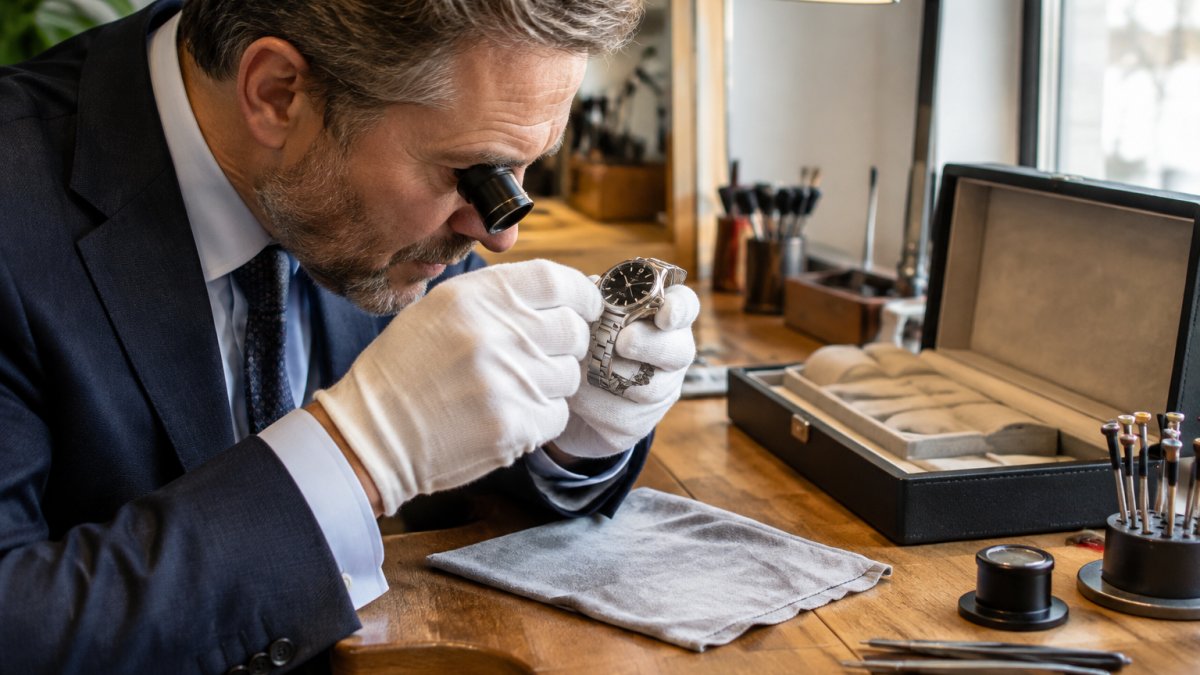
Before buying any pre-owned watch, work through this checklist:
- Case condition: light polishing marks are normal; deep dents are not.
- Bracelet and clasp: check stretch, play in the links, and clasp snap.
- Crystal: scratches can be polished out; cracks cannot.
- Dial and hands: look for water stains, repainted dials or mismatched hands.
- Movement: ask for timekeeping figures and any service history.
- Water resistance: confirm when the seals were last tested.
- Authenticity: compare serials, engravings and paperwork.
- Warranty: confirm what cover comes with the sale.
Authenticity deserves its own step. Our guide on verifying pre-owned luxury watch authenticity walks through the checks in detail.
Longines Golden Wing L3606.5 quartz watch →
How Storage, Water, Shocks and Daily Wear Age a Watch
Storage matters more than most buyers expect. A watch left in a drawer for years still ages: oils dry, seals harden, and the movement can seize. A watch winder or regular wear keeps an automatic running smoothly.
Water is the quiet killer. Water resistance depends on rubber gaskets that harden with age, so get seals tested if the watch will see water.
Shocks shorten life too. A knock against a door frame can shift the balance and ruin timekeeping accuracy. Daily wear adds up: dust, sweat, sun and temperature swings all take a small toll.
Vintage Watches, Parts Availability and Realistic Ownership Costs
Vintage watches bring a different calculation. The movement may be superb, but replacement parts can be scarce, and some brands no longer supply them. Repairability becomes the real question, not just condition. Age alone is not decisive: a 1960s piece with strong parts support can outlast a 1990s model with an obsolete movement.
Budget for the long term, not just the purchase. Always get a written quote for the specific watch before committing:
| Cost | What to expect |
|---|---|
| Routine service (mechanical) | £150-£400 for many independent watchmakers; £400-£800+ for branded or complex movements |
| Quartz battery and reseal | £10-£25 battery; £30-£60 with pressure test |
| Parts | Higher and slower for vintage models; some parts must be sourced from donor watches |
| Water-resistance testing | £20-£50 per test |
| Strap or bracelet care | Leather strap £40-£150; bracelet refurbishment £80-£250 |
| Full restoration (vintage) | £500-£2,000+ depending on parts and labour |
Over a decade of ownership, servicing and consumables add to the total cost of a mechanical watch. That total ownership cost matters more than the headline lifespan. For vintage pieces, practical maintenance habits make a real difference. Our guide to maintaining vintage mechanical watches covers the essentials, and if you are weighing up whether a service is worth the outlay, read is watch servicing worth it for vintage timepieces.
Watch out: a bargain vintage watch with no service history can hide a worn movement that costs more to restore than the watch is worth, always factor a worst-case service into your offer.
Choosing Your Pre-Owned Watch at Morgan Banks
Our previously enjoyed collection is chosen with care, and we are happy to talk you through condition, service history and what to expect.
A few current examples:
- Longines Golden Wing quartz watch, £495, with a new battery fitted in March 2026.
- EBEL Sportwave quartz, 40mm, £595, in very nice condition with only light signs of previous wear.
- Maurin Automatic Chronograph, Valjoux 7750 movement, 39mm, £995.
- Hublot MGM Geneve Automatic, 36mm on a Hublot bracelet, £4,995, complete with box.
If you want to know what protection comes with a purchase, our guide on the pre-owned luxury watch warranty explains the cover in plain terms.
Frequently Asked Questions
How long can a well-maintained luxury watch last?
A mechanical luxury watch that is serviced regularly can keep running for decades, often passing between generations. The key is routine care: lubrication breaks down over time, so a service every four to five years protects the movement components before wear sets in. Quartz watches are simpler and often need only a battery change and occasional reseal. No single figure applies to every pre-owned watch, because age, condition and ownership history all change the picture.
Do pre-owned luxury watches last as long as new ones?
A pre-owned watch in good working condition can serve just as long as a new one, provided it has been maintained and inspected. What matters is service history and current condition rather than the fact it has had a previous owner. A watch with maintenance records and a recent overhaul is often a safer buy than an unused piece that has sat untouched for years, since seals and lubrication degrade without use.
How can you tell how much life a pre-owned watch has left?
Start with the pre-owned watch condition checklist: ask for service history, check timekeeping accuracy and power reserve, inspect case and bracelet condition, and confirm water resistance. A professional inspection by a watchmaker reveals worn movement components that a visual check misses. On our previously enjoyed pieces, for example, the Longines Golden Wing had a new battery fitted in March 2026, which tells you the quartz movement is running correctly now.
Is it safe to buy a pre-owned luxury watch without service records?
It can be, but you should price in a service. Without maintenance records you cannot confirm when the movement was last lubricated, so budget for an overhaul and factor that into what you pay. Buy from a seller who offers a professional inspection and a clear warranty position. Ask about the warranty before you buy, so you know what protection a sale includes if an issue appears later.
The real question is not how long a pre-owned watch lasts, but how well it has been looked after and how well you look after it next. Come and see the collection at Morgan Banks, where our team will help you check condition, service history and warranty cover before you decide. Get started with Morgan Banks and choose a pre-owned watch with confidence.
