
Last Updated: November 2, 2026
Quick Summary
To verify diamond authenticity, start with safe at-home checks like the fog test and loupe inspection, then confirm the grading report number on the issuing laboratory's own website and match its measurements, carat weight and laser inscription to the exact stone. Home tests cannot separate natural from lab-grown diamonds or detect treatments, so book a professional gemologist for high-value or undocumented stones.
- The fog test clears almost at once on real diamond but cannot separate diamond from moissanite.
- A jeweller's loupe is usually 10× magnification and reveals inclusions and facet edge quality.
- A difference of more than 0.1 mm from the report's measurements is a warning sign.
- A stone weighing 0.05 ct or more below the report weight may have been swapped or damaged.
- Under the Consumer Rights Act 2015, goods must be as described, of satisfactory quality and fit for purpose.
Table of Contents
- Why Diamond Authenticity Checks Matter Before You Buy
- Step 1: Run a Diamond Authenticity Test at Home
- Step 2: Understand What Each Home Test Can and Cannot Prove
- Step 3: Weigh Up Diamond Tester Accuracy
- Step 4: Learn How to Verify a Diamond Certificate
- Step 5: Tell Natural, Lab-Grown, Simulant and Treated Stones Apart
- Step 6: Book Professional Diamond Identification
- Step 7: Choosing a Certified Diamond with Confidence
- Frequently Asked Questions
Why Diamond Authenticity Checks Matter Before You Buy
A diamond is one of the few purchases where a single wrong assumption can cost thousands.
Diamond authenticity means confirming that a stone is a real diamond, that it is natural or lab-grown as described, and that it matches its paperwork.
The stakes are real. Simulants such as cubic zirconia and moissanite look convincing in a shop window, and a setting can hide a stone's true nature.
Below, we walk through a safe, ordered workflow: what you can check at home, what each test proves, and when to bring in a professional. If you are also weighing up what to wear every day, our guide to choosing diamond jewellery for daily wear covers practical durability and setting choices.
Step 1: Run a Diamond Authenticity Test at Home
Home tests are a first filter, not a verdict. Used correctly, they can help rule out obvious fakes and flag anything needing a closer look. Used carelessly, they can scratch a stone or give false comfort.
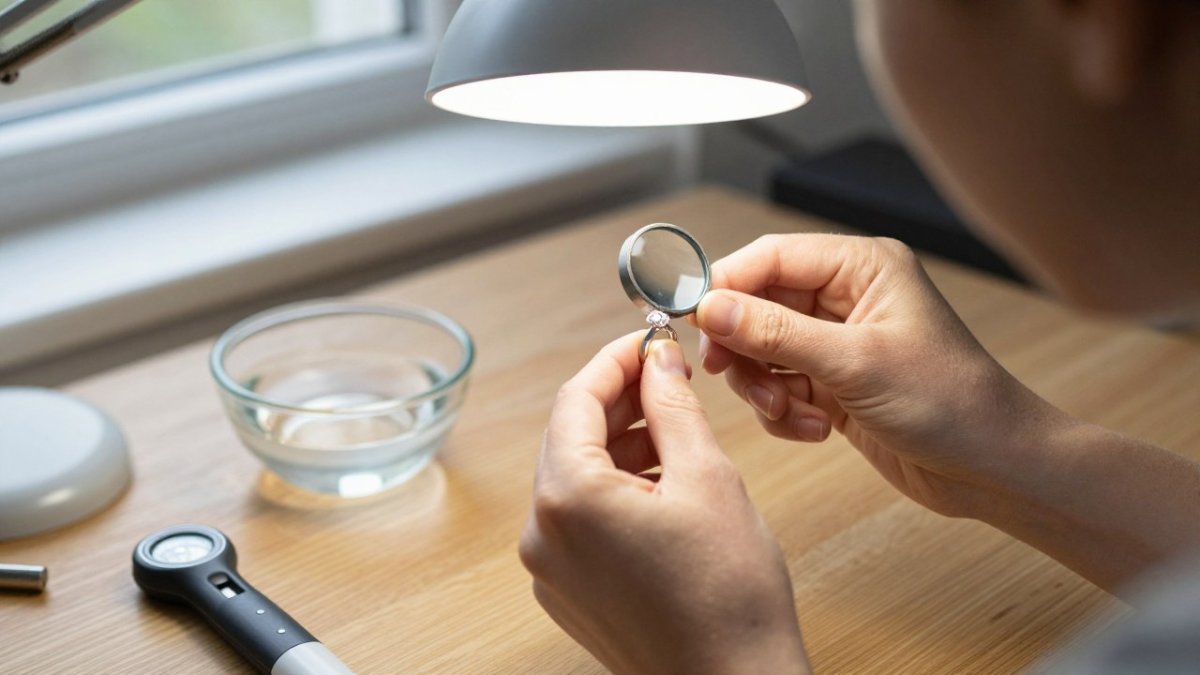
Start with the simplest checks and work up. Never force a stone, never scratch it, and never test a loose stone over a hard floor.
The Fog Test and Water Test
The fog test is quick and free. Breathe on the stone: fog on a real diamond clears almost at once because diamond conducts heat quickly, while fog lingers on glass and many simulants.
The water test relies on density. A real diamond sinks when dropped into a glass of water, but many simulants sink too, so a positive result proves little.
Loupe Inspection: Inclusions, Facets and Sparkle
A jeweller's loupe, usually 10× magnification, shows what the eye cannot. Look for natural inclusions, tiny internal features that formed with the stone, and at facet edges: sharp, crisp junctions suggest diamond, while rounded or soft edges suggest glass or a coated imitation.
Under light, a real diamond throws back white brilliance and flashes of colour, known as fire. Cubic zirconia can look almost too colourful, while glass looks flat.
Step 2: Understand What Each Home Test Can and Cannot Prove
Every home test has a narrow range. Knowing the limits stops you trusting a result it was never able to give.
- Fog test: can flag glass and some simulants; cannot separate diamond from moissanite.
- Water test: can suggest density; cannot confirm identity, and is unreliable on mounted stones.
- Loupe inspection: can reveal inclusions, facet quality and wear; cannot prove a stone is natural rather than lab-grown.
What all these tests share is an inability to read the stone's origin. A lab-grown diamond is a real diamond in every physical sense.
Each home test has a narrow range, so here is what it can and cannot prove.
| Home test | Can prove | Cannot prove |
|---|---|---|
| Fog test | Flags glass and some simulants | Cannot separate diamond from moissanite |
| Water test | Suggests density | Cannot confirm identity; unreliable on mounted stones |
| Loupe inspection | Reveals inclusions, facet quality and wear | Cannot prove natural rather than lab-grown |
| Sparkle check | Spots dull imitations | Cannot detect treatments such as fracture filling |
Step 3: Weigh Up Diamond Tester Accuracy
Handheld diamond testers measure how heat or electricity moves through a stone. Diamond conducts heat unusually well, so a thermal tester separates diamond from cubic zirconia and glass with reasonable reliability.
The gap appears with moissanite, which also conducts heat well and can fool a basic thermal pen.
Accuracy also depends on the user. A probe must sit flat on a clean, dry surface, and the stone must be at room temperature.
Step 4: Learn How to Verify a Diamond Certificate
A grading report from an independent laboratory is the strongest evidence most buyers will hold. It records the stone's weight, colour, clarity, cut and measurements, plus a unique report number.
A report number alone is not enough: a genuine report can be copied, or belong to a different stone. The real task is matching the document to the exact diamond you are buying.
Matching the Report Number to the Exact Stone
Work through this checklist before you accept any certificate:
- Confirm the report number on the document matches the number the seller quoted
- Check the report on the issuing laboratory's own website, not a link the seller sent
- Compare the measurements on the report with the stone, using calipers if it is loose
A report that cannot be found on the laboratory's database, or whose measurements do not fit the stone, is a serious warning sign. Our guide on how to verify diamond certification reports goes deeper into reading a report line by line.
How to Match Report Details to the Stone
A report number alone proves nothing if the document describes a different diamond. Match these details in order:
Platinum Pear Shaped Diamond Ring 1.02ct E SI1 GIA Certificate 100936156389 →
- Measurements. The report lists minimum and maximum diameter and depth in millimetres. Use digital calipers on a loose stone and compare. A difference of more than 0.1 mm in any dimension is a warning sign. On a mounted stone, ask the jeweller to measure with the stone removed from the setting if possible.
- Carat weight. The report states weight to two decimal places. Ask for an independent scale reading, not the seller's own figure. A stone that weighs 0.05 ct or more below the report weight may have been swapped or damaged.
- Shape and cut style. Confirm the outline (round, oval, pear, emerald, and so on) and the facet pattern match the report description. A round brilliant report cannot describe a cushion-cut stone.
- Laser inscription. Most laboratories inscribe the report number on the girdle. A jeweller can read it with a loupe or microscope. If the inscription is missing, ask why. Some older stones were never inscribed, but a missing inscription on a recently graded stone is a question worth pressing.
- Proportions and finish. The report records table percentage, crown height, pavilion depth and polish and symmetry grades. These are harder to check by eye, but a jeweller can confirm the table size and overall proportions against the report.
What to Do When a Report Cannot Be Verified
If the report number does not appear on the laboratory's database, stop. Do not rely on a screenshot, photocopy or link the seller provides; contact the laboratory directly using the details on its own website. If the laboratory confirms the report is genuine but the stone does not match the measurements, treat the stone as undocumented and walk away unless the seller resolves the discrepancy in writing.
Step 5: Tell Natural, Lab-Grown, Simulant and Treated Stones Apart
Four categories get confused constantly, and they are not the same thing.
Visual checks cannot separate natural from lab-grown, and they cannot reliably reveal treatment. If lab-grown is on your shortlist, our guide on whether lab grown diamond jewellery is worth it sets out the trade-offs in plain terms.
Watch out: a seller who describes a stone as "certified" without naming the laboratory is giving you nothing you can check. Ask for the laboratory name and the report number in writing before any money changes hands.
Step 6: Book Professional Diamond Identification
Some answers only a gemologist and a laboratory can give. Book professional identification when the stone is high value, when the paperwork is missing or unclear, when the stone is already mounted, or when you need written confirmation for insurance.
A gemologist examines the stone under magnification and uses instruments that measure refractive index and light behaviour. Laboratories go further, analysing internal growth patterns to determine whether the stone formed naturally or in a reactor.
What a Professional Assessment Actually Involves
A gemologist's inspection is not a single test but a sequence of observations and instrument readings that together build a picture of the stone. Expect the following:
- Microscopic examination. The gemologist looks for inclusions, growth patterns and surface features under 10× to 40× magnification. Natural diamonds often show internal graining or mineral inclusions; lab-grown diamonds may show different growth patterns that a trained eye can recognise.
- Refractive index and dispersion. A refractometer measures how light bends through the stone. Diamond has a refractive index of about 2.42, which separates it from most simulants. Moissanite, however, has a higher refractive index and can overlap, so this test is not definitive on its own.
- Spectroscopy. Advanced laboratories use instruments such as Fourier-transform infrared (FTIR) spectroscopy to detect trace elements and treatments, and to distinguish natural from lab-grown origin. This is the step that home tests cannot replicate.
What to Ask For and What to Keep
When you commission a professional assessment, ask for a written report on the gemologist's letterhead, signed and dated, stating the stone's identity, weight, measurements, and whether it is natural or lab-grown.
Keep the following documents together:
- The original grading report and any laboratory verification you obtained
- The gemologist's written assessment
- The seller's invoice, which should describe the stone accurately
An independent appraisal is not the same as a grading report. A grading report describes the stone; an appraisal values it. For insurance, your insurer will usually ask for an appraisal from a qualified valuer, and some will accept a grading report alongside a purchase invoice.
Consumer Protection and Purchase Documentation
Under the Consumer Rights Act 2015, goods must be as described, of satisfactory quality, and fit for purpose.
Before you pay, confirm the seller's returns policy in writing.
Expect the process to take time and cost money. For a significant purchase, that cost is small against the risk.
Watch out: an appraisal prepared by the seller or by a jeweller with a commercial interest in the sale is not independent.
Step 7: Choosing a Certified Diamond with Confidence
Buy from sellers who hand you the evidence before you ask. A stone with a recognised laboratory report, a matching laser inscription and a clear return policy removes most of the risk in one move.
Our own approach reflects that. Examples from our collection include the platinum pear shaped diamond ring, 1.02ct, E colour, SI1 clarity, with its GIA certificate at £11,795.

What most guides miss is that certification is not a luxury add-on. It is the difference between a claim and proof.
Frequently Asked Questions
How can you tell if a diamond is real at home?
Start with the fog test: breathe on the stone and see whether the mist clears within a second or two, which points towards a real diamond. A water test, where a loose stone sinks in a glass of water, and a close look with a 10x loupe for sharp facets and natural inclusions can add clues. None of these confirm diamond authenticity on their own, so treat them as a first filter before checking the grading report or asking a jeweller.
Can a diamond tester distinguish a natural diamond from a lab-grown diamond?
A basic thermal conductivity tester cannot. It separates diamond from simulants such as cubic zirconia or glass, but natural and lab-grown diamonds share the same thermal properties, so both read as diamond. Multi-tester devices that also measure electrical conductivity can flag some lab-grown stones, though results vary by model. For a definitive answer on origin, you need a gemological laboratory report.
How do you verify a diamond certificate?
Take the report number from the certificate and check it directly with the issuing laboratory, either through their online database or by contacting them. Compare the report's carat weight, measurements, colour, clarity and cut against the stone in front of you, and confirm any laser inscription on the girdle matches. A genuine GIA report, for example, can be checked against its unique number, and the details must line up exactly with the diamond.
Are home diamond tests reliable enough to skip a professional check?
No. Home tests can rule out obvious fakes, but they cannot confirm diamond authenticity, detect treatments or separate natural from lab-grown stones. A jeweller with a loupe, microscope and testing equipment can assess mounted stones, check the setting for clues and match the stone to its paperwork. For any high-value purchase, professional diamond identification is the step that protects your money.
Buying a diamond should feel certain, not hopeful. Morgan Banks has guided buyers through certified diamond purchases since 1935, with GIA-certified stones, bespoke engagement rings and a team who will walk you through every report number. Browse our certified diamond rings and add the piece you can verify to your cart with confidence.
