
Table of Contents
- How to Clean a Vintage Watch Without Causing Damage
- How to Store a Vintage Watch to Prevent Deterioration
- How to Wind a Vintage Mechanical Watch Correctly
- Vintage Watch Servicing Frequency: When to See a Watchmaker
- Managing Moisture and Water Resistance on Older Watches
- Protecting Vintage Mechanical Watches from Shocks and Magnetism
- Safe Home Care vs Professional Repair: Knowing the Boundary
- Frequently Asked Questions
Last Updated: October 5, 2026
How to Clean a Vintage Watch Without Causing Damage
Learning how to clean a vintage watch starts with one rule: dry beats wet, every time. For anyone maintaining vintage mechanical watches at home, gentle external cleaning with a soft cloth is safe, while water, soap and ultrasonic tanks are not. At Morgan Banks, we have handled previously enjoyed luxury timepieces for decades. Below, we explain the seven best practices for maintaining vintage mechanical watches at home, from cleaning and storage to winding and knowing when to stop.
A vintage watch is a mechanical timepiece, typically decades old, whose case, dial and movement were made before modern sealing and materials became standard. That age changes everything about care. Old gaskets harden, plating wears thin, and internal oils dry out. Treat these watches as delicate objects first and timekeepers second.
Routine External Cleaning with a Microfiber Cloth
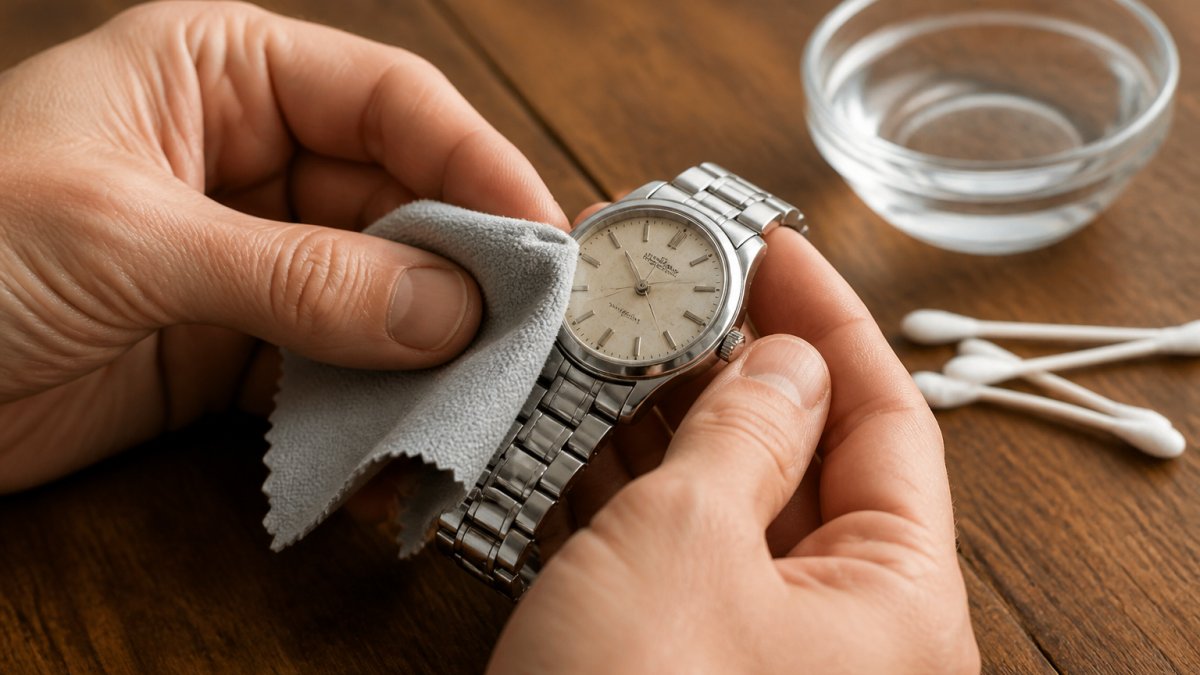
Wipe the watch with a dry microfiber cloth after every wear. That single habit removes skin oils, dust and grit before they settle into links and lugs.
Work in this order:
- Wipe the case and crystal with a dry microfiber cloth.
- Clean bracelet gaps with a dry soft-bristled brush.
- Use a barely damp cotton swab around the lugs only if needed.
- Dry immediately with a second soft cloth.
Never press hard on the crystal or dial. Pressure is how scratches and loosened hands happen.
What to Avoid: Water, Soap, and Ultrasonic Cleaners
Skip running water, soap and ultrasonic cleaning entirely. Water creeps past worn seals and corrodes the movement. Soap leaves residue that attracts dust. Ultrasonic cleaners can shake loose old lume, hands and plating.
For anything beyond surface dust, that is a job for a watchmaker, not a sink.
How to Store a Vintage Watch to Prevent Deterioration
Store each watch in a dry environment with a stable temperature. Moisture and heat are the two quiet killers of vintage mechanical watches, and both are easy to control.
Follow these storage basics:
- Keep watches in a dry box or drawer away from radiators and windows.
- Aim for a stable temperature range, roughly 15-25°C.
- Use a soft pouch or watch roll to prevent scratches.
- Add a silica gel pack to the storage box and replace it regularly.
- Keep service records and receipts with the watch.
Dry Environment, Stable Temperature, and Storage Choices
A dry, dark drawer beats a display stand every time. Sunlight fades dials, and open air exposes movements to dust. If you rotate several watches, a lined case with individual cushions keeps bracelets from knocking together. For long-term storage, a lightly wound watch in a dry box is safer than one left running for months.
How to Wind a Vintage Mechanical Watch Correctly
Wind a vintage mechanical watch slowly, at the same time each day, and stop the moment you feel resistance. Forcing past that point can snap the mainspring, and a replacement is rarely simple on an older movement.
A mainspring is the coiled spring inside a mechanical watch that stores energy to power the movement. On a self-winding movement, the rotor winds it as you move, but regular winding still keeps the oils circulated. On a manual-wind movement, the crown is the only source of power, so the winding feel tells you a great deal about the movement's health.
Step-by-Step Winding and Setting Instructions
- Pull the crown to the setting position only when the watch has stopped.
- Turn the crown gently clockwise, 20-30 turns, until you feel firm resistance.
- Stop immediately. Never force the final turn.
- Push the crown back in and set the time.
- Wind at roughly the same time daily to keep timekeeping steady.
Vintage-Specific Winding Risks Most Guides Skip
Older movements punish careless crown handling in ways modern watches do not. Keep these points in mind:
- Never change the date between roughly 9pm and 3am. During this window the date-change mechanism is already engaged, and forcing the quick-set can strip teeth on the calendar wheel. If the date must be corrected, wind the hands forward past midnight first, then set the date, then advance the time again.
- Do not use the quick-set date function on a watch that has one unless the crown is fully in the correct position. Pulling a two-position crown to the wrong notch and turning can damage the keyless works.
- Feel the winding tension, not just the count. A healthy manual-wind movement offers smooth, even resistance. A gritty, spongy or suddenly stiff feel suggests a dry mainspring or a worn ratchet, and continued winding can cause damage.
- Do not over-wind an automatic. Most self-winding movements slip once fully wound, but older or cheaper automatics may not, so stop when resistance firms up.
- Avoid winding a watch that is already running if the crown feels stiff. On a vintage piece, a stiff crown can mean a worn stem or a dry gasket, and forcing it can shear the stem.
If the crown feels loose, wobbly or refuses to engage, stop and have a watchmaker look at it. Crown and stem repairs are inexpensive compared with a damaged mainspring or calendar mechanism.
Vintage Watch Servicing Frequency: When to See a Watchmaker
Book a professional service every three to five years. That is the standard interval for a mechanical watch, and vintage pieces often need it sooner because their oils degrade faster.
Watch for these signs that a service is due:
- The watch runs fast or slow by more than a minute a day.
- The winding feels gritty or stiff.
- The watch stops overnight despite full winding.
- You notice condensation under the crystal.
A watchmaker will strip, clean and re-lubricate the movement, replacing worn parts as needed. Regular servicing protects both timekeeping and value. According to guidance from the British Horological Institute, professional servicing is the single most important step in preserving a mechanical movement.
Managing Moisture and Water Resistance on Older Watches
Assume a vintage watch has no water resistance, whatever the caseback says. Seals harden with age, and ratings printed decades ago no longer apply.
Treat moisture like this:
- Remove the watch before washing hands, showering or swimming.
- If it gets caught in rain, dry it with a soft cloth at once.
- Never open the case yourself to dry it out.
If you see fog under the crystal, take it to a watchmaker straight away. Moisture inside a case leads to rust on the movement, and rust spreads.
Protecting Vintage Mechanical Watches from Shocks and Magnetism
Treat impact and magnetism as the two invisible threats to accuracy. A single drop can dislodge a balance staff, and a magnetic field can pull a watch minutes off course. Vintage movements are more vulnerable to both because their hairsprings and balance pivots were made to tolerances and materials that predate modern anti-magnetic alloys.
Protect against both:
- Remove the watch for DIY, sport and heavy lifting.
- Keep it away from speakers, laptops and magnetic clasps.
- Store it separately from phones and tablets.
- If it suddenly runs fast, have it demagnetised by a watchmaker.
Recognising Magnetisation Versus Other Accuracy Faults
A magnetised watch typically runs fast, often by several minutes a day, and may be inconsistent from one day to the next. That pattern is different from the slow, steady drift of a watch that simply needs regulating, and different again from the erratic behaviour of a watch with a dry or damaged movement.
Common sources of magnetism in the home include:
- Magnetic clasps on bags, phone cases and tablet covers.
- Speakers, headphones and earbud cases.
- Laptop lids and tablet keyboards.
- Induction hobs and some kitchen appliances.
- Magnetic jewellery and some watch winders with magnetic motors.
A watchmaker can check for magnetisation in seconds with a simple compass or demagnetiser, and the fix is usually quick and inexpensive. Do not attempt to demagnetise a vintage watch at home with a cheap tool unless you know the movement tolerates it, some older hairsprings and balance assemblies are easily disturbed.
Impact Damage: What to Watch For
A dropped or knocked vintage watch may not stop immediately. Watch for these signs over the following days:
- Sudden loss or gain of several minutes a day.
- The watch stopping intermittently or only running when held at certain angles.
- A rattling or scraping sound when the watch is moved.
- The seconds hand catching or stuttering.
Any of these suggests a dislodged balance staff, a bent pivot or a loose jewel, and the watch should go to a watchmaker before further running causes more wear.
Safe Home Care vs Professional Repair: Knowing the Boundary
Draw a hard line between cleaning and repair. Safe home care means wiping, storing and winding. Everything else belongs to a watchmaker.
Do at home:
- Wipe with a microfiber cloth.
- Store in a dry, stable place.
- Wind gently and regularly.
Leave to a professional:
- Opening the case or movement.
- Regulating a movement for accuracy.
- Replacing gaskets, crystals or mainsprings.
- Any work on the dial, hands or lume.
| Task | Do It at Home? | Frequency |
|---|---|---|
| Wipe case and bracelet | Yes | After each wear |
| Wind the movement | Yes | Daily or as worn |
| Check storage conditions | Yes | Monthly |
| Full professional service | No | Every 3-5 years |
This boundary matters most with vintage pieces, where a wrong move can cost far more than the watch is worth. If you are unsure, ask before you touch. Morgan Banks offers expert guidance on previously enjoyed luxury timepieces, so you can care for your watch with confidence.
Frequently Asked Questions
How often should a vintage mechanical watch be serviced?
Most watchmakers recommend a service interval of three to five years for vintage mechanical watches. However, if the watch runs accurately and has no moisture issues, you can wait slightly longer. Regular servicing cleans internal oils, replaces worn lubrication, and prevents long-term damage to the movement. Always choose a watchmaker experienced with vintage pieces, as parts and techniques differ from modern watches.
Should you wind a vintage mechanical watch every day?
No, daily winding is not necessary for most vintage mechanical watches. Wind it fully once every two to three days if you wear it regularly, or once a week if stored. For automatic watches, wearing them daily is usually enough to keep them running. Always wind gently and stop when you feel resistance.
Can a vintage watch get wet?
Older watches often have degraded gaskets and seals, so water resistance cannot be assumed. Avoid running water, swimming, and even heavy rain unless the watch has been recently tested and resealed by a watchmaker. Moisture inside the case can rust steel parts and damage the movement. If your watch fogs up, take it to a professional immediately.
How do you protect a vintage watch from magnetism?
Keep your vintage watch away from magnets found in speakers, tablets, phones, and household appliances. Magnetism can cause a watch to run fast or slow. If you suspect magnetisation, a watchmaker can demagnetise it in seconds. For daily wear, store the watch in a dry box away from electronics. Regular accuracy checks help you spot magnetism early.
Caring for a vintage mechanical watch takes patience, not products. The right cloth, the right drawer and a good watchmaker will keep a fine timepiece running for decades. At Morgan Banks, we have helped collectors care for and choose previously enjoyed luxury watches since 1935, backed by our curated selection of authenticated timepieces and our team's expert guidance. Get started with Morgan Banks and give your vintage watch the care it deserves.