
Table of Contents
- The Case for Vintage Watch Servicing
- How Often to Service Vintage Watches
- Vintage Watch Restoration Costs in the UK
- Impact of Servicing on Vintage Watch Value
- The Risks of Over-Servicing and Authenticity Concerns
- Professional Servicing vs DIY: What You Need to Know
- Making the Decision: Repair, Restore, or Replace
- Frequently Asked Questions
Last Updated: September 20, 2026
The Case for Vintage Watch Servicing
Is watch servicing worth it for vintage timepieces 2026? The answer depends on what you own, what it means to you, and whether you plan to keep it or sell it later. A vintage mechanical watch isn't like a modern quartz timepiece, it's a precision instrument with dozens of moving parts that degrade over time. Proper servicing can restore accuracy, prevent damage, and preserve value. Neglect it, and you risk permanent harm to something irreplaceable.
At Morgan Banks, we offer a curated collection of previously enjoyed luxury timepieces. The difference between a well-maintained watch and a neglected one isn't subtle, it's the difference between an heirloom you can wear and pass down versus a broken relic gathering dust. But servicing isn't always the right choice. Sometimes the cost outweighs the benefit. Sometimes the risk of restoration outweighs the reward.
The real question isn't whether servicing is "worth it" in the abstract. It's whether servicing is worth it for your specific watch, in your specific situation. This guide breaks down that decision.
How Often to Service Vintage Watches
Mechanical movements need regular maintenance. The lubrication inside degrades. Friction increases. Wear and tear accumulates. A properly serviced vintage watch should be overhauled every 5 to 10 years, depending on how often you wear it and how well it was maintained previously.
This is where many collectors stumble. They inherit a watch, don't wear it for years, then assume it still works. It might. But the oil inside has oxidised. The escapement friction has increased. The balance wheel's amplitude has dropped. The watch might keep time, just poorly. This is the "running condition" fallacy. A watch that runs isn't necessarily a watch in good condition.
If you wear your vintage watch regularly, plan on a full service every 5 to 7 years. If you wear it occasionally, every 7 to 10 years is reasonable. If it sits unworn in a drawer, you can stretch intervals, but don't assume indefinite storage keeps it safe. Dust and moisture creep in. Metal corrodes. When you finally decide to wear it again, you'll need a service anyway.

Vintage Watch Restoration Costs in the UK
Servicing costs vary wildly depending on the movement complexity, the damage present, and the expertise of the watchmaker. A simple quartz movement might require a battery replacement and basic cleaning. A mechanical movement with complications, such as chronographs, annual calendars, or perpetual calendars, can involve more extensive work.
Full restoration, where parts are replaced or repaired rather than simply cleaned, can involve significant costs. Case polishing, dial refinishing, and crystal replacement are additional considerations for comprehensive restoration.
The Longines Golden Wing L3606.5 quartz watch available at Morgan Banks (£495) is an example of a previously enjoyed vintage timepiece that's already been serviced, the battery was fitted in March 2026. This removes the restoration question entirely and lets you wear the watch immediately. By contrast, the Maurin Automatic Chronograph with Valjoux 7750 movement (£995) is a rarer piece that required professional assessment before being offered for sale.

For investment-grade watches, those you plan to sell later, restoration costs matter. If you spend £800 servicing a watch you paid £600 for, your economics don't work unless the watch appreciates. Vintage provenance and originality affect resale value more than you might think. Over-restoration can actually harm value.
| Service Type | Typical Cost Range | Time Required | Best For |
|---|---|---|---|
| Battery replacement (quartz) | £50-£150 | 1 week | Basic maintenance |
| Movement cleaning & lubrication | £200-£400 | 2-3 weeks | Regular wear |
| Full mechanical overhaul | £400-£800 | 3-4 weeks | Neglected movements |
| Case & dial restoration | £300-£1,200 | 4-6 weeks | Aesthetic preservation |
| Parts replacement | £500-£2,000+ | 4-8 weeks | Damaged movements |
Impact of Servicing on Vintage Watch Value
This is where the financial case for servicing becomes clearer. A well-serviced vintage watch with documented service history commands a premium. Collectors and buyers trust a watch that's been professionally maintained. They can wear it without worry. They know the movement is clean, lubricated, and accurate.
A neglected watch, one that hasn't been serviced in decades, trades at a discount. Buyers assume hidden damage. They budget for immediate servicing. They're uncertain about reliability. The price reflects that uncertainty.
Documentation matters enormously. If a watch has service records from a reputable horologist, these can be valuable. They serve as proof of care and can increase buyer confidence, potentially enhancing resale value. A watch with a full service history from a known watchmaker may be worth more than an identical watch with no records.
The original components also affect value. Collectors of investment-grade watches prefer originality. An original dial is worth more than a refinished one. Original hands matter. Original case finishing matters. Over-restoration, excessive polishing, dial refinishing, parts replacement, can actually harm value by destroying the patina and authenticity that collectors prize.
Jamie 3068/ zenith watch on green →
This creates a tension. If you're buying a vintage watch as an investment, aggressive restoration might hurt your exit price. If you're buying it to wear and enjoy, restoration doesn't matter as much. The decision shifts based on intent.
The Risks of Over-Servicing and Authenticity Concerns
Not all servicing is beneficial. Some is actively harmful. This is the paradox of vintage watch restoration: the act of preserving can damage what makes the watch valuable.
Case polishing is the most obvious culprit. A vintage watch develops patina over decades. Scratches, wear marks, and colour changes tell the story of the watch's life. Collectors value this authenticity. When a watch case is polished back to mirror brightness, it can erase its history. The watch may look newer, but this can also affect its value.
Dial refinishing has the same problem. Original dials, even damaged ones, are worth more than refinished ones. A worn dial with fading is preferable to a pristine replacement. This seems counterintuitive until you understand that vintage watch value is built on originality and provenance, not cosmetic perfection.
Parts sourcing creates another risk. Finding original components for rare vintage watches is difficult. Sometimes impossible. A watchmaker might substitute a modern part that functions identically but isn't original. While a practical compromise, this can reduce authenticity and value. The more substitutions, the less "original" the watch becomes.
There can be a risk of damage during service itself. While skilled horologists are careful, accidents can happen. A delicate part might crack, a screw might strip, or a dial might be damaged during cleaning. This is why choosing the right watchmaker is important.
Professional Servicing vs DIY: What You Need to Know
Some collectors attempt DIY servicing. This is almost always a mistake. Vintage watch movements are precise instruments. The tolerances are measured in fractions of a millimetre. The tools required, jeweller's loupe, movement holder, balance wheel trimmers, oil cups, are specialised and expensive. The knowledge required takes years to develop.
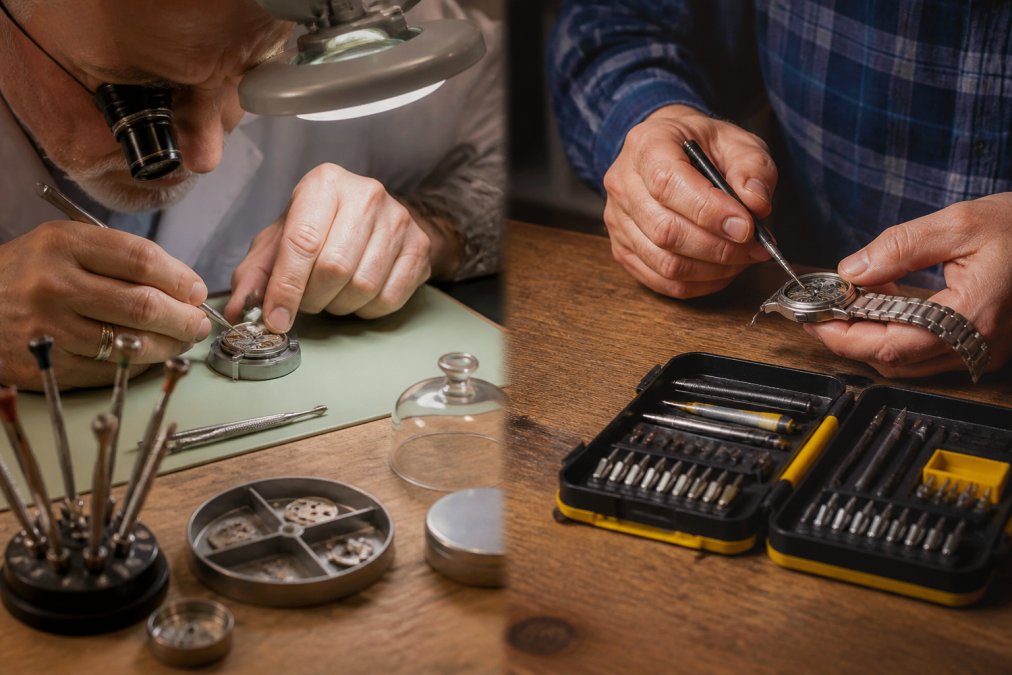
A professional horologist typically has extensive experience in servicing watches. They understand the specific characteristics of different calibres, and know which movements are robust and which are delicate. They usually have the right tools and parts, and can diagnose problems that may not be immediately apparent.
DIY servicing risks permanent damage. You might strip a screw. You might lose a tiny part. You might apply the wrong lubricant. You might reassemble the movement incorrectly. Any of these errors can render the watch unusable. And once damage occurs, fixing it costs more than professional servicing would have in the first place.
The only exception is basic maintenance: keeping the case clean, replacing batteries in quartz watches, changing straps.
Making the Decision: Repair, Restore, or Replace
The decision framework depends on three variables: the watch's current condition, its market value, and your intended use.
Frequently Asked Questions
How much does it cost to get a vintage watch serviced?
Vintage watch servicing costs vary significantly depending on the movement type and condition. A basic service for a quartz movement typically ranges from £150-£300, whilst a full overhaul of a mechanical movement can cost £400-£800 or more. The Jamie 3068/ zenith watch on green strap, available at Morgan Banks for £295.00, has had a full service completed, reflecting professional care of vintage timepieces. Luxury brands and complex chronograph movements command higher fees due to the specialist expertise required.
Does regular servicing increase the resale value of a vintage timepiece?
Yes, documented servicing history can significantly enhance resale value. Buyers of vintage watches often prioritise mechanical movements with verified service records, as this demonstrates proper maintenance and reliability. A watch with a complete service history and original components may command a higher value than an unserviced equivalent. However, excessive servicing or replacement of original parts can diminish value, authenticity and originality are prized by collectors.
How often should a vintage watch be serviced compared to modern models?
Vintage mechanical watches typically require regular servicing, depending on movement type and usage. Quartz vintage watches may need less frequent servicing, often only when the battery dies or the movement shows signs of wear. Modern watches often have improved sealing and lubrication, which can sometimes extend service intervals. The key is monitoring timekeeping accuracy and water resistance; any deviation can signal the need for professional inspection.
Is it worth servicing a vintage watch that isn't a luxury brand?
Yes, if the watch holds sentimental value or has a reliable movement like the Valjoux 7750 (found in the Maurin Automatic Chronograph). Non-luxury vintage watches with robust calibres can often offer significant durability. While service costs can be a consideration relative to a watch's market value, proper maintenance can extend its life by decades. Evaluate the watch's historical significance, movement quality, and personal attachment before deciding.