
Table of Contents
- Why Proportion Matters More Than Carat Weight
- The Best Diamond Shapes for Petite Fingers
- The Ideal Engagement Ring Band Width for Small Hands
- How to Measure Ring Size at Home Accurately
- Setting Styles That Flatter Small Hands
- Comfort and Wearability for Daily Wear
- Choosing an Engagement Ring for Small Hands: A Final Checklist
- Frequently Asked Questions
Last Updated: September 13, 2026
Why Proportion Matters More Than Carat Weight
Most people searching for how to choose an engagement ring small hands can wear well start with the wrong question. They ask "what carat size can I get away with?" when the real question is "what proportions suit my finger?" Carat weight is a measure of mass, not visual size, and it tells you nothing about how a stone will sit on a slender hand. A well-proportioned 0.75ct oval can look more impressive than a poorly cut 1.5ct round brilliant, because spread, cut quality and setting height all shape what the eye actually sees.
This guide from Morgan Banks, a fine jeweller established in 1935, covers the technical decisions that matter: stone shape, band width, setting style and ring sizing. Below, we'll show you exactly how to match each one to your hand.
The Best Diamond Shapes for Petite Fingers
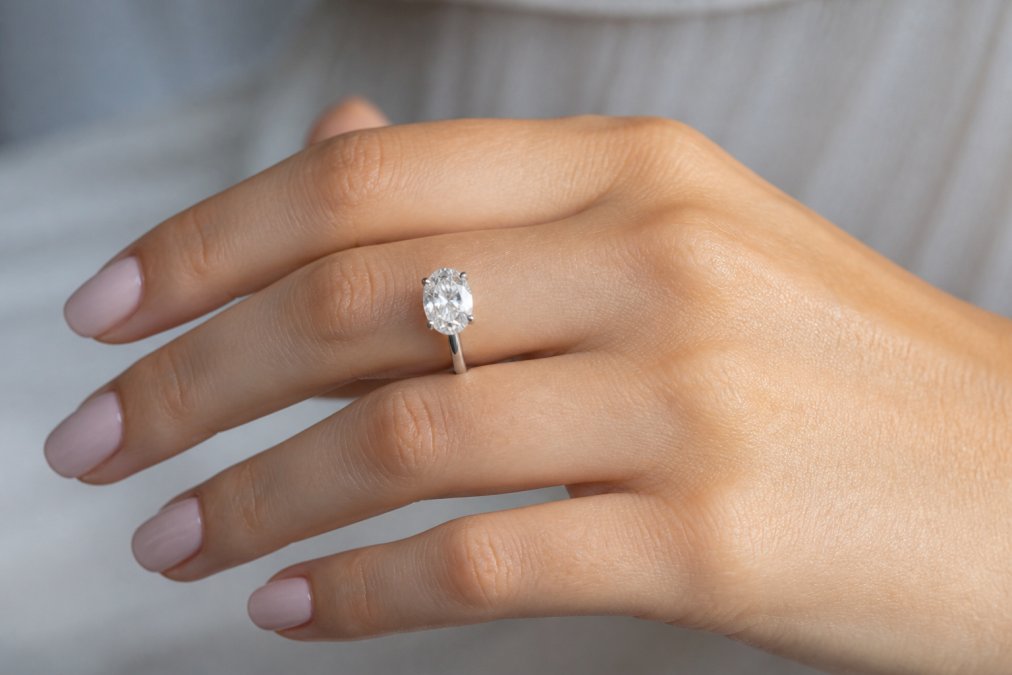
The best diamond shapes for petite fingers are elongated cuts: oval, marquise, pear and emerald. Each creates vertical length across the finger, which makes the hand look longer and the stone look larger than its carat weight suggests. Round brilliants are the exception; they are symmetrical and timeless, but they read wider rather than longer.
The mechanism is straightforward. An elongated shape directs the eye along the length of the finger rather than across it, so the finger appears longer and the stone appears to occupy more of it. This is why a 0.75ct oval can read as visually larger than a 1ct round on a narrow hand, even though the round carries more carat weight.
Here is how the main shapes compare on a small hand:
| Shape | Visual Effect on a Small Hand | Best For |
|---|---|---|
| Oval | Elongates the finger, generous spread | Most petite hands |
| Marquise | Maximum length, dramatic look | Narrow, short fingers |
| Pear | Balances length with softness | Hands wanting a tapered line |
| Emerald | Step-cut elegance, clean lines | Longer, slender fingers |
| Round | Classic, widest visual footprint | Those prioritising tradition |
Stone-to-Band Ratio: The Number Most Guides Skip
Proportion on a small hand is not about the stone alone. It is about the ratio between the stone's spread and the band width beneath it. A useful working range is a stone spread roughly 3 to 5 times the band width (gia.edu). On a 2mm band, that points to a stone spread of about 6mm to 10mm, which corresponds to roughly a 0.5ct to 1.5ct oval depending on cut quality. Below that ratio the band dominates and the stone looks undersized; above it the stone looks top-heavy and the band looks like wire.
This ratio matters more on a small hand than a large one because there is less finger surface to absorb the imbalance. On a wider finger a slightly off ratio reads as a style choice; on a petite finger it reads as a mistake.
Visualising Carat Size Before You Buy
Carat weight is mass, not spread, so two 1ct stones of different shapes can look very different in size. Rather than guessing, ask to see loose stones or calibrated CZ replicas in the shapes you are considering, placed on your own finger. A simple trick is to cut paper templates to each stone's actual millimetre dimensions and lay them on the finger. Most practitioners find this is more reliable than trying to imagine proportions from a photograph, because photographs are shot at different focal lengths and flatter the stone.
As a rough reference, an ideal-cut 1ct round brilliant is about 6.5mm across, while a 1ct oval is typically around 7.7mm by 5.7mm (gia.edu). The oval's greater length is what creates the elongating effect, even though the two stones weigh the same.
A common mistake is choosing a marquise purely for length without checking the points. Marquise stones have sharp ends that need protective prongs, and on a very small hand a large marquise can overwhelm the finger entirely. The same caution applies to very long ovals: past a certain length-to-width ratio the stone starts to look like a sliver rather than a gem.
The Ideal Engagement Ring Band Width for Small Hands
For an engagement ring small hands look best in a band width between 1.5mm and 2.2mm. Bands narrower than 1.5mm can distort under daily wear; bands wider than 2.5mm make a petite finger look shorter and can feel uncomfortable against the neighbouring fingers.
Band width works alongside stone size, not in isolation. A 2mm band with a 1ct oval keeps the ring in proportion. The same 2mm band with a 2ct stone makes the band look thin and the stone top-heavy.
Tapered bands and tapered shanks are worth considering. They narrow toward the centre stone, which draws the eye upward and adds to the illusion of length without sacrificing structural strength at the base of the ring.
How to Measure Ring Size at Home Accurately
Measuring ring size at home is straightforward if you account for finger circumference properly. Fingers change size through the day, so measure at the end of the afternoon when your hands are at their largest.
- Wrap a strip of non-stretch paper or a piece of string around the base of the finger.
- Mark where the ends meet, then lay the strip flat against a ruler in millimetres.
- Divide that circumference by 3.14 to estimate the internal diameter.
- Compare the diameter against a ring sizing chart, or slide an existing ring onto a cone gauge.
- Measure twice, on two different days, and take the larger reading.
The British Standards Institution guide to ring sizing is a useful reference for standardised sizing, and it matters because sizing systems differ between countries. A size that fits in one system may not translate directly to another.
Two practical warnings. First, knuckles wider than the finger base mean you should size to the knuckle, not the base. Second, cold hands measure smaller; warm the finger first.
Setting Styles That Flatter Small Hands
Setting styles that flatter small hands share one trait: they keep metal to a minimum and let the stone do the work. Minimalist prongs, a low setting height and an open gallery all reduce visual bulk.
- Solitaire: the cleanest option; nothing competes with the centre stone.
- Halo: adds apparent size, but a large halo can crowd a slender finger. Choose a thin halo or skip it.
- East-west orientation: sets an elongated stone horizontally across the finger. It reads modern and suits marquise and oval cuts, though it changes the visual line of the hand.
- Bezel: protects the stone and sits flush, ideal for anyone active with their hands.
Prong placement deserves attention. Four prongs show more of the stone than six, which matters when the stone is modest in size. Six prongs add security but eat into the visible surface. On a small hand, four well-formed prongs often give the best balance of security and visible stone.
Setting Height and Daily Wearability
Setting height is the most under-discussed variable in ring choice, and on a small hand it changes both how the ring looks and how it feels. A high-set cathedral or peg-head setting lifts the stone well above the finger. From above, the stone looks larger, but from the side it tips forward, so you see the profile rather than the face. It also catches on knitwear, hair and doorways, and on a hand with less padding it can feel unstable.
A low-profile setting sits closer to the finger. The stone reads slightly smaller from above but stays upright, snags less and distributes weight more evenly. For anyone who wears the ring daily, works with their hands or types for a living, a low profile is usually the more practical choice. A mid-height setting is the compromise: enough lift to show the stone, not so much that it becomes a hazard.
Resizing Limits You Should Know Before You Commit
Resizing is where small-hand buyers most often get caught out, because a slim band has less metal to work with. Most plain bands can be resized roughly two sizes up or down. Beyond that, the metal thins and the band can distort. Bands set with stones all the way around, such as full eternity rings, cannot be resized at all without removing and resetting stones. Channel settings and some tension settings carry similar restrictions.
If you are choosing a ring for a small finger, the practical rule is to buy a design with resizing room built in. A plain or partially set shank gives you that room. A full eternity band does not. This matters because finger size changes over time with weight, temperature and age, and a ring that cannot be resized may become unusable.
This is where bespoke work earns its keep. Morgan Banks designs and makes rings to order, so band width, setting height and stone orientation are specified for the individual hand rather than adjusted after the fact.
Comfort and Wearability for Daily Wear
Comfort is the factor most style guides skip, and it is the one you will notice every day. A ring that spins, digs into the adjacent finger or catches on knitwear will spend more time in a drawer than on your hand.
Key comfort considerations for a small hand:
- Setting height: lower settings sit closer to the finger and snag less.
- Band interior: a comfort-fit profile curves on the inside, which suits fingers with less padding.
- Ring size stability: a top-heavy stone on a slim band rotates. Consider sizing beads or a slight taper to keep the stone upright.
- Resizing limits: most bands can be resized roughly two sizes up or down. Bands set with stones all the way around, and some tension or channel settings, cannot be resized at all. If you plan to wear the ring long-term, choose a design with resizing room built in.
This is where bespoke work earns its keep. Morgan Banks designs and makes rings to order, so band width, setting height and stone orientation are specified for the individual hand rather than adjusted after the fact.
Choosing an Engagement Ring for Small Hands: A Final Checklist
Use this list before you commit to a design. It compresses everything above into decisions you can make in one appointment.
- Confirm the finger is measured at the correct time of day, in millimetres.
- Choose an elongated shape: oval, marquise, pear or emerald.
- Specify a band width between 1.5mm and 2.2mm.
- Decide between a solitaire, thin halo, bezel or east-west orientation.
- Check the setting height from the side and from above.
- Confirm the band can be resized by at least one size.
- Ask how the ring will sit against a future wedding band.
For a lower-commitment starting point, Thomas Sabo rings such as the delicate silver ring with white zirconia show how a slim band and small stones sit on a petite hand. They are useful for judging proportion before you commission a diamond piece.

Choosing an engagement ring for small hands comes down to proportion, not price. The challenge is that most off-the-shelf rings are designed for average hands, which is why so many petite buyers end up with a stone that looks smaller than it is or a band that never quite sits right. Morgan Banks has been making bespoke jewellery since 1935, with engagement rings and wedding bands designed around individual hand measurements, a curated selection of Thomas Sabo, ChloBo and BOSS pieces, and expert guidance through stone selection, band width and setting style. Get started with Morgan Banks and find a ring built for your hand, not adjusted to it.
Frequently Asked Questions
What engagement rings look good on small hands?
Elongated shapes like oval, marquise, pear, and emerald cuts work best because they create an illusion of length. A delicate band, ideally 1.5 to 2.2 millimetres wide, keeps the ring proportionate. Avoid overly wide bands or large clusters that overwhelm the finger. A solitaire with a tapered shank is a classic choice for small hands.
What size diamond is most flattering for small hands?
A diamond between 0.5 and 1.5 carats often looks most balanced on petite fingers. The goal is proportion, not maximum size. An elongated cut like a 1-carat oval can appear larger than a 1.5-carat round because of its spread. Focus on the stone's measurements in millimetres rather than carat weight alone, and try rings on to judge the visual balance.
What band width is best for small hands?
A band width of 1.5 to 2.2 millimetres is generally ideal for small hands. Bands under 1.5 millimetres can feel fragile for daily wear, while bands over 2.5 millimetres may look heavy on petite fingers. A tapered shank, which narrows toward the centre stone, adds elegance and makes the diamond appear larger without adding bulk.
How do I measure ring size at home for a petite finger?
Wrap a strip of paper or a piece of string around the base of the finger, mark where it overlaps, and measure the length in millimetres against a ring size chart. Measure at the end of the day when fingers are largest, and check that the paper slides over the knuckle. For the most accurate result, visit a jeweller for a professional fitting.