
Table of Contents
- Bespoke Engagement Ring vs Ready Made Rings: The Key Differences
- What the Engagement Ring Design Process Actually Involves
- The Cost of Custom Engagement Rings vs Off-the-Shelf Prices
- How Long Does a Bespoke Ring Take? Lead Times Explained
- Craftsmanship and Quality: Hand-Finished vs Mass-Produced
- Insurance, Resale Value and Maintenance: What Happens After Purchase
- Frequently Asked Questions
Last Updated: September 10, 2026
Bespoke Engagement Ring vs Ready Made Rings: The Key Differences
A bespoke engagement ring is designed and made for one person, while a ready made ring is manufactured in standard designs and sizes for general sale. The core difference is control: you choose the stone, metal, setting and finish with bespoke, or pick from existing stock. At Peter George banks trading as Morgan Banks, we've guided couples through both routes since 1935, and the right answer depends on your priorities, timeline and budget.
What the Engagement Ring Design Process Actually Involves
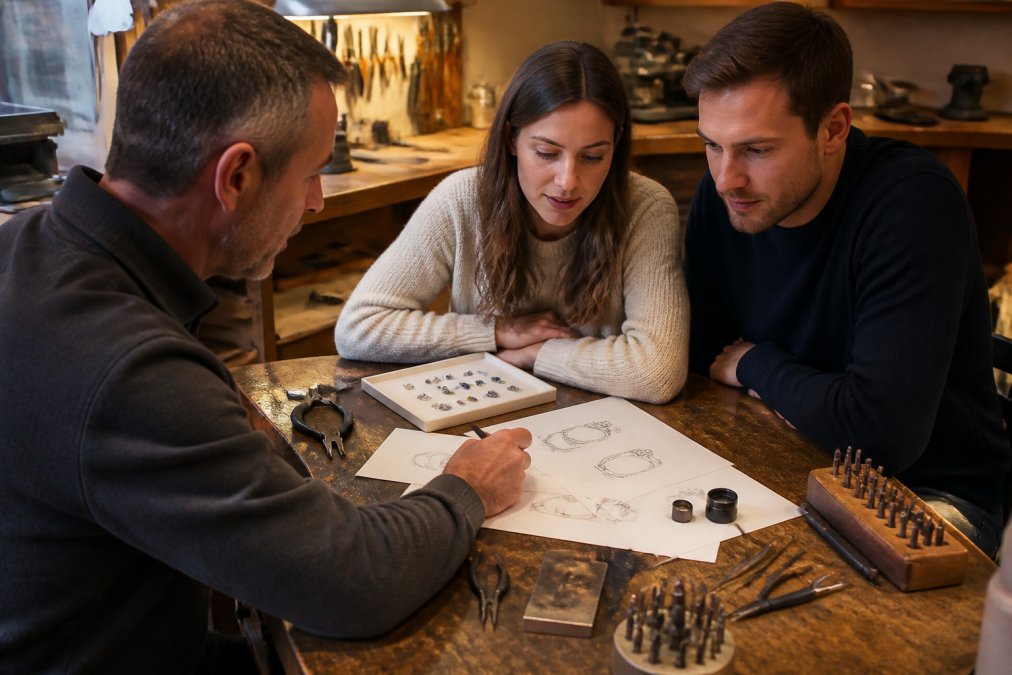
The engagement ring design process for a bespoke piece starts with a consultation, moves through sketches or CAD design, and ends with a ring cast, set and hand-finished by an artisan, usually two to three conversations before any metal is cut. Ready made rings skip this: you try on the retail inventory and buy the piece that fits best.
For bespoke, expect these stages:
- Initial consultation to discuss style, gemstone choice and precious metal
- Design development, often with sketches or a 3D CAD model for approval
- Stone selection, either sourced to your brief or chosen from existing stock
- Setting, polishing and quality control before collection
The collaboration is the point: if you have a clear picture of what you want, bespoke delivers it; if you'd rather hold the ring today, ready made wins.
The Cost of Custom Engagement Rings vs Off-the-Shelf Prices
The cost of custom engagement rings is generally higher than off-the-shelf equivalents because you pay for design time, individual stone sourcing and one-off manufacturing, but the gap narrows when you compare like-for-like specifications. Ready made rings benefit from standardized manufacturing, so unit costs are lower and prices are fixed and visible.
For bespoke, our own commissions illustrate the range clearly:
| Ring | Centre Stone | Metal | Price |
|---|---|---|---|
| Emerald cut with brilliant shoulders | 0.25ct F VS2 | Platinum | £1,900 |
| Round brilliant, GIA certified | 0.70ct E SI1 | Platinum | £7,750 |
| Three-stone oval, lab grown | 1.6ct D VVS | Platinum | £2,250 |
| Three-stone emerald cut, lab grown | 3.50ct total | 18ct yellow gold | £3,150 |
| Single stone, lab grown | 2.50ct E VS1 | Platinum | £2,295 |
What Actually Drives the Bespoke Premium
A bespoke quote is not one number, it is four. Understanding each line is the difference between comparing fairly and comparing emotionally.

- The centre stone. Usually the largest cost and most sensitive to the 4Cs. A stone sourced to your brief carries a sourcing fee; one already in inventory does not.
- The metal. Platinum costs more per gram than 18ct gold and is denser, so a platinum ring weighs and costs more. An 18ct yellow gold setting can cut the metal line without changing the design.
- The making charge. This covers the artisan's time: CAD modelling, casting, setting, polishing and quality control. A simple solitaire takes a fraction of the bench time of a three-stone with a halo.
- The setting and finishing. Hand-set pavé, milgrain detail and hand-engraved shoulders add bench hours. These details make a bespoke ring feel bespoke, and are the easiest line to trim.
How to Compare a Bespoke Quote Against a Ready Made Price
The mistake most couples make is comparing a bespoke quote against a ready made ring with a different stone, two different products. To compare fairly, match the specification first:
- Note the ready made ring's centre stone carat, colour, clarity and certification.
- Note the metal and its purity (for example, 18ct gold or 950 platinum).
- Note whether the setting is cast or hand-finished.
- Ask the bespoke jeweller to quote to that exact specification.
When specifications match, the bespoke premium is usually the design and making charge, not the stone. That gap is far smaller than headline prices suggest.
Budgeting for a Bespoke Commission
A common pattern is to set a total budget and allocate it in this order: centre stone first, metal second, making charge third, finishing details last. If the stone is the priority, a simpler setting keeps the total in range; if the design is the priority, a smaller or lab-grown stone frees up budget for bench work. Lab-grown diamonds have changed the conversation: a larger, higher-clarity stone is achievable at a fraction of the natural equivalent, which is why many couples put the savings into a bespoke setting. The trade-off is resale, lab-grown stones generally hold less of their purchase price.
VAT is included in the prices shown above. If you are commissioning from outside the UK, import duty and VAT may apply on entry, and the jeweller should be able to confirm the landed cost before you pay a deposit.
Where Ready Made Wins on Price
Ready made rings win on price predictability, not necessarily on price. A mass-produced ring has no design, sourcing or one-off tooling fees, so the unit price is lower at equivalent specifications, and the published price lets you compare three retailers in an afternoon. But if the ring you want does not exist in the inventory, the price advantage is irrelevant.
The Deposit and Payment Structure
Bespoke commissions typically require a deposit before work begins, with the balance due on collection. The deposit covers the stone and initial bench time, which is why it is usually non-refundable once the stone is sourced. Ready made purchases are paid in full at the point of sale, with no staged payments and no design risk. If cash flow matters, bespoke spreads the cost over weeks; ready made concentrates it into one transaction.
How Long Does a Bespoke Ring Take? Lead Times Explained
A bespoke ring typically takes four to eight weeks from design approval to collection, depending on stone sourcing and setting complexity. Ready made rings take zero lead time if the size is in stock. Lead time is often the deciding factor: if you're planning a proposal around a specific date, work backwards from it, because a custom-made commission needs room for design revisions.
Practical timelines to plan around:
- Ready made, in stock: immediate
- Ready made, resizing needed: a few days to two weeks
- Bespoke with stones in stock: four to six weeks
- Bespoke with sourced stones: six to eight weeks or longer
If your timeline is tight, a ready made ring resized to fit is a sensible compromise. If you have two months or more, bespoke is comfortably achievable.
Craftsmanship and Quality: Hand-Finished vs Mass-Produced
Hand-finished rings are shaped, set and polished by an artisan, allowing finer control over the setting and a more individual finish. Mass-produced rings are made to consistent tolerances by machine, delivering reliability and lower cost but less character. Neither is inherently lower quality, a well-made ready made ring from a reputable jeweler can be excellent. The difference shows in the details: setting precision, shoulder symmetry and how the metal is finished around the stone. Quality control matters more than the manufacturing method. Ask about certification: a GIA or IGI certificate tells you exactly what you're buying, whether the ring was made to order or pulled from inventory.
- Bespoke strengths: unique design, exact specification, personalization
- Ready made strengths: proven designs, immediate availability, predictable pricing
- Shared requirement: certified stones and a jeweller who stands behind the work
Insurance, Resale Value and Maintenance: What Happens After Purchase
Most comparisons stop at the till, but the decisions that cost or save money happen in the years after purchase, and bespoke and ready made rings behave very differently once they leave the workshop.
Insuring a Bespoke Ring vs a Ready Made Ring
Insurance for a bespoke ring usually requires a valuation or appraisal, because the piece has no direct market comparison. A ready made ring is easier to insure because replacement value can be established from current retail pricing for the same model. Most UK home contents policies offer two routes:
- Replacement as new. The insurer replaces the item with a new equivalent. For a ready made ring, this is straightforward, the model still exists. For a bespoke ring, the insurer needs a valuation that describes the piece in enough detail to commission a replacement.
- Agreed value. You and the insurer agree a sum insured up front, based on a professional valuation. This is the more common route for bespoke pieces, because it removes the argument about what "equivalent" means.
A valuation for a bespoke ring should itemise the centre stone (carat, colour, clarity, certification number), the metal and its purity, the setting style and the making charge. A one-line "diamond ring, £5,000" valuation is not enough to rebuild the piece, and an insurer may settle short if the ring is lost. Ready made rings from recognised brands are often easier to insure because brand, model and current retail price are verifiable, an advantage of documentation, not of the ring itself.
Resale Value: Why Ready Made Usually Wins
Resale value favours ready made rings from recognised brands, because buyers can look up the model, check the current retail price and offer with confidence, which creates liquidity. Bespoke pieces are personal, and that personalisation reduces resale appeal, a ring designed around one person's taste, finger size and stone preference is a smaller market, so sellers usually accept a discount to move it. There are exceptions: a bespoke ring built around a certified natural diamond of exceptional quality retains value through the stone, even if the setting adds nothing, while one built around a lab-grown stone typically retains less because the stone has a thinner secondary market.
If resale matters to you, weigh it honestly:
- Ready made, branded: strongest liquidity, most predictable resale.
- Ready made, unbranded: moderate liquidity, priced on stone and metal.
- Bespoke, natural stone: value concentrated in the stone, setting largely irrelevant on resale.
- Bespoke, lab-grown stone: weakest resale, strongest value at the point of purchase.
None of this makes bespoke a bad decision. It makes it a decision about what you value: a ring that is uniquely yours, or a ring that is easy to sell. Most couples buying an engagement ring are not planning to sell it.
Maintenance and Repairability
Maintenance is broadly similar for both routes: periodic cleaning, checking of settings and occasional re-polishing. The differences appear when something needs repairing. Bespoke rings can be easier to repair because the maker knows the original specification, the alloy, setting geometry and stone dimensions, so a repair is a known quantity if the jeweller is still trading. If the jeweller has closed, a new bench must reverse-engineer the piece first. Ready made rings from recognised brands often have a service network, so repairs can be handled through the brand rather than a single workshop, a real advantage for long-term ownership.
Practical maintenance guidance for both:
- Have the setting checked annually by a qualified jeweller, particularly claw settings.
- Remove the ring before swimming, gardening or gym work, chlorine and abrasion are the two most common causes of damage.
- Clean with warm water and a soft brush; avoid ultrasonic cleaners on treated or fracture-filled stones.
- Insure the ring before you wear it, not after.
Sustainability and Provenance
Sustainability is another angle worth considering. Lab-grown diamonds offer a traceable, ethical sourcing story, and several of our bespoke commissions use them precisely for that reason. If provenance matters, ask where the stones come from before you commit. Bespoke has a structural advantage here: because the stone is sourced individually, the jeweller can tell you its origin, certification and journey, whereas mass-market inventory is harder to trace because stones are bought in batches.
The Long-Term Ownership Summary
| Factor | Bespoke | Ready Made |
|---|---|---|
| Insurance | Needs itemised valuation; agreed value common | Easier to insure; replacement value verifiable |
| Resale | Weaker unless natural stone carries value | Stronger, especially branded |
| Repair | Easier if maker still trading; harder if not | Brand service network helps |
| Provenance | Stronger traceability | Weaker traceability |
| Maintenance | Broadly similar | Broadly similar |
The ring you choose on day one is the ring you own for decades. Weighing the post-purchase picture alongside the purchase price separates a decision you are happy with from one you merely made.
Frequently Asked Questions
Are bespoke engagement rings more expensive than ready-made options?
Not always. A bespoke engagement ring can start around £1,900 for a 0.25ct emerald cut in platinum, while a ready-made piece with a larger certified stone can reach £7,750. The difference lies in what you control: with bespoke you choose the gemstone, precious metal and setting, so you can direct your budget toward what matters most rather than paying for a brand's retail inventory and packaging.
How long does a bespoke ring take from first consultation to collection?
Most bespoke commissions run four to eight weeks, depending on the complexity of the design and whether stones need sourcing. A CAD design and wax model stage adds roughly one to two weeks before manufacturing begins. If you have a proposal date fixed, start the process at least two months ahead so there is room for adjustments at the design approval stage.
What is the most durable design for an engagement ring?
Platinum settings with a low-profile or bezel-set centre stone offer the best protection for daily wear. Platinum is denser than gold, holds claws more securely and develops a patina rather than losing metal over time. Round brilliant cuts in a six-claw setting balance security with light performance, while emerald cuts need corner claws because their pointed edges are more vulnerable to knocks.
Do ready-made rings offer better value for money?
Ready-made rings win on speed and immediate availability. You can try a finished piece, check the finger size and take it home the same day. Bespoke wins on specification: you decide the colour, clarity and cut of the diamond, so no money goes toward features you did not want. If your priority is a specific stone quality rather than a quick purchase, bespoke usually delivers more ring for the same spend.
How do I know the finished bespoke ring will match what I imagined?
A proper bespoke service shows you the design before any metal is cut. You should see sketches, then a CAD rendering, and often a wax or resin model you can hold and try on. Approving that model is your safeguard. Ask specifically whether the model is included in the quoted price and whether you can request changes to the setting height or band width at that stage.