
Table of Contents
- What Drives the Price of a Bespoke Jewellery Commission
- The Custom Engagement Ring Cost Breakdown
- The Jewellery Commission Process Timeline: From Consultation to Collection
- Bespoke Jewellery Deposit and Payment Terms You Should Expect
- Made-to-Order vs Fully Bespoke: What Changes the Price
- How to Get an Accurate Quote and Stay Within Budget
- Resale Value and Budget-Friendly Alternatives to Consider
- Frequently Asked Questions
Last Updated: September 12, 2026
What Drives the Price of a Bespoke Jewellery Commission
Bespoke jewellery commission pricing explained comes down to four cost centres: metal, stones, labour and design time. Understanding how each is calculated is the difference between a confident commission and an unwelcome surprise at final balance.
This guide from Peter George banks trading as Morgan Banks, fine jewellers since 1935, breaks down every stage of the process, from the first consultation to the day you collect the finished piece.
Three variables move the number more than anything else:
- Metal choice - platinum costs considerably more per gram than 18ct gold, which in turn sits above sterling silver
- Stone selection - a certified natural diamond with strong colour and clarity grades carries a very different price to a lab-grown or coloured alternative
- Construction complexity - a simple band takes far fewer workshop hours than intricate construction with hand-cut stone setting and engraving
A common mistake is fixating on the headline quote and ignoring how design revisions, resizing and hallmarking affect the final figure. Each adds real cost.
Material Costs: Precious Metals and Gemstone Sourcing
Precious metal is priced by weight at the day's market rate, plus a fabrication margin. A platinum band uses a denser, harder metal than 18ct gold, so it costs more in raw material and takes longer to work.
Gemstone sourcing changes the equation just as sharply. A certified stone with documented colour and clarity commands a premium over an uncertified one, and traceable sourcing adds a further layer (gem-a.com). When you commission a piece such as the Telford bespoke diamond and sapphire set band at £2,350.00, you are paying for matched stones, precious metal and the hours of setting that hold them in place.

Labour and Craftsmanship: Stone Setting, Engraving and Intricate Construction
Labour costs reflect time at the bench, not the size of the piece. Stone setting, engraving and intricate construction are the three most labour-intensive tasks in any commission.
Hand-cutting a setting for an emerald cut stone takes longer than a standard round brilliant mount because the corners must be protected precisely. Engraving adds a separate specialist stage, often subcontracted. Expect labour to represent a meaningful share of any quote, and expect it to rise with every detail you add.

The Custom Engagement Ring Cost Breakdown
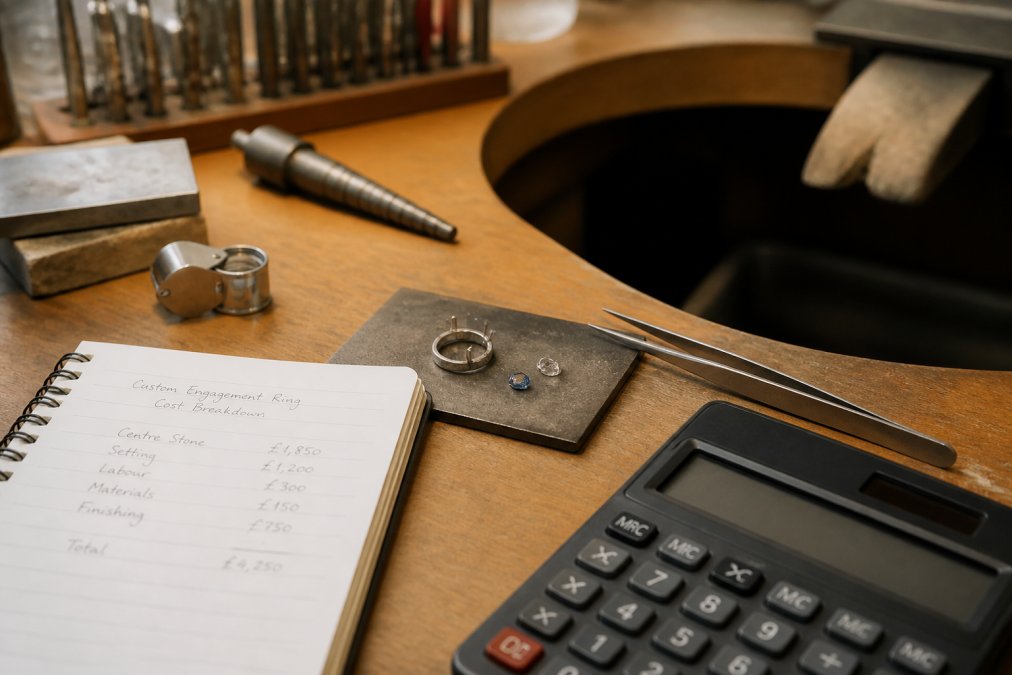
A custom engagement ring cost breakdown typically splits into four lines: design fee, metal, stone and setting. Seeing them separated is the single best way to judge whether a quote is fair.
Design and consultation usually carry a fee, sometimes credited against the final balance. Metal and stone are quoted at current market rates. Setting and finishing are charged as workshop hours. Ask for each line in writing before you commit.
Design Fees and Initial Consultation Costs
Initial consultation fees vary by jeweller and are often redeemable against the commission. The fee covers the designer's time sketching your concept and refining it into something buildable.
Some workshops charge a flat design fee; others fold it into the overall quote. What matters is knowing which applies before you sign. If you commission a platinum emerald cut engagement ring, for example, the design stage determines how the shoulders are set and how the centre stone is framed, so it is not a step to rush.
Hidden Costs to Watch For in a Bespoke Commission
Hidden costs are the most common complaint in bespoke work, and most are avoidable. Watch for resizing charges after collection, rhodium plating on white gold, and separate hallmarking or valuation fees.
Ask upfront whether the quote includes:
- Resizing within a set period
- Rhodium plating and refinishing
- Independent valuation for insurance
- Engraving and personalisation
- Any charge for design revisions beyond an agreed number
The Jewellery Commission Process Timeline: From Consultation to Collection
A jewellery commission process timeline usually runs six to twelve weeks, depending on complexity (gov.uk).
The stages follow a predictable order:
- Consultation and brief
- Sketching and design confirmation
- CAD modelling and approval
- Metal and stone sourcing
- Bench work, setting and finishing
- Hallmarking and final quality check
- Collection or delivery
Delays almost always come from revisions at the approval stage. Decide early and the timeline holds.
Design Confirmation: Sketches, CAD Modelling and Your Approval
Design confirmation is the checkpoint that protects both sides. You should see sketches first, then a CAD model, before any metal is cut.
This is where the customer question "how do I know it will look like what I'm imagining?" gets answered. A CAD render shows proportions, stone placement and profile in three dimensions, so you approve the design rather than hope for the best. No reputable workshop should begin bench work without written design confirmation.
Bespoke Jewellery Deposit and Payment Terms You Should Expect
Bespoke jewellery deposit and payment terms normally follow a two-stage structure: a non-refundable deposit to begin, then the final balance on collection.
The deposit covers materials and reserved workshop time, which is why it is typically non-refundable. Expect to pay the balance before or at collection, once the piece has passed hallmarking and your final inspection. Ask whether staged payments are possible for larger commissions; many jewellers will accommodate them.
Made-to-Order vs Fully Bespoke: What Changes the Price
Made-to-order pieces adapt an existing design, while fully bespoke work starts from a blank page. The price gap between them is almost entirely design time and tooling.
| Factor | Made-to-Order | Fully Bespoke |
|---|---|---|
| Starting point | Existing design, adjusted | Blank page |
| Design time | Minimal | Substantial |
| Stone choice | From a set range | Sourced to your brief |
| Timeline | Shorter | Longer |
| Cost | Lower | Higher |
| Uniqueness | Limited variation | Entirely one-off |
If your heart is set on a specific combination of metal, stone and setting, fully bespoke is the only route. If you simply want a well-made ring that suits you, made-to-order often delivers better value.
How to Get an Accurate Quote and Stay Within Budget
An accurate quote depends on how specific your brief is. Vague briefs produce vague numbers, and vague numbers produce disputes later.
Set a firm budget first, then ask what is achievable within it. A good jeweller will tell you honestly where the money goes and what to trade off. Bring reference images, know your ring size, and decide on metal and stone preferences before the consultation. The more decisions you make early, the tighter the quote.
The Commission Contract Checklist
A commission contract should cover design, materials, money and timing in writing. Use this checklist before signing anything:
- Full description of the piece, including metal, stones and dimensions
- Confirmed design drawings or CAD renders attached
- Total price, with design fee, materials and labour itemised
- Deposit amount and whether it is non-refundable
- Payment schedule and accepted methods
- Agreed completion date
- Resizing, warranty and aftercare terms
- Hallmarking and valuation arrangements
- What happens if you cancel or the jeweller cannot deliver
Two signatures, one copy each. It takes ten minutes and prevents most disputes.
Resale Value and Budget-Friendly Alternatives to Consider
Resale value on bespoke pieces is generally lower than the purchase price, and buyers should understand why before committing rather than discovering it at resale.
The mechanism is straightforward. A bespoke piece is built to one person's finger size, taste and brief. That narrows the pool of second-hand buyers to almost nobody, and a narrow pool means a weak price. On top of that, the retail price you paid already includes design time, CAD modelling, workshop labour and the jeweller's margin, none of which transfers to a resale buyer, who is effectively pricing the metal and stones alone. A common pattern is that a bespoke commission recovers a fraction of its cost on the secondary market, with the gap widest on highly personalised designs and narrowest on classic, recognisable styles.
If resale matters to you, the levers are the same ones that make any piece easier to move on:
- Classic silhouettes, a solitaire or plain band appeals to a far wider resale audience than an asymmetric one-off
- Certified stones, a stone with an independent grading report is tradeable; an uncertified stone is not, because a buyer cannot verify what they are getting
- Recognised metals, platinum and 18ct gold hold value better than silver or plated alternatives
- Documentation, keep the valuation, the grading report and the original receipt together; a resale buyer will ask for all three
Treat a bespoke commission as a piece to wear and enjoy, not as an investment. If investment is the goal, a certified loose stone or a recognised branded piece is a different purchase entirely.
Budget-Friendly Alternatives That Still Look Bespoke
You do not need a full from-scratch commission to get a one-off result. There are several routes that deliver a bespoke look at a lower price point, and a good jeweller will talk you through which suits your brief.
Modify an existing setting. If a design you like already exists in a jeweller's range, adapting it, changing the stone, altering the shoulder profile, adding engraving, avoids the design and CAD fees that a blank-page commission attracts. You get a piece that is yours, without paying for the drawing board.
Reset an inherited stone. If you have a family stone, having it reset into a new mount is often the single most cost-effective way to commission something personal. You are paying for metal and labour only, and the sentimental value is built in.
Choose made-to-order over fully bespoke. As the comparison above sets out, made-to-order adapts an existing design rather than starting from nothing. The saving is almost entirely design time and tooling, which is often the largest single line in a fully bespoke quote.
Trade metal, not craft. Moving from platinum to 18ct gold, or from a certified natural stone to a lab-grown or coloured alternative, reduces the material line without touching the quality of the setting or finish. The piece is still made properly; it simply costs less in raw material.
Build in stages. Start with a simpler band and add detail later, an anniversary engraving, a second stone, a re-polish. Spreading the spend does not compromise the finished piece.
Use smaller commemorative appointments. For pieces that do not need a full commission, a keepsake, a small gift, a welded bracelet, permanent jewellery appointments are a lower-cost entry point. A £10 booking fee is typically taken off the final amount, so the appointment itself costs you nothing if you proceed.

None of these compromise quality. They simply shift where the money goes, and each one keeps the piece personal.
Frequently Asked Questions
What factors influence the final price of a bespoke jewellery commission?
The final price depends on four main factors: the precious metals you choose (platinum, 18ct gold or sterling silver), the gemstones and their sourcing, the labour and craftsmanship required for intricate construction and stone setting, and any design fees for CAD modelling or hand sketches. A simple sterling silver band sits at the lower end, while a platinum ring with a certified diamond and engraved shoulders costs significantly more. Hallmarking and any final adjustments also add to the total.
Do I need to pay a deposit for a custom jewellery commission?
Yes, most bespoke jewellery commissions require a non-refundable deposit before work begins. This covers material sourcing and design time. Always ask for the deposit and payment terms in writing before committing. At Morgan Banks, for example, a £10 booking fee secures your permanent jewellery appointment and is deducted from the final amount.
What is the typical timeline for a bespoke jewellery commission?
A bespoke commission usually takes four to eight weeks from design confirmation to collection. Complex pieces with intricate construction or rare gemstones can take longer, so build in a buffer if you are working towards a specific date.
How does the cost of bespoke jewellery compare to off-the-shelf pieces?
Bespoke jewellery offers a one-of-a-kind piece made to your exact specifications, which off-the-shelf cannot offer. If budget is tight, made-to-order options sit between the two: you choose from existing designs but customise metals, gemstones or engraving at a lower cost than a fully bespoke commission.