
Table of Contents
- The Real Cost of a Bespoke Engagement Ring vs Ready-Made
- Custom Engagement Ring Cost: A Full Pricing Breakdown
- The Benefits of Bespoke Engagement Rings: Beyond the Aesthetics
- The Bespoke Jewellery Design Process in the UK: From Sketch to Setting
- Hidden Costs of Bespoke: Revisions, Resizing and Maintenance
- Resale Value and Long-Term Investment: Does Custom Hold Up?
- Bespoke vs Off-the-Shelf: Which Is Right for You?
- Frequently Asked Questions
Last Updated: September 14, 2026
The Real Cost of a Bespoke Engagement Ring vs Ready-Made
A bespoke engagement ring is a piece of jewellery designed and made to your specification, rather than selected from existing stock. Whether it is worth it depends less on the price tag than on what you value: a ring nobody else owns, or a faster, cheaper purchase off the shelf. According to The Goldsmiths' Company's guidance on hallmarking and precious metal standards, precious metal pieces sold in the UK must carry an assay office hallmark, a protection that applies equally to bespoke and ready-made work. At Morgan Banks, we have handled both routes since 1935, and the honest answer is that bespoke rarely costs dramatically more than a comparable ready-made piece. It costs more of your time.
What Drives the Price of a Custom Engagement Ring
Four things decide the final figure: the centre stone, the metal, the setting style, and the labour behind the design. A lab-grown diamond of a given carat weight typically costs a fraction of a natural stone with similar visual characteristics, which is why so many couples now put their budget into size and cut. Platinum costs more per gram than 18ct gold, though it wears harder over decades.

Custom Engagement Ring Cost: A Full Pricing Breakdown
There is no single industry price for a custom engagement ring, because the stone drives most of the cost. Know where your money goes before you commit, and compare like for like against ready-made alternatives.
| Element | What It Covers | Where Budget Goes |
|---|---|---|
| Centre stone | Main diamond or gemstone | Largest share of cost |
| Shoulder stones | Side stones framing the centre | Moderate share |
| Metal | Platinum or 18ct gold band | Smaller, predictable cost |
| Setting and labour | Craftsmanship and finishing | Fixed per design |
| Certification | Independent grading report | Small fixed fee |
| Design and CAD | Sketches, renders, revisions | Fixed per commission |
| Hallmarking | Assay office testing and stamping | Small fixed fee per piece |
For a concrete benchmark, our platinum single stone lab-grown diamond ring with a 2.50ct centre stone and natural shoulder stones is £2,295, while an 18ct yellow gold three-stone emerald cut lab-grown diamond ring totalling 3.50ct is £3,150. The stone specification, not the word "bespoke", sets the price.

The UK Cost Layers Most Guides Leave Out
Three charges sit on top of the metal and stone figure, and all three apply to bespoke and ready-made alike:
- VAT at 20%. Every retail sale of jewellery in the UK carries standard-rate VAT, normally shown inclusive in the ticket price. When comparing a bespoke quote against a ready-made piece, check whether both figures include VAT, a quote that excludes it is not cheaper, it is incomplete.
- Hallmarking. Under the Hallmarking Act 1973, any item described as gold, silver, platinum or palladium must be tested and struck by one of the UK's assay offices (London, Birmingham, Sheffield or Edinburgh) before it can be legally described as such (Hallmarking: practical guidance - summary). The fee is modest and scales with the number of articles, but it is a real line item on a bespoke commission.
- Import and shipping on stones. If a centre stone is sourced from overseas, import VAT and any applicable customs duty are payable on entry. A dealer who sources frequently will build this into the stone price; a one-off commission may show it separately.
Design Fees, Deposits and Payment Stages
A bespoke commission is usually paid in stages: a deposit to secure the stone and begin design, a second payment at CAD approval, and the balance on collection. Ask what the deposit covers and whether it is refundable if you walk away after the sketch stage. Design fees vary, some jewellers absorb them into the final price, others charge separately and credit them against the commission. Know which one you are being quoted.
Lab-Grown vs Natural Diamonds: How the Choice Affects Your Budget
Lab-grown diamonds are chemically and optically identical to mined stones, and independent grading bodies such as the International Gemological Institute certify both to the same standards. Choosing lab-grown usually means a larger or higher-clarity centre stone for the same spend. A common mistake is assuming lab-grown means lower quality; in practice it means the money moves from rarity to size and cut.
The trade-off is resale. A certified natural diamond has a long-established second-hand market; a lab-grown stone does not, because new supply keeps pushing prices down. If you are buying for the wearer and not the market, that rarely matters. If you are buying with one eye on resale, it is the single biggest budget decision in the whole commission.
The Benefits of Bespoke Engagement Rings: Beyond the Aesthetics
The strongest argument for bespoke is not how the ring looks. It is that the ring is a commission, not a purchase. You choose the centre stone, the setting, the metal and the proportions, so the finished piece reflects a specific person rather than a season's bestseller. Personalisation is where the sentimental significance lives: an engraving, a stone from a family piece, a setting that echoes a grandmother's ring.
The Bespoke Jewellery Design Process in the UK: From Sketch to Setting
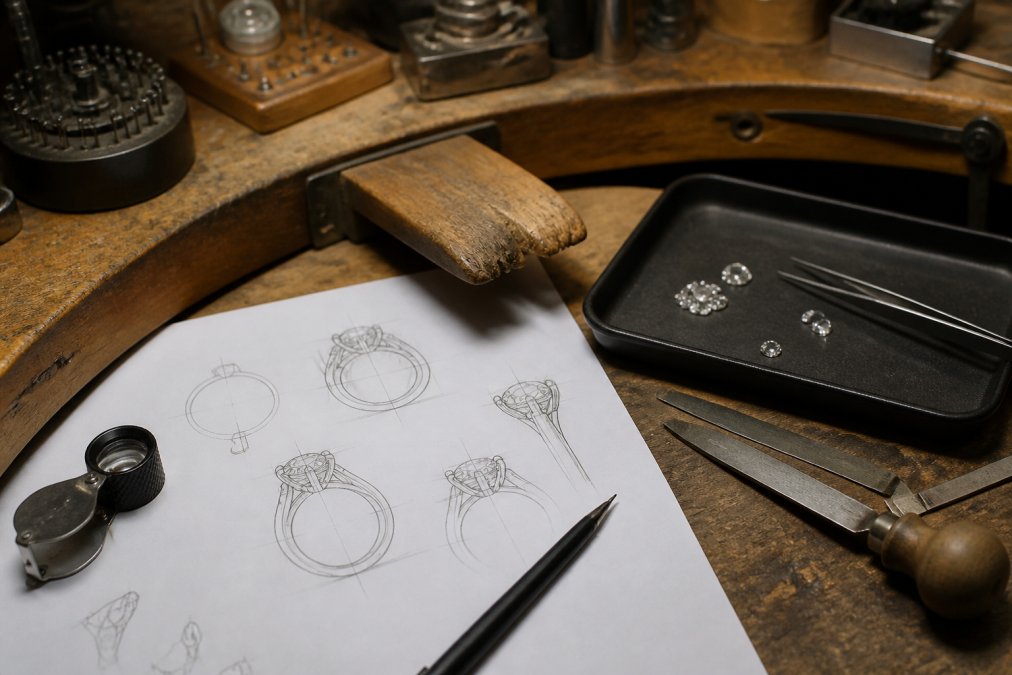
The process runs through five stages: consultation, sketch, CAD design, approval, and making. Each removes guesswork before metal is cut. Expect the design phase to take a few weeks and the making several more, depending on stone sourcing and workshop capacity.
CAD Design, Revisions and Approval: What to Expect
Computer-aided design lets you see the ring in three dimensions before it is made, from every angle and at realistic scale. It answers the most common worry: how do you know it will look like what you imagined? You approve a rendering, not a description. Revisions at this point are normal and cheap; after casting they are neither.
Hidden Costs of Bespoke: Revisions, Resizing and Maintenance
Bespoke is not a one-off payment. The purchase price covers the making, not everything that happens to the ring afterwards. Understanding the three recurring costs, revisions, resizing and maintenance, separates a commission that stays on budget from one that drifts past it.
Revisions During the Design Phase
Revisions before casting are the cheap ones. Once you have approved a CAD render, the workshop can adjust proportions, claw style, band width or stone placement in the model at little or no cost, because nothing physical has been made yet. Most jewellers include two or three revision rounds and charge beyond that, so ask before you sign off on the first render.
Revisions after casting are the expensive ones. Once the metal is formed and the stone is set, changing the design usually means rebuilding the piece. A wider band, a different head, a repositioned centre stone: each is effectively a new commission. That is why the approval stage matters more than any other.
Resizing: What a Bespoke Setting Can and Cannot Take
A plain band can usually be resized up or down by a size or two without difficulty. A bespoke setting is different. Where the shoulders are set with stones, where the band tapers, and how the head is constructed all limit how much the ring can be altered before the setting is compromised.
As a rough guide, a fully set band can be adjusted by one or two UK sizes before the work becomes a rebuild rather than a resize. Channel-set and pavé-set shoulders are the most restrictive; a plain or lightly set band is the most forgiving. If you are unsure of the wearer's size, say so at the design stage, a jeweller can build in allowance for a future resize, far cheaper than rebuilding later.
Long-Term Maintenance: What Bespoke Actually Requires
- Claw and setting checks. A daily-worn ring takes knocks, and a loose claw is a stone waiting to fall out. An annual check at the jeweller, often free or nominal, catches this before it becomes a replacement.
- Polishing and rhodium plating. Platinum develops a patina that some wearers like and others do not; a polish restores the original finish. White gold is usually rhodium-plated for colour, and that plating wears through over time and needs redoing, typically every year or two depending on wear.
- Repair access. A bespoke setting is not inherently harder to repair than a mass-produced one, but it can be harder to repair elsewhere. A workshop that did not make the piece may be reluctant to work on an unfamiliar setting. Keeping the original maker's details, and the CAD file if they will share it, makes future repairs simpler.
- Insurance and valuation. Insurers typically want a current valuation for a bespoke piece, because there is no catalogue price to reference. An independent appraisal at purchase, refreshed every few years, keeps the cover accurate and avoids a dispute if you ever need to claim.
Resale Value and Long-Term Investment: Does Custom Hold Up?
A bespoke ring is a commission, not a commodity, and resale value follows the stone far more than the design. A certified diamond retains value on the basis of its grading; the labour you paid for the setting does not transfer to a buyer. If investment value matters, put the budget into a well-certified centre stone and treat the design as something you are buying for the wearer, not the market. Buyers of pre-owned pieces look for paperwork, which is where independent certification and a proper jewellery appraisal pay off.
Bespoke vs Off-the-Shelf: Which Is Right for You?
The right answer depends on three questions: how specific your taste is, how much time you have, and whether the wearer wants something nobody else owns.
| Your Priority | Better Route | Why |
|---|---|---|
| Unique design, exact specification | Bespoke | Full control over stone, metal and setting |
| Speed and a known price | Ready-made | Available immediately, no design phase |
| Maximum stone for the budget | Bespoke with lab-grown | Budget shifts from rarity to size |
| Trying on before deciding | Ready-made | See the finished piece on the hand |
If you are torn between a bespoke piece and an off-the-shelf design, the difference is usually the design fee and the lead time, not the stone. Bespoke suits someone who knows what they want and will wait for it. Ready-made suits someone who wants to see it, hold it, and take it home.
Choosing an engagement ring is a decision you will look at every day for decades, and the pressure to get it right is real. Morgan Banks has been making and sourcing fine jewellery since 1935, and our team guides couples through stone selection, metal choice, and design approval so nothing is left to chance. Our bespoke service, our collection of lab-grown diamond engagement rings, and our expert guidance for engagement and wedding ring selection are all built around getting the details right. Get started with Morgan Banks and commission a ring made for one person only.
Frequently Asked Questions
How much does a bespoke engagement ring typically cost?
Costs vary widely based on the centre stone, metal and complexity of the setting. At Morgan Banks, platinum and lab-grown diamond rings range from £1,995 for a 2.00ct emerald cut to £3,150 for a 3.50ct three-stone design. Budget for the stone first, then the setting and metal. A design consultation will give you a precise quote before any work begins.
Is a bespoke ring more expensive than an off-the-shelf alternative?
A custom engagement ring cost depends on your chosen stone and metal. Lab-grown diamonds, for example, let you get a larger centre stone for the same budget. The bespoke process gives you control over where every pound goes.
Does a custom-made engagement ring hold its value better than mass-produced jewellery?
Resale value depends mainly on the stone's certification and quality, not on whether the ring was bespoke or mass-produced. A certified diamond with strong colour and clarity grades retains value better than an uncertified stone. The bespoke setting itself rarely adds resale value. Think of bespoke as an emotional investment rather than a financial one.
How long does the bespoke jewellery design process usually take?
Most bespoke commissions take six to ten weeks from initial consultation to finished ring. The timeline includes design sketches, CAD modelling, your approval, stone sourcing, casting, setting and final polish. Complex designs or rare stones can extend this. Start the process at least three months before you plan to propose to allow room for revisions.