
Table of Contents
- What You'll Need Before You Measure Ring Size at Home
- How to Measure Ring Size with a Paper Strip
- How to Measure Ring Size with String or Thread
- Measuring an Existing Ring for Size
- UK Ring Size Chart: Converting Millimetres to Ring Size
- Knuckle vs Base: Which Measurement Matters Most
- Factors That Affect Finger Size and Measurement Accuracy
- Average Ring Size for Women in the UK
Last Updated: August 26, 2026
Getting your ring size wrong is one of the most frustrating, and avoidable, mistakes when buying jewellery online. At Morgan Banks, we've guided customers through this process for decades, and the same errors come up again and again: printed guides that aren't scaled correctly, measurements taken at the wrong time of day, and fingers sized at the base when the knuckle is actually the tighter point. This guide covers how to measure ring size at home accurately, with methods that work, warnings about what goes wrong, and a full UK ring size chart so you can order with confidence.

What You'll Need Before You Measure Ring Size at Home
To measure ring size at home reliably, you need only a few simple items.
Basic tools:
- A strip of paper (roughly 1cm wide, 10cm long) or a length of thin string or thread
- A ruler marked in millimetres
- A pen or fine-tipped marker
- An existing ring that fits well (optional)
- A flat, stable surface with good lighting
The ruler is critical. Measuring in millimetres gives you the precision this process demands. Avoid measuring in centimetres and converting; the rounding error is enough to push you into the wrong size.
Avoid tape measures with worn ends, strips of paper narrower than 8mm (they twist), and any printable ring sizer guide from the internet unless you have verified the print scale is exactly 100%.
How to Measure Ring Size with a Paper Strip
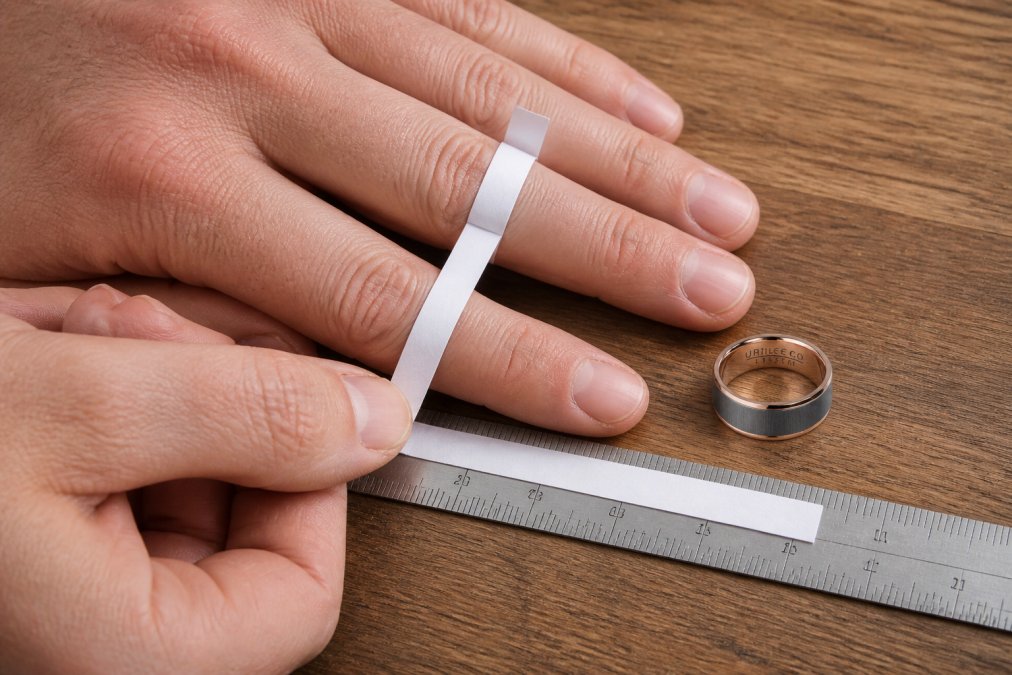
The paper strip method is the most widely recommended approach for measuring ring size at home: paper holds its shape, is easy to mark, and gives a clean, readable result when laid flat against a ruler.
Step-by-Step: Paper Strip Method
- Cut a strip of paper roughly 1cm wide and 10cm long.
- Wrap it snugly around the base of the finger you want to size. The paper should sit flat against the skin without gaps, but should not compress the flesh.
- Mark the point where the paper overlaps with a pen.
- Lay the paper flat on a ruler and measure from the edge to your mark in millimetres.
- This figure is your finger's circumference in millimetres.
- Use the UK ring size chart below to convert that circumference to your ring size letter.
If the ring needs to pass over a prominent knuckle, repeat the process around the widest part of the knuckle and note both measurements. See the section on knuckle versus base measurement for guidance on which to prioritise.
Printable Ring Sizer Warnings: Printer Scaling Errors
Printable PDF ring sizers carry a significant risk: printer scaling. Most home printers default to "fit to page" settings, which silently shrink or enlarge the printed guide. A reduction of even 3-5% is enough to push your measurement off by one full ring size.
According to guidance from the British Hallmarking Council's consumer jewellery resources, professional sizing always uses calibrated tools. A printed guide is only reliable if you can confirm the printed scale against a known measurement before trusting the ring sizer.
If you do use a printable guide, always set your printer to 100% scale (not "fit to page"), print on plain white paper, and measure the calibration bar printed on the guide before using it.
The paper strip method with a physical ruler avoids this problem entirely.
How to Measure Ring Size with String or Thread
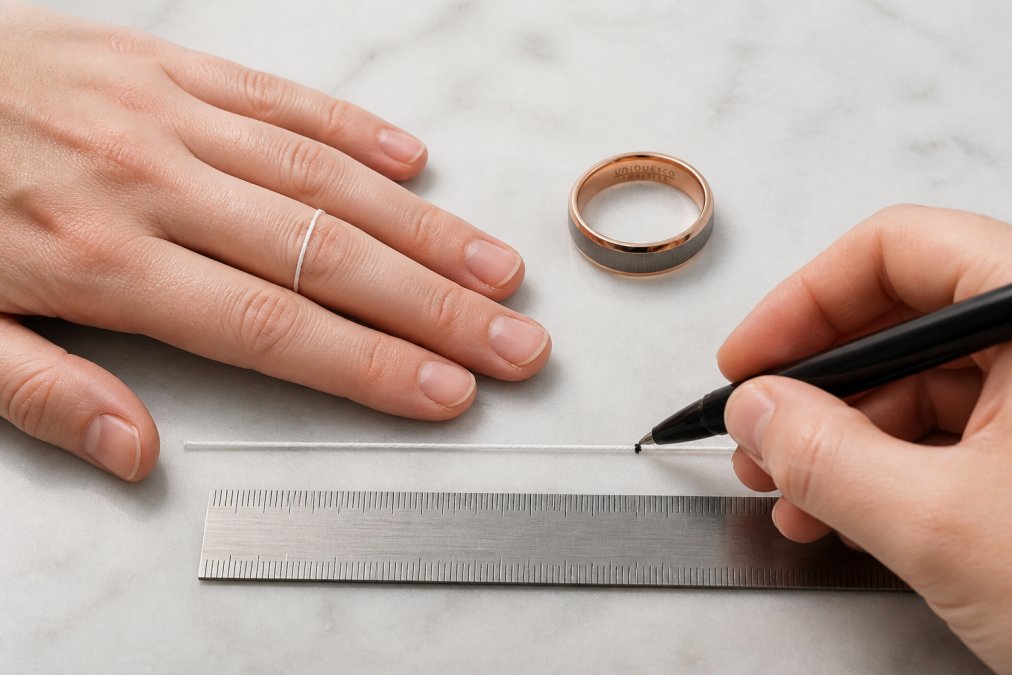
String works well when paper isn't available. Use non-stretchy thread or thin string such as embroidery thread, kitchen twine, or dental floss. Avoid elastic thread, yarn, or anything that stretches under tension.
Steps:
- Wrap the string once around the base of your finger.
- Mark or pinch the point where the string meets itself.
- Lay the string flat along a millimetre ruler.
- Read the circumference in millimetres.
- Cross-reference with the UK ring size chart below.
Measuring an Existing Ring for Size
If you already own a ring that fits the intended finger well, measuring it is often the most accurate method, and it sidesteps the physiological variables that affect live finger measurements.
To find the internal diameter:
- Place the ring flat on a ruler.
- Measure straight across the inside of the ring from one inner edge to the other.
- This gives you the internal diameter in millimetres.
To find the internal circumference: Multiply the internal diameter by 3.14 (π). For example, an internal diameter of 17.3mm gives a circumference of approximately 54.3mm.
Use the chart below to match either measurement to a UK ring size letter. Only use a ring that genuinely fits the correct finger on the correct hand. A ring that's been worn on the wrong finger or one that's slightly too loose will give you a misleading reading.
UK Ring Size Chart: Converting Millimetres to Ring Size
The UK uses an alphabetical sizing system, running from A upwards. Most adult women's rings fall between J and P; most adult men's rings fall between P and W.
| UK Size | Internal Diameter (mm) | Internal Circumference (mm) |
|---|---|---|
| H | 15.1 | 47.4 |
| I | 15.5 | 48.7 |
| J | 15.9 | 49.9 |
| K | 16.3 | 51.2 |
| L | 16.7 | 52.5 |
| M | 17.1 | 53.8 |
| N | 17.5 | 55.1 |
| O | 17.9 | 56.3 |
| P | 18.4 | 57.8 |
| Q | 18.8 | 59.1 |
| R | 19.2 | 60.3 |
| S | 19.6 | 61.6 |
| T | 20.0 | 62.8 |
| U | 20.4 | 64.1 |
| V | 20.8 | 65.4 |
| W | 21.2 | 66.6 |
Measure your finger circumference, find the closest figure in the third column, and read across to the UK size letter.
International Sizing Differences to Know
If you're ordering from an international retailer, the sizing system changes. The UK alphabetical system is not used universally.
- European sizing uses circumference in millimetres directly as the size number. A UK N (53.8mm circumference) is approximately a European 54.
- US sizing uses a numerical scale where sizes run from 3 to 13 in half increments. A UK N is roughly a US 7.
- Japanese sizing uses a different numerical scale where a UK N is approximately a Japanese 13.
The safest approach when ordering internationally is to provide your measurement in millimetres rather than relying on size conversions. As noted in the National Association of Jewellers' consumer guidance, providing the internal diameter in millimetres is the most universally understood specification.
Knuckle vs Base: Which Measurement Matters Most
For most fingers, the knuckle is wider than the base. A ring sized purely at the base will fit comfortably when stationary but may not pass over the knuckle. A ring sized at the knuckle may spin or feel loose at the base.
The right answer depends on the finger and the ring style:
- If the knuckle is noticeably larger than the base: size closer to the knuckle measurement, then consider a comfort-fit band or a ring with a slight taper at the back.
- If the knuckle and base are close in size: the base measurement is usually sufficient.
- For wide bands: size up by at least half a size from a narrow-band measurement. Wide bands sit across more surface area and feel tighter than a narrow ring of the same internal diameter.
- For narrow bands (under 3mm): the base measurement is generally accurate.
A common mistake is to measure only at the base, find the ring fits perfectly when first tried on, and then discover it won't come off easily after a few hours of wear, particularly in warm weather when fingers swell slightly.
Factors That Affect Finger Size and Measurement Accuracy
Finger circumference is not fixed. Several physiological factors cause it to fluctuate, sometimes by enough to shift your ring size by a full letter.
Temperature: Cold temperatures cause blood vessels to constrict, making fingers temporarily slimmer. Warm temperatures have the opposite effect. Measuring when your hands are cold can result in a ring that feels tight in summer.
Time of day: Fingers tend to be slightly larger in the afternoon and evening than in the morning, due to fluid accumulation over the course of the day.
Hydration and sodium intake: High sodium intake causes water retention, which can temporarily increase finger circumference.
Physical activity: Exercise increases blood flow and temporarily enlarges fingers. Avoid measuring immediately after a workout.
Pregnancy and hormonal changes: These cause significant and sometimes lasting changes to ring size. Sizing during pregnancy is not recommended for a permanent ring.
The practical guidance from the Gemmological Association of Great Britain's consumer resources is consistent with what experienced jewellers observe: measure at a stable body temperature, at a moderate time of day, on a day when you haven't been particularly active. Take the measurement two or three times and use the average.
Average Ring Size for Women in the UK
The average ring size for women in the UK is generally considered to fall between L and N, with M being the most commonly cited single size. This corresponds to an internal diameter of roughly 16.7mm to 17.5mm, or a circumference of approximately 52.5mm to 55.1mm.
Men's average ring size in the UK is typically between R and T, with S being most common, corresponding to an internal diameter of approximately 19.2mm to 20.0mm.
These averages are useful as a starting point when buying a surprise gift and the recipient's exact size is unknown. However, individual variation is wide. If you're buying an engagement ring as a surprise, the best approach is to borrow a ring the recipient wears on their left ring finger and measure its internal diameter.
For bespoke commissions and engagement rings, Morgan Banks recommends a professional sizing appointment where possible. A ring sizer tool gives a more reliable result than any home method, particularly for comfort-fit bands and wider styles.
If you're browsing rings online before visiting us, the London Road White Gold 3mm Rope Stacking Ring is a popular choice for women in the M-O range, while the Unique and Co Tungsten Carbide Ring is a durable option for men and is available in size 60 (European sizing, equivalent to approximately UK T).


| Method | Best For | Accuracy | Key Risk |
|---|---|---|---|
| Paper strip | Most people, first measurement | Good | Twisting, not measuring in mm |
| String or thread | When paper isn't available | Good | String stretch, twisting |
| Existing ring | Surprise gifts, known fit | Excellent | Must be the correct finger |
| Printable PDF sizer | Convenient reference | Variable | Printer scaling errors |
| Professional ring sizer | Bespoke and wide bands | Best | Requires jeweller visit |
Choosing the right ring size is the foundation of a comfortable, lasting fit. Morgan Banks has been helping customers find the perfect fit since 1935, with expert guidance for bespoke commissions, engagement rings, and wedding bands. Whether you'd like to visit our Kendal showroom for a professional sizing or simply want advice before ordering online, our team is here to help. Browse our ring collection and get in touch to begin your commission or find your perfect size.
Frequently Asked Questions
How can I measure my ring size at home in the UK?
Wrap a narrow strip of paper or a piece of string around the base of your finger, mark where it overlaps, then measure the length in millimetres with a ruler. That measurement is the circumference of your finger. Divide it by 3.14 to get the internal diameter in millimetres, then match that figure to a UK ring size chart. For the most reliable result, measure at the end of the day when fingers are at their largest.
Can I use a piece of string to measure my ring size?
Yes. Wrap a thin piece of non-stretchy string or thread around the base of your finger, mark the point where it meets itself, then lay it flat against a ruler and measure in millimetres. This gives you the circumference. Avoid wool or elastic thread, as these stretch and produce an inaccurate measurement. The string method works well when you do not have paper to hand and is just as reliable when done carefully.
What should I do if my ring size falls between two sizes?
If your measurement sits between two UK sizes, choose the larger of the two. A ring that is slightly loose is far easier for a jeweller to resize than one that is too tight to remove. This is especially important for wide-band rings, which fit more snugly than narrow bands at the same nominal size. If your knuckle is noticeably wider than the base of your finger, size up to ensure the ring passes over the knuckle comfortably.
Does finger size change throughout the day?
Yes. Fingers swell in warm weather, after exercise, and later in the day due to fluid retention. They shrink in cold temperatures and first thing in the morning. For the most accurate measurement, measure your finger at the end of the day when it is at its largest, and avoid measuring when you are cold or immediately after physical activity. Taking two or three measurements at different times and using the average gives a more reliable result than a single reading.
This article was written using GrandRanker