
Last Updated: October 25, 2026
Quick Summary
Ethical gemstone sourcing means obtaining gemstones through methods that respect human rights, ensure fair labour practices, and minimise environmental damage. When you choose ethical gemstone sourcing for custom jewellery, you commit to fair worker pay, ecosystem protection, and verifiable stone origin documentation.
- More than 70% of gemstones come from small-scale mines that are harder to monitor than large industrial operations.
- Traceable gemstones require documentation, third-party audits and chain-of-custody records, which is why ethically sourced stones often cost more.
- Lab-grown, recycled, and responsibly mined stones each offer different trade-offs in traceability, labour impact, environmental footprint and cost.
- Ask your jeweller for provenance documentation before production begins, not after, to avoid losing time if you need to change suppliers.
- Provenance evidence is strongest when it is specific, independent, recent, continuous and site-specific rather than desk-based.
Table of Contents
- What Ethical Gemstone Sourcing Means for Your Custom Piece
- Why Supply-Chain Transparency and Traceability Matter
- Questions to Ask a Jeweller About Gemstone Sourcing
- Understanding Traceable Gemstones and Provenance Documentation
- Lab-Grown Gemstones: A Responsible Alternative
- Recycled Gemstones: Reclaiming Beauty from Pre-Owned Stones
- Designing Your Ethically Sourced Custom Piece
- Frequently Asked Questions
What Ethical Gemstone Sourcing Means for Your Custom Piece
Ethical gemstone sourcing means obtaining gemstones through methods that respect human rights, ensure fair labour practices, and minimise environmental damage. At Morgan Banks, your bespoke piece represents not just beauty, but values.
The difference between ethically sourced gemstones and those obtained through exploitative practices can be stark. A gemstone's journey from mine to your finger involves dozens of hands and decisions. Research on human rights in jewellery supply chains shows that human-rights and environmental issues persist across gem and jewellery supply chains, yet growing attention from producers and customers is driving change.
When you choose ethical gemstone sourcing for custom jewellery, you're making three commitments:
- Workers are paid fairly and work in safe conditions
- Mining doesn't destroy ecosystems or leave communities worse off
- You can trace where your stone actually came from
Most couples focus on the four Cs (cut, colour, clarity, carat), but a stone's origin is becoming as important as its sparkle. At Morgan Banks, we help you navigate lab-grown, recycled, or responsibly mined options so you understand what you're buying.
Why Supply-Chain Transparency and Traceability Matter
Supply-chain transparency means you can follow a gemstone's path from extraction to your jeweller's workshop. Traceability is the ability to document each step of that journey with verifiable records.
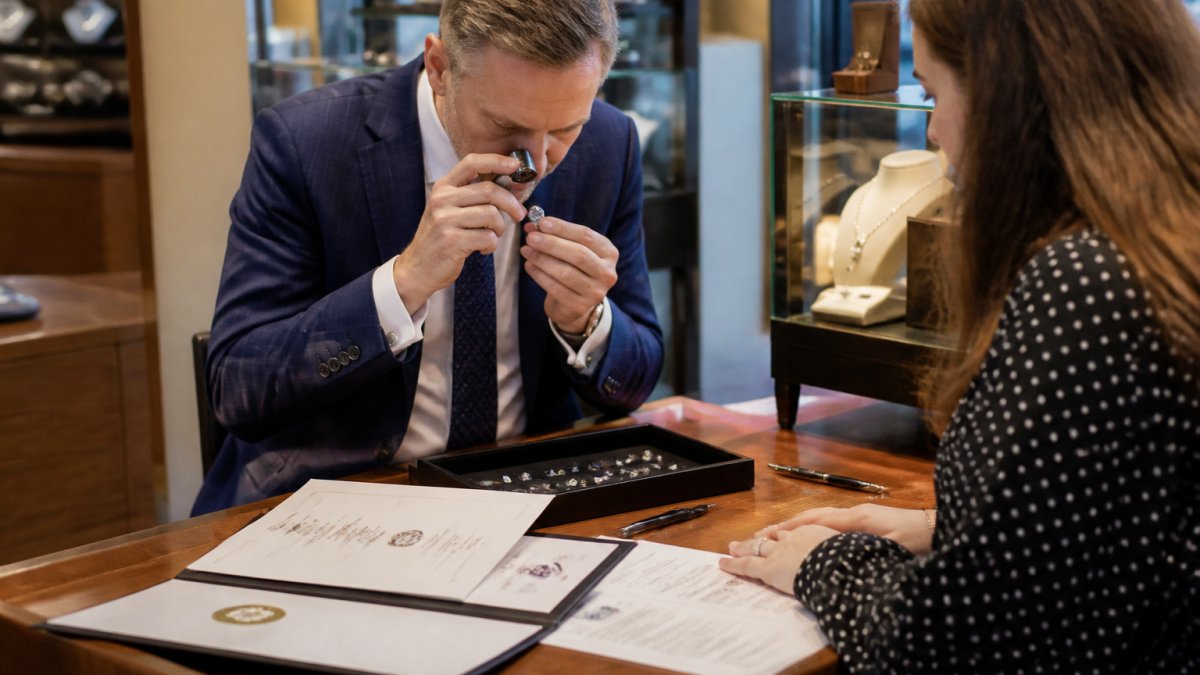
Without it, ethical claims are just words.
More than 70% of gemstones come from small-scale mines, according to Reflective Jewelry's ethical gemstones overview. Small-scale operations are harder to monitor than large industrial mines.
Traceability costs money, documentation, third-party audits and supplier relationships, which is why ethically sourced gemstones often cost more than stones with unknown origins.
Questions to Ask a Jeweller About Gemstone Sourcing
Before committing to a custom piece, ask specific questions that separate genuine ethical sourcing from marketing claims.
Start with the basics:
- Where did this gemstone come from? (Specific country or region, not just "ethically sourced")
- Can you provide documentation of its origin?
- Who verified this information, and how recent is that verification?
Then dig deeper:
- What certifications does this stone carry? (Look for third-party audits, not just supplier promises)
- Can you trace the supply chain from mine to your workshop?
- What standards do your suppliers follow for worker safety and fair wages?
Ask about alternatives:
- Would a lab-grown or recycled gemstone work for my design?
- What's the price difference between sourcing options?
- How long will each option take for my custom piece?
A good jeweller answers directly, admits what they don't know, explains the limits of their claims, and shows actual documentation. One who brushes off these questions or uses only marketing phrases is prioritising speed and profit.
Understanding Traceable Gemstones and Provenance Documentation
Traceable gemstones have documented proof of origin and journey through the supply chain; provenance documentation is the records that establish this proof. Think of provenance like a passport: it shows key checkpoints, not a continuous recording.
What each document can and cannot prove
- Mine certificate or origin declaration. Can prove: a stated country or region of extraction, often with an extraction date and initial assessment. Cannot prove: the labour conditions at the mine, whether the stated origin is accurate if the certificate was self-issued, or that the stone was not mixed with others after extraction.
- Chain-of-custody record. Can prove: a documented sequence of transfers between mine, dealer, cutter and jeweller, with named parties and dates. Cannot prove: that the goods in each transfer were the same goods, unless the record uses sealed parcels, unique identifiers or independent inspection at each handover.
- Supplier invoice and commercial paperwork. Can prove: a commercial transaction occurred and who sold to whom. Cannot prove: origin or ethical conditions. Invoices are commercial records, not ethical assurance.
Evidence standards: how to weigh what you are shown
A common pattern is that provenance evidence is strongest when it is specific, independent and recent. Use these tests:
- Specificity. Does the document name a country, region or mine, or does it say only "ethically sourced"? Vague language is a warning sign.
- Independence. Was the document created by the seller, or by a third party with no commercial interest in the sale? Self-certification carries less weight than independent audit.
- Recency. Is the verification dated within the last two to three years? Older records may no longer reflect current conditions.
- Continuity. Does the chain of custody run unbroken from extraction to your jeweller, or are there gaps where the stone changed hands without records?
- Scope. Does an audit cover the specific mine or facility, or only a trader's office? Site-specific evidence is stronger than desk-based assurance.
The limits of provenance, and how to handle uncertainty
Provenance documentation is not perfect. Many gemstones come from small-scale mines where formal record-keeping is absent, stones change hands many times, documents can be lost or falsified, and pooled supply chains make individual traceability difficult. Assess uncertainty honestly:
- Ask your jeweller to state plainly what is documented and what is not.
- Prefer stones where the evidence chain is short and the parties are named.
- Where full traceability is unavailable, ask what compensating checks exist, for example, membership of a recognised responsible-sourcing scheme, independent audit of the supplier, or a documented policy on conflict-free sourcing.
Look for recent verification dates, named auditors, specific geographic origins, and transparency about limitations. A jeweller who can explain the limits of their evidence is usually more reliable than one claiming certainty they cannot support.
Lab-Grown Gemstones: A Responsible Alternative
Lab-grown gemstones are created in controlled environments that mimic natural formation. They are chemically identical to mined stones but carry a different ethical profile, not automatically ethical, so compare them honestly.
How the four sourcing routes compare
- Responsibly mined natural stones. Traceability: variable, strong where a documented chain of custody exists, weak where stones pass through pooled small-scale supply. Labour: depends on the mine; independent audit is the main assurance. Environmental impact: land use, water use and rehabilitation are the key issues. Durability: unchanged natural material. Cost: typically the highest for comparable quality, and rising with stronger provenance requirements.
- Lab-grown stones. Traceability: generally the shortest and most verifiable chain, often to a specific facility and production date. Labour: no extraction labour, but facility working conditions and energy sourcing still matter. Environmental impact: energy-intensive production; the footprint depends on the electricity mix and process. Durability: same hardness and wear characteristics as natural stone of the same material. Cost: typically lower than comparable natural stones, though the gap varies by size and quality.
- Recycled or reclaimed stones. Traceability: often limited for the stone's original origin, even though the recent chain is known. Labour: no new extraction labour. Environmental impact: avoids new mining; the main footprint is re-cutting and re-setting. Durability: depends on the individual stone's condition and any earlier treatments. Cost: driven by the specific stone's quality and availability rather than a standard market price.
Gemstone-specific verification
Sourcing and disclosure risks vary by gemstone type, so tailor your checks:
- Diamonds. Confirm natural versus lab-grown with a laboratory report, and check treatment disclosure (for example, fracture filling or irradiation). Ask how the supplier evidences conflict-free sourcing.
- Sapphires and rubies. Heat treatment is common and should be disclosed; ask whether the stone is unheated and whether origin is stated on a laboratory report. Origin claims carry more weight when supported by a recognised laboratory.
- Emeralds. Treatments such as oiling or resin filling are common and materially affect value; disclosure is essential. Emerald is also more brittle, so setting and wear matter for a custom piece.
Cost and lead-time implications for a custom piece
Origin requirements, rarity, certification and small-batch sourcing affect price and availability:
Platinum 3 stone Oval Lab Grown Diamond Ring 1.6ct D vvs →
- Certification adds cost and time. Independent laboratory reports and audits carry fees and turnaround times, which are reflected in the stone price and the production schedule.
- Rarity constrains availability. A specific origin, unheated status or particular cut may mean waiting for the right stone rather than choosing from stock.
- Small-batch sourcing lengthens lead times. Sourcing a single traceable stone to a design brief takes longer than selecting from a parcel.
[Lab-grown stones suit buyers who prioritise a short, verifiable supply chain and predictable availability. Explore lab-grown diamond rings to see examples of ethically sourced options available for custom designs.](page:2) They are not automatically more ethical than a well-documented mined or recycled stone, the right answer depends on which trade-offs matter most to you. They are not automatically more ethical than a well-documented mined or recycled stone, the right answer depends on which trade-offs matter most to you.

At Morgan Banks, we help you weigh these trade-offs for your design brief, budget and timeline, and we explain what each sourcing option can and cannot evidence.
Recycled Gemstones: Reclaiming Beauty from Pre-Owned Stones
Recycled gemstones are recovered from pre-owned or vintage jewellery and repurposed into new designs, no mining, no new environmental impact, no extraction labour concerns.
Where do recycled gemstones come from?
- Inherited jewellery you no longer wear
- Vintage pieces from antique dealers
- Jewellery returned to retailers or refiners
SCS Global Services recommends considering previously owned stones that have re-entered the supply chain as one route to ethical jewellery sourcing.
The appeal is ethical and emotional: a diamond from your grandmother's ring adds meaning beyond physical beauty.
For a custom piece, recycled gemstones work best when you're flexible on specifications or willing to wait for the right stone.
Designing Your Ethically Sourced Custom Piece
Step 1: Define your vision and priorities
Step 2: Choose your sourcing approach
Decide between lab-grown, recycled, or responsibly mined gemstones. Each has different lead times, costs, and ethical profiles.
Step 3: Discuss design and specifications
Refine your design with sketches, 3D models or samples so your vision translates into reality before work begins.
Step 4: Request documentation
Ask your jeweller for provenance documentation or sourcing certificates for your chosen gemstone, these should come with your finished piece.
Step 5: Review and approve before production
Before crafting begins, confirm all specifications in writing to protect both you and the jeweller.
At Morgan Banks, we guide you through each step, selecting gemstones that align with your values and delivering a custom piece you'll treasure. Our Bespoke Jewellery Design guide walks you through the full process, and our Diamond and Precious Stone Jewellery collection shows ethically sourced options we work with.
Frequently Asked Questions
What makes a gemstone ethically sourced?
Ethical gemstone sourcing means the stone has been mined or produced with fair labour practices, safe working conditions, and environmental responsibility. It involves verifying that workers receive living wages, that mining doesn't damage ecosystems, and that the supply chain from mine to market is transparent. For custom jewellery, this means asking your jeweller for documentation proving the stone's origin and the practices used to extract or produce it.
How can I check where a gemstone comes from?
Request provenance documentation from your jeweller, including certificates from independent gemological laboratories and supplier declarations. Ask for the mine location, extraction date, and any third-party audits. For lab-grown stones, ask for production records. For recycled gemstones, request evidence of the stone's previous ownership history. Reputable jewellers maintain chain-of-custody records showing every step from source to your custom piece.
Are lab-grown gemstones more ethical than mined gemstones?
Lab-grown gemstones eliminate many mining risks, including habitat damage and unsafe working conditions. However, they require significant energy to produce. Mined gemstones can be ethical if sourced from responsible operations with fair labour practices and environmental controls. The choice depends on your priorities: lab-grown excels in environmental impact reduction, while responsibly mined stones support local livelihoods. Ask your jeweller for specific sourcing details for either option to make an informed decision.
Are recycled or antique gemstones a more sustainable choice?
Recycled and antique gemstones avoid new mining entirely, making them highly sustainable. They carry existing provenance and reduce environmental impact and carbon footprint associated with extraction and transport. However, older stones may lack modern certification. SCS Global Services recommends considering previously owned stones that have re-entered the supply chain as an ethical route to sourcing jewellery materials. Ask your jeweller to verify the stone's condition and authenticity before including it in your custom design.
Ethical gemstone sourcing for custom jewellery is no longer niche, it's becoming standard. When you commission a piece with Morgan Banks, you're choosing a jeweller committed to transparency, quality craftsmanship, and responsibility. We work with suppliers who document their sourcing, offer lab-grown and recycled options, and help you make choices aligned with your values. Start your custom commission with us today and create a piece with a story you're proud to tell.
