
Last Updated: November 3, 2026
Quick Summary
Platinum is the stronger choice for most diamond rings, since it is about 95% pure and needs little upkeep, while white gold is lighter and cheaper but its rhodium finish must be re-plated over time. The right pick depends on whether durability or budget matters more to you. In short, platinum vs white gold comes down to maintenance and price.
- Platinum is typically sold at 950 purity, meaning it is 95% pure platinum.
- White gold is usually sold in 18ct (75% gold) or 14ct (58.3% gold) strengths.
- White gold's bright white finish depends on rhodium plating that wears away over time.
- Platinum typically costs more than white gold because the metal is rarer and denser.
- White gold is generally easier and cheaper to resize than platinum.
Table of Contents
- Platinum vs White Gold: The Core Difference in Composition
- Durability and Wear Resistance: Which Metal Holds Up Better
- Rhodium Plating on White Gold: What It Is and How Often It Needs Renewing
- Platinum Ring Maintenance: Polishing, Patina and Long-Term Care
- Platinum vs White Gold Cost: Budgeting for Your Diamond Ring
- Skin Sensitivity, Colour Over Time and Stone Settings
- Choosing Your Metal: Side-by-Side Comparison and Next Steps
- Frequently Asked Questions
Choosing between platinum and white gold for a diamond ring is one of the first decisions most couples face, and it shapes the look, feel and upkeep of the ring for decades. At Peter George banks trading as Morgan Banks, we have been fine jewellers since 1935. Recent engagement ring research points to a clear pattern. According to Blue Nile's engagement ring metal preference statistics, platinum accounts for 17% of engagement rings, while 14k white gold accounts for 14%. Together, white metals make up nearly half of all rings, which is why the platinum vs white gold question comes up so often.
Platinum vs White Gold: The Core Difference in Composition
Platinum is a naturally white metal that is typically sold at 950 purity, meaning it is 95% pure platinum. White gold is not a natural metal at all. It is a blend of gold with white alloys such as nickel, palladium or silver, and it is usually sold in 18ct (75% gold) or 14ct (58.3% gold) strengths. This difference in composition drives almost every other difference between the two metals.
Because platinum is a single dense metal, it holds its shape well and feels weighty on the hand. White gold is lighter, which some wearers prefer for everyday comfort. Our 18ct white gold round brilliant engagement ring, for example, is priced at £1,100.00, while our platinum eternity band is priced at £1,610.00.

Durability and Wear Resistance: Which Metal Holds Up Better
Platinum and white gold wear in different ways, and understanding the difference matters more than a simple 'which is harder' verdict.
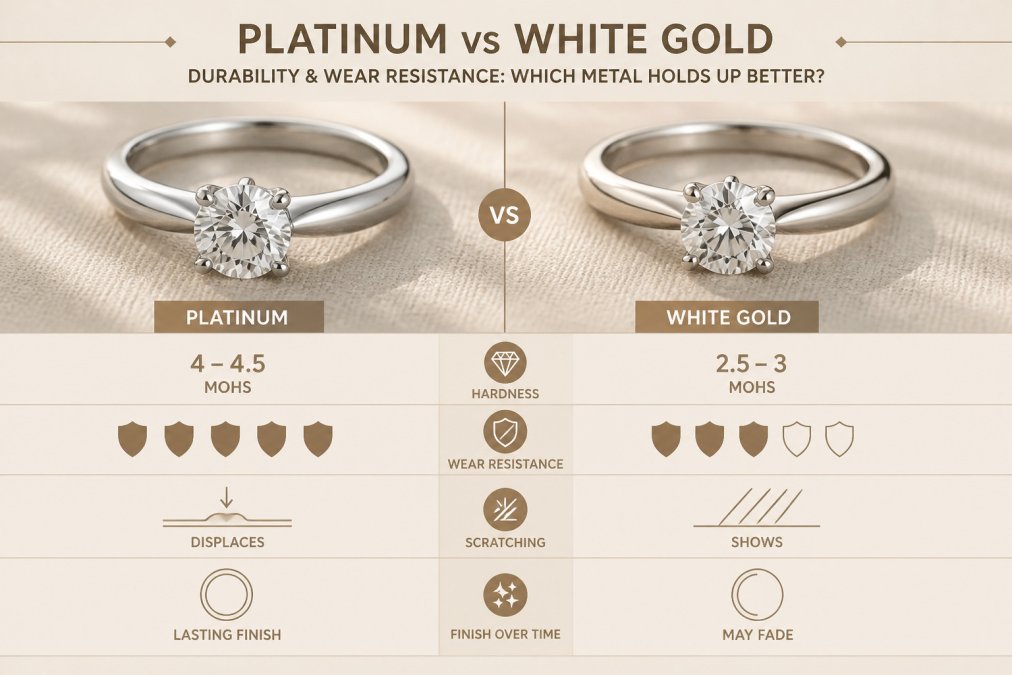
White gold behaves differently, and its bright white colour depends on a rhodium coating that wears away over time.
Platinum's density and malleability are also useful in stone settings, which is one reason it is often chosen for diamond rings.
If you expect your finger size to change, white gold is generally the more forgiving metal to resize, while platinum is often chosen for a ring that holds its shape with minimal intervention.
Visually, the two metals age differently. White gold's bright finish depends on a rhodium coating that can be renewed, while platinum's colour is inherent to the metal.
Rhodium Plating on White Gold: What It Is and How Often It Needs Renewing
Rhodium is a bright, silvery metal from the platinum group. Jewellers coat white gold with it to give the ring a brilliant white finish and to hide the faint yellow tone of the gold alloy. The plating is thin, so it wears away gradually, especially on the band and prongs where the ring meets everyday surfaces.
Rhodium plating wears over time with daily use, so white gold rings may need periodic re-plating. Platinum does not require rhodium. If you choose white gold, factor the cost of re-plating into your long-term budget.
Platinum 3 stone Oval Lab Grown Diamond Ring 1.6ct D vvs →
Platinum Ring Maintenance: Polishing, Patina and Long-Term Care
Platinum generally needs less active care than white gold, but routine cleaning and periodic professional checks of the setting remain sensible.
Platinum vs White Gold Cost: Budgeting for Your Diamond Ring
Platinum typically costs more than white gold because the metal is rarer and denser. Our 18ct white gold ring with a 0.60ct round brilliant diamond is £1,100.00. Prices depend on stone size and grade, so compare them with your own budget in mind. If you want help setting a realistic figure, our guide on how to calculate an engagement ring budget in the UK walks through the main factors.
Skin Sensitivity, Colour Over Time and Stone Settings
Some wearers react to one metal and not another, so skin sensitivity is worth considering when choosing between them.
Skin reactions relate to the alloy and skin chemistry rather than metal quality. If you have sensitive skin, it is worth asking about the alloy composition of any white gold ring before you buy.
Colour over time differs between the two metals. White gold's bright white comes from rhodium plating, which wears with use, so re-plating is a recurring rather than one-off cost.
Platinum's density and malleability are often valued in stone settings, particularly for diamonds of any significant size.
Resizing and repair logistics are the practical test. Platinum is harder to work at the bench, so a resize usually costs more and may take longer, but the join is strong and nearly invisible once polished. White gold is easier and cheaper to resize, though the rhodium finish must be reapplied to the resized area, so many jewellers quote a resize and re-plate as one job. If you expect your finger size to change, or you plan to pass the ring down and have it altered later, white gold is the more forgiving metal at the bench; if you want the ring to hold its shape and setting with minimal intervention, platinum is the stronger long-term choice.
Choosing Your Metal: Side-by-Side Comparison and Next Steps
| Factor | Platinum | White Gold |
|---|---|---|
| Composition | About 95% pure platinum | Gold alloyed with white metals |
| Maintenance | Polish and prong checks | Rhodium re-plating every 1-2 years |
| Colour over time | Softens to a satin patina | Can turn yellow as rhodium wears |
| Weight | Heavier, dense feel | Lighter feel |
| Typical cost | Higher | Lower |
If durability and a low-maintenance finish matter most, platinum is the stronger choice. If you prefer a lighter ring at a lower price and don't mind re-plating, white gold works well. Browse our platinum 3 stone oval lab grown diamond ring 1.6ct D vvs for a platinum option, or view our 18ct white gold round brilliant 0.60ct diamond engagement ring if white gold suits your plans better.

Frequently Asked Questions
Is platinum or white gold better for a diamond ring?
Neither is better in every case. Platinum is denser, naturally white and hypoallergenic, so it suits people who want a secure setting and minimal maintenance. White gold is lighter and generally costs less for the same design, but it is usually rhodium-plated to achieve its bright white finish, which wears over time and needs periodic renewal. For a diamond ring, the best choice depends on your budget, skin sensitivity and how much upkeep you are willing to do.
Does white gold need replating?
Most white gold rings are finished with rhodium plating, a thin layer that gives a bright white colour. This coating gradually wears away with daily use, and the ring may take on a slightly yellowish tone as the underlying gold shows through. Re-plating with rhodium restores the original finish and is usually a routine jeweller service. Platinum does not require rhodium plating to look white, so it does not need this renewal.
Does platinum scratch more easily than white gold?
Platinum is a dense metal that does not lose material when scratched; instead it displaces, which creates a fine surface wear that develops a soft satin look called patina. White gold is harder in alloy form, but its rhodium coating can scratch and wear through. Over time, both metals show wear, but platinum's marks are not lost metal, so the ring keeps its weight and setting security. Regular polishing keeps either metal looking its best.
Is platinum more expensive than white gold?
Platinum generally costs more than white gold for an equivalent ring, reflecting the higher price of the raw metal and the greater density of the material used. Platinum rings are also heavier, which affects the overall price. Prices vary with the diamond, setting style and carat weight, so compare final quotes for identical specifications. Our current examples include a platinum three-stone lab-grown diamond ring at £2,250.00 and an 18ct white gold round brilliant 0.60ct diamond ring at £1,100.00.
