
Table of Contents
- What Luxury Watch Repair Services in Cumbria Actually Cover
- Luxury Watch Servicing: Mechanical vs Quartz Movements
- Common Repairs: Batteries, Glass, Straps and Case Work
- Vintage Watch Restoration and Brand-Specific Capability
- Watch Service Cost UK: What Drives the Price
- Watch Repair Turnaround Time and What to Expect
- Watch Repair Warranty, Guarantees and Safe Custody
- Conclusion
- Frequently Asked Questions
Last Updated: October 19, 2026
What Luxury Watch Repair Services in Cumbria Actually Cover
Luxury watch repair services in Cumbria cover far more than a battery swap. A proper service includes movement diagnosis, cleaning and lubrication, case and bracelet refinishing, water-resistance testing and accuracy regulation. At Morgan Banks, we have handled fine jewellery and timepieces from our Kendal base since 1935.
Here is the thing most people get wrong: they judge a repair by what it costs and how fast it comes back. Both matter, but neither tells you whether the work was done properly.
Below, we break down what each service tier actually involves, what drives the price, and how to judge a provider.
Luxury Watch Servicing: Mechanical vs Quartz Movements
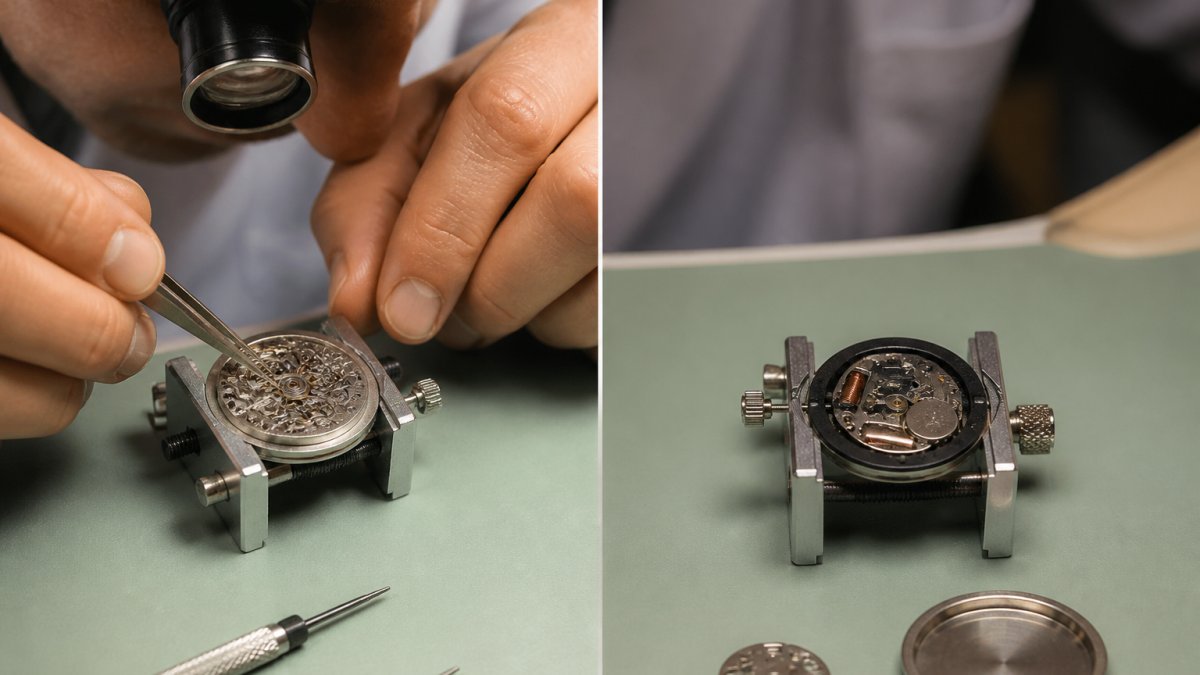
Mechanical and quartz watches need completely different servicing. A mechanical movement needs full disassembly, cleaning, lubrication and regulation. A quartz watch usually needs a battery, gasket check and a circuit test, and only occasionally a movement swap.
Mechanical watches are the demanding ones. Hundreds of tiny components wear against each other, and old oil turns gummy over time. A full movement service strips the watch down, cleans every part, re-oils it to spec and rebuilds it. That is why a mechanical service costs more and takes longer.
Quartz watches are simpler but not maintenance-free. Battery leakage is the quiet killer. Leave a dead battery in a drawer for a year and the acid can eat into the circuit board, turning a cheap job into an expensive one.
Common Repairs: Batteries, Glass, Straps and Case Work
Battery replacement is the fastest job in the workshop, usually a while-you-wait task for a quartz watch. Glass and crystal replacement sits in the middle: a scratched crystal can often be swapped without touching the movement, but a cracked one needs a pressure test afterwards. Case and bracelet work is the slowest.
Straps are the simplest decision. Leather wears out and gets replaced. Steel bracelets are another matter: stretched links and worn pins need rebuilding, not just polishing.
Case work deserves a warning. Polishing removes metal, and every polish takes a little more off the case. Over-polish a vintage piece and you round off the very edges that give it character and value.
Vintage Watch Restoration and Brand-Specific Capability
Vintage restoration is a different discipline from routine servicing. It asks the workshop to preserve originality while making the watch run again. That means sourcing period-correct parts, matching patina rather than erasing it, and knowing when to leave a dial alone.
The practical test is documentation. A serious restorer will photograph the movement and case before work begins, list every part replaced, and return the original components to you. Ask for that paper trail up front. If a workshop cannot tell you which parts it intends to replace and which it intends to conserve, it is not restoring, it is refurbishing.
Brand capability matters just as much, and it is where most generic service pages stay vague. Rolex, Tudor, Omega, TAG Heuer, Cartier and Zenith all have their own movement architectures, parts channels and tolerances. A workshop that handles a Rolex calibre every week will approach it differently from one that sees one a year.
Here is what that difference looks like in practice:
- Rolex and Tudor. Modern calibres use proprietary parts and tight regulation tolerances. Independent workshops can service them, but genuine parts supply is restricted, so ask whether parts are sourced through authorised channels or from donor movements. For watches still under manufacturer guarantee, an unauthorised service can affect your standing with the brand, check before you commit.
- Omega. Co-Axial movements require specific lubrication and adjustment procedures. A workshop without Co-Axial experience may return a watch that runs but does not perform to specification.
- TAG Heuer. Broad calibre range from entry quartz to in-house automatic. Quartz TAGs are straightforward; in-house automatics need the right parts channel.
- Cartier. Many models are jewellery-first, movement-second. Case and bracelet refinishing must protect the finish and hallmarks, not just the movement.
- Zenith. High-frequency El Primero movements are unforgiving of poor regulation. Ask directly whether the workshop has regulated an El Primero before.
Authorisation is the other half of the question. Manufacturer-authorised service preserves your guarantee and uses genuine parts, but it usually means the watch travels to a brand service centre and turnaround runs longer. Independent service can be faster and more personal, but parts sourcing and guarantee implications vary. Neither is automatically better, but you should know which one you are buying.
Ask a direct question before you commit: which brands do you service regularly, can you source genuine parts for mine, and is the work manufacturer-authorised or independent? A vague answer is your answer.
Watch Service Cost UK: What Drives the Price
Watch service cost in the UK is driven by four things: movement type, parts availability, case condition and brand. There is no single price list, and any provider who quotes one without seeing the watch is guessing.
Here is how the drivers stack up:
| Cost Driver | What It Means | Effect on Price |
|---|---|---|
| Movement type | Mechanical vs quartz | Mechanical costs more |
| Parts availability | Genuine vs pattern parts | Rare parts push cost up |
| Case condition | Scratches, dents, wear | More refinishing, more cost |
| Brand complexity | Movement architecture | Premium brands cost more |
| Water resistance | Gasket and seal renewal | Adds a testing step |
Our advice is simple: insist on a written quotation after diagnosis, not before. Pricing depends on the assessment. For current pricing on our watch services, check our website or ask in store.
Watch Repair Turnaround Time and What to Expect
Watch repair turnaround time depends entirely on the job. A battery or strap change can be done while you wait. A crystal replacement may take a few days. A full mechanical service or vintage restoration can run to several weeks, largely because parts have to be ordered and the movement needs time to settle and be regulated.
The mistake is comparing a two-week service with a two-day one and assuming the faster workshop is better. It usually is not. Speed on a mechanical service often means skipped steps.
Ask three questions before you leave the watch:
- What is the estimated turnaround, and what could extend it?
- Will you contact me if the diagnosis changes the quote?
- Do you test water resistance and accuracy before handover?
A provider who answers all three clearly is one worth trusting.
Watch Repair Warranty, Guarantees and Safe Custody
A watch repair warranty should cover both the workmanship and any parts fitted. Ask how long it runs, what it covers and what voids it. Water damage after a reseal, or damage from a knock, is usually excluded, and that is reasonable.
What separates a strong guarantee from a weak one is specificity. A credible workshop will tell you, in writing:
- the guarantee period for workmanship, and whether it differs for parts;
- whether the guarantee is transferable if you sell the watch;
- what evidence is needed to make a claim (receipt, service record, photographs);
- which events void it, typically impact damage, water ingress after a reseal, unauthorised third-party intervention, and normal wear;
- whether re-regulation or a follow-up accuracy check is included in the price.
If any of those is answered with a shrug, treat it as a warning. A guarantee that cannot be described precisely is difficult to enforce.
Safe custody matters just as much, and this is where most service pages go quiet. Your watch should be logged on arrival, make, model, serial number, condition notes and any existing marks, stored securely and insured while it is with the workshop. Ask what insurance cover the business holds for customer property, and whether it covers the full replacement value of your watch or a capped amount. A jeweller's block policy may cap individual items; if your watch exceeds that cap, you need to know before you hand it over.
If you are posting a watch, the practical safeguards are straightforward but easy to skip:
- Use a tracked, insured postal service and declare the full value. Royal Mail Special Delivery Guaranteed by 1pm includes consequential loss cover up to a stated limit, check the current limit against your watch's value, because high-value pieces often exceed it and need separate cover.
- Photograph the watch, the packaging and the sealed parcel before dispatch, and keep the receipt and tracking number.
- Ask the workshop to confirm receipt in writing on the day it arrives, and to confirm the watch is insured from that point.
- Agree in advance who bears risk in each leg of transit, outbound, in the workshop, and return.
- Request that the watch is returned by a signed-for, insured service, not a standard parcel.
At Morgan Banks, we have built our reputation on careful handling of high-value pieces since 1935.
Conclusion
The real challenge with luxury watch repair is not finding someone who will take the job. It is finding someone who will diagnose it properly, quote honestly and stand behind the work.
That is where we come in. Morgan Banks has served Cumbria from Kendal since 1935, combining a fine jewellery heritage with a curated collection of previously enjoyed luxury timepieces and expert watch handling. Bring your watch in, and we will assess it, explain exactly what it needs and give you a clear quotation before any work begins. Get started with Morgan Banks and give your timepiece the care it deserves.
Frequently Asked Questions
Where can I get a luxury watch repaired in Cumbria?
Cumbria has a small number of independent jewellers and watchmakers who handle luxury watch repair, with Kendal and Carlisle among the main centres. Look for a workshop that is BHI-accredited or time-served, can name the brands it services, and offers a written quotation before work starts. Ask whether servicing is done in-house or sent away, and confirm what watch repair warranty covers the workmanship. A short conversation about diagnosis, parts sourcing and timescales tells you quickly whether a provider is set up for mechanical watches rather than just battery swaps.
How much does a luxury watch service cost in the UK?
Watch service cost UK varies widely by movement type, brand and condition. A straightforward quartz service sits at the lower end, while a full mechanical strip-down, clean, lubrication and regulation costs more, and chronographs or complicated movements cost more again. Brand authorisation and genuine parts add to the figure. Because pricing depends on the specific watch and what the diagnosis finds, ask for an itemised quotation covering labour and parts separately, and check whether pressure testing and a new gasket are included or charged as extras.
How long does watch repair turnaround time usually take?
Watch repair turnaround time depends on the job. Battery replacement and strap fitting can often be done while you wait, glass and crystal replacement may take a few days to a couple of weeks if a part is ordered, and a full mechanical service commonly runs from several weeks to a few months, especially where the watch goes to a brand service centre. Ask for an estimated completion date in writing and confirm whether the provider will contact you if parts delays push it back.
Is an independent watchmaker better than an authorised service centre?
Both have a place. An authorised service centre guarantees genuine parts and keeps a manufacturer's warranty intact, which matters for recent or high-value pieces. An independent watchmaker can be quicker, more personal and often cheaper, and is frequently the better route for vintage watches where brand support has lapsed. Check the watch repair warranty offered either way, ask how water resistance is restored and tested after the work, and confirm the provider's experience with your specific brand before committing.