
Table of Contents
- Why the 5% Newsletter Discount Is the Smartest First Move
- How to Claim Your 5% Discount: A Step-by-Step Newsletter Guide
- Engagement Ring Buying Guide 2024: The 4 Cs and Ring Sizing
- How to Choose a Diamond Engagement Ring: Settings, Metals and Certification
- Budgeting for an Engagement Ring: What Your 5% Saving Actually Buys
- Bespoke Engagement Ring Consultation: What to Expect
- Discount Stacking and the Fine Print: What the 5% Offer Excludes
- Conclusion
- Frequently Asked Questions
Last Updated: September 15, 2026
Why the 5% Newsletter Discount Is the Smartest First Move
A 5% saving is often the easiest discount an engagement ring guide will ever point you toward. The best 5% discount on first purchase via newsletter subscription for engagement ring guidance costs nothing but an email address and applies before any negotiation or sale begins. Claim it first, then spend the saving on a better cut grade or a heavier band.
An engagement ring is a considered purchase, and the difference between a 0.70ct and a 0.80ct stone at the same quality is frequently smaller than buyers expect. A first-order incentive applied at the start quietly widens the specification you can afford. The Competition and Markets Authority guidance on misleading pricing is clear that promotional offers must be genuine and clearly explained, so a legitimate newsletter discount should be stated plainly, with its terms visible before you subscribe.
How to Claim Your 5% Discount: A Step-by-Step Newsletter Guide
Claiming the discount follows a predictable path: subscribe, confirm, receive the code, then apply it at checkout, before you browse in earnest.
Checking Your Eligibility Before You Subscribe
Most offers apply to new subscribers and first-time customers only. Read the eligibility criteria on the sign-up form, and check whether the offer excludes sale items, gift cards or made-to-order commissions. Subscribing with an email address already on the retailer's list can disqualify the discount before you start.
Three eligibility traps catch buyers most often:
- Shared email addresses. If a partner, flatmate or family member has already subscribed from the same address, the retailer's system may treat you as an existing contact. Use an address that has never been on the list.
- Previous abandoned baskets. Some retailers link the discount to a customer record rather than an email address, so a past order, even a cancelled one, can disqualify you.
- Business or trade accounts. If you have ever bought through a trade or wholesale channel, the consumer first-order offer may not apply.
If unsure, ask customer service before subscribing, a two-minute question that prevents a wasted sign-up.
Redeeming Your Code at Checkout
Redemption is usually a single field at the payment stage, but apply the code before entering payment details, some checkout systems lock the promotional field once a payment method is attached.
- Subscribe using an email address you actually check
- Confirm your subscription via the verification email
- Save the discount code somewhere you will find it again
- Add your chosen ring to the basket
- Enter the code in the promotional field before payment
- Check the order total updates to reflect the 5% reduction
- Complete checkout and keep the confirmation email
Why Your Code Might Not Work, and What to Do
If the code does not reduce the total, check these five causes first:
- The item is excluded. Sale pieces, gift cards, loose stones and some bespoke commissions are commonly outside the offer. Try the code against a full-price item to confirm the code itself is valid.
- The code has expired. First-order codes often carry a validity window of 30 to 90 days from issue. Check the expiry date in the welcome email, not the sign-up page.
- The code has already been used. Most codes are single-use and tied to one customer record. If you have placed any order since subscribing, the code may already be spent.
- The basket contains a mix of eligible and ineligible items. Some systems reject the code entirely rather than applying it only to eligible lines. Remove the excluded item and reapply.
- The code was entered with a typo or trailing space. Copy and paste rather than typing, and check for a space at the end.
If none of these resolve it, contact the retailer before paying. A discount applied after purchase is usually honoured as a refund or credit note, but it is far easier to fix at the basket stage.
Timing the Sign-Up Around Your Purchase
Sign up too early and the code may expire before you buy; too late and the saving cannot shape your shortlist. Subscribe once you have a rough budget and a sense of the styles you like, but before committing to a specific stone.
Engagement Ring Buying Guide 2024: The 4 Cs and Ring Sizing
The 4 Cs, cut, colour, clarity and carat weight, remain the standard framework in any engagement ring guide for judging diamond quality and the fastest way to compare two stones honestly. Cut grade governs how much light the diamond returns, so it has the greatest effect on how lively the stone looks. Colour runs from colourless downward, clarity describes how few inclusions are visible under magnification, and carat weight is the mass of the stone.
Ring sizing deserves equal attention, because a resized band is never quite the same as one made to fit.
- Cut grade: the most important factor for sparkle; prioritise it over carat
- Colour: near-colourless grades look identical to the eye in most settings
- Clarity: inclusions invisible at arm's length rarely justify a premium
- Carat weight: the visible size depends on cut and shape, not weight alone
For sizing, have the finger measured at the end of the day, when fingers are at their largest, and measure the correct hand. A ring that fits in the morning can feel tight by evening. The Gemological Institute of America's guide to the 4Cs explains each characteristic in detail if you want to go deeper before viewing stones.
How to Choose a Diamond Engagement Ring: Settings, Metals and Certification
Choosing a diamond engagement ring comes down to three decisions: the shape of the stone, the setting that holds it, and the metal it sits in. Getting the combination right matters more than chasing the largest stone in the case.
Shape is largely taste, but it has practical consequences: emerald cuts show clarity and suit buyers who prefer clean lines, while round brilliants hide inclusions better and return more light. Settings follow, a solitaire focuses on the centre stone, a halo adds apparent size for less money, and a trilogy spreads weight across three stones for a broader look.
Metals are a durability question as much as a colour one.
| Decision | Options | Best For |
|---|---|---|
| Shape | Emerald cut, oval, round brilliant | Emerald for clean lines, round for maximum sparkle |
| Setting | Solitaire, halo, trilogy | Solitaire for focus, halo for apparent size |
| Metal | Platinum, 18ct yellow gold | Platinum for durability, gold for warmth |
| Certification | GIA, IGI reports | Any independent laboratory report |
Budgeting for an Engagement Ring: What Your 5% Saving Actually Buys
| Ring | Price | 5% Saving | What It Could Fund |
|---|---|---|---|
| Platinum 3 stone oval lab grown, 1.6ct | £2,250 | £112.50 | A higher clarity grade in the centre stone |
| 18ct yellow gold 3 stone emerald cut, 3.50ct total | £3,150 | £157.50 | A larger shoulder stone or upgraded setting |
| Platinum emerald cut, 0.70ct with diamond shoulders | £7,995 | £399.75 | A meaningful step up in carat weight |
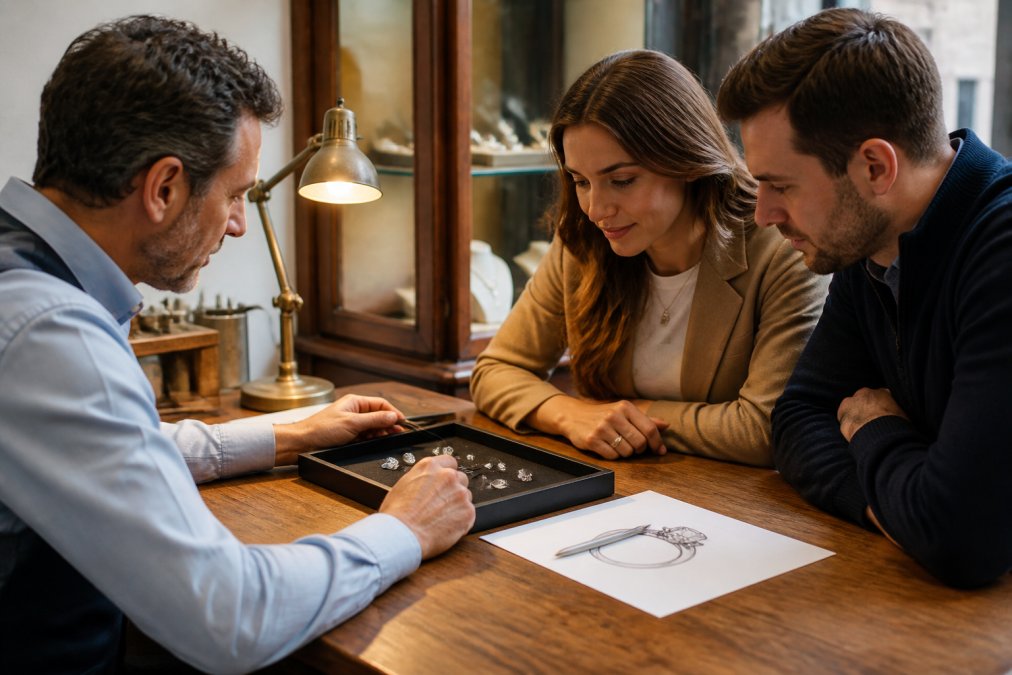
Bespoke Engagement Ring Consultation: What to Expect
Discount Stacking and the Fine Print: What the 5% Offer Excludes
What the Fine Print Usually Excludes
Can You Stack the Newsletter Code with Other Discounts?
The Psychology of the First-Purchase Discount
A Quick Checklist Before You Rely on the Code
Conclusion
Frequently Asked Questions
How do I get 5% off my first engagement ring purchase?
Subscribe to the retailer's newsletter before you buy. You will receive a first order incentive code by email, usually within minutes. Apply it at checkout to take 5% off your first purchase. Read the eligibility criteria first, because some offers exclude bespoke commissions, sale items or pre-owned watches. If you are planning a bespoke engagement ring, confirm with the team that the code applies before you pay a deposit.


Are online engagement ring discounts legitimate?
Genuine newsletter discounts come directly from the retailer's own website, not from third-party code sites. A legitimate offer states the discount value, the expiry date and the exclusions in writing. Check that the retailer is a registered business with a physical presence and a returns policy. If a code demands payment details before you have chosen a ring, treat it as a red flag. A 5% offer on a £2,250 ring saves £112.50, so it is worth verifying.
Can I stack my 5% newsletter discount with other offers?
Most jewellers allow one promotional offer per transaction, so the 5% newsletter code usually cannot be combined with seasonal sales or clearance pricing. The smart approach is to compare the total: a 5% code on full-price stock may beat a 10% sale discount on a ring you do not want. Ask the team directly which combination gives you the lower final price before you commit.
What should I look for when buying an engagement ring for the first time?
Focus on the 4 Cs: cut grade, carat weight, colour and clarity. Cut matters most because it controls how the diamond handles light. Confirm the ring comes with a gemological report from GIA or IGI, and check the metal, whether platinum or 18ct gold. Get your finger size measured properly, ideally at the end of the day when fingers are largest. Set a budget first, then let the specification follow.