
Table of Contents
- Bespoke vs Off-the-Shelf Jewellery: The Core Differences
- Quick Comparison: Bespoke vs Off-the-Shelf
- Custom-Made Jewellery Cost: What You Actually Pay For
- The Bespoke Jewellery Design Process Explained
- Bespoke Jewellery Timescale: How Long Does It Take?
- Bespoke vs Off-the-Shelf Engagement Rings: Which to Choose?
- Quality, Warranty, and Aftercare: What to Expect
- Conclusion: Making the Right Choice for You
- Frequently Asked Questions
Last Updated: October 13, 2026
Bespoke vs Off-the-Shelf Jewellery: The Core Differences
Choosing between bespoke vs off-the-shelf jewellery comes down to one question: do you want a piece designed around you, or a finished design you can take home today? Bespoke jewellery is made to order for one individual client, while off-the-shelf jewellery is a ready-made design produced in multiples.
Here is the part most comparison guides skip. The gap is not simply "expensive versus affordable". It is control versus convenience, and the right answer changes depending on the occasion, the timeline, and how much the piece needs to mean.
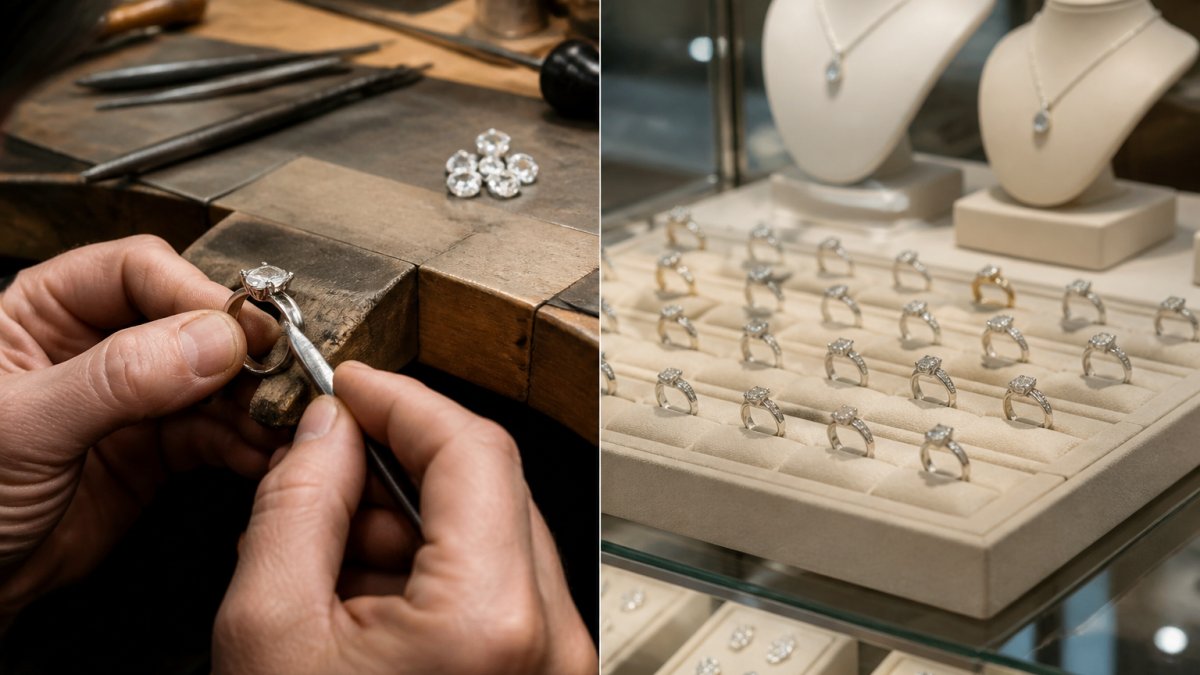
What Bespoke Jewellery Means
Bespoke jewellery is a piece designed and made for one individual client, from the first sketch through to the finished item. You choose the precious metals, the gemstones, the setting, and the fit.
The trade-off is time and cost. A bespoke commission involves a jewellery designer, a design consultation, and a production window measured in weeks rather than minutes.
What Off-the-Shelf Jewellery Means
Off-the-shelf jewellery is a ready-made design, produced in multiples and available to buy immediately. You select from an existing design, pay, and wear it the same day.
Off-the-shelf pieces suit gift buyers, anyone working to a short deadline, and shoppers who want a recognised brand name. Personalisation is usually limited to sizing or engraving rather than the design itself.
Quick Comparison: Bespoke vs Off-the-Shelf
The table below summarises the practical differences at a glance.
| Factor | Bespoke | Off-the-Shelf |
|---|---|---|
| Design control | Full, unique design | Existing design only |
| Lead time | Weeks | Immediate |
| Cost | Higher, reflects labour and materials | Lower, fixed price |
| Gemstone choice | Selected to your requirements | As produced |
| Fit and sizing | Made to your measurements | Standard sizes, adjustable |
| Best for | Engagement rings, milestone pieces | Gifts, quick purchases, brand favourites |
Custom-Made Jewellery Cost: What You Actually Pay For
Custom-made jewellery cost reflects four things: materials, design time, labour, and the risk the jeweller carries while making a one-off piece. Off-the-shelf prices spread those costs across many identical pieces, which is why the price tag is lower. The honest comparison is not "expensive versus affordable" but "what is included at each price point".
A Like-for-Like Cost Breakdown
Most guides say bespoke costs more and stop there. Here is where the money actually goes, so you can compare quotes properly.
- Precious metal: priced by weight at the day's metal rate, plus a fabrication charge. A platinum band uses more grams than the same design in 18ct gold, so the metal line alone can differ by hundreds of pounds between two otherwise identical commissions.
- Gemstone: the largest single variable. A certified natural diamond, a lab-grown diamond, and a coloured gemstone of similar visual size can sit in very different price bands. Ask for the stone's carat, cut, colour, and clarity, and whether it is certified.
- Design fee: covers sketches, CAD renders, and revisions before production. Some jewellers waive it against the final invoice; others charge it separately and non-refundably. This is the line most first-time buyers forget.
Realistic Example Budgets
Rather than vague claims, here is how the layers stack up at different levels. These are illustrative ranges, not quotes:
| Budget band | What it typically buys |
|---|---|
| Under £500 | Silver or gold-plated off-the-shelf pieces; a simple bespoke silver or 9ct gold band with a small stone |
| £500-£1,500 | Off-the-shelf 9ct or 18ct gold with a modest natural or lab-grown stone; a straightforward bespoke ring in 9ct gold |
| £1,500-£4,000 | Bespoke 18ct gold or platinum with a certified lab-grown or mid-range natural diamond; more complex settings |
| £4,000+ | Bespoke platinum with a larger certified natural stone, hand engraving, or multiple stones |
For a sense of scale on our own shelves, off-the-shelf pieces start at £65 for a silver and amethyst pendant necklace and £125 for a gold-plated ring, while a bespoke platinum engagement ring sits at £1,900 and upwards depending on the stone. That range is the clearest illustration of the difference.
Questions to Ask Before You Commit
- Is the design fee separate, refundable, or credited against the final invoice?
- How many design revisions are included, and what does an extra revision cost?
- Is the gemstone certified, and by whom?
The Bespoke Jewellery Design Process Explained
The bespoke jewellery design process follows a set path: consultation, design, approval, production, and collection. Each stage exists to reduce the risk that the finished piece does not match what you imagined. What most guides leave out is how the approval mechanics actually work, and what your rights are if something goes wrong.
Stage 1: Consultation
A conversation about the occasion, your budget, the style you have in mind, and any deadline. Bring photos of pieces you already love, the wearer's ring size if known, and a clear upper budget. A good designer will tell you early whether your budget and your ambition are compatible.
Stage 2: Design and Visualisation
The designer produces sketches, and for most commissions a CAD (computer-aided design) render so you can see the piece from multiple angles before any metal is cut. For complex or sculptural pieces, a wax model or resin print may be produced so you can hold a physical version. Ask which of these are included and which are charged separately.
Stage 3: Approval and Revisions
This is the safety net of the whole process. Nothing is made until you have seen and signed off the design. Ask upfront how many revisions are included, because that detail varies between jewellers, some include two or three rounds, others charge per revision after the first. Get the revision policy in writing.
Stage 4: Deposit and Production
Most jewellers take a deposit at approval, commonly in the region of 50%, with the balance due on collection. The deposit covers materials and the start of production. Once the metal is cast or the stone is set, changes become difficult or impossible, so treat approval as the point of no return.
Stage 5: Collection and Final Check
Before you accept the piece, check the hallmark, the stone certification, the setting security, and the fit. If the finished piece differs from the approved design in a material way, raise it immediately and in writing.
Permanent Jewellery Appointment £10 Deposit →
What Happens If the Finished Piece Differs From Expectations
This is the question almost no comparison guide answers. Under the Consumer Rights Act 2015, goods must be of satisfactory quality, fit for purpose, and as described. For a bespoke commission, the approved design and written specification form part of that description. If the finished piece does not match what was agreed, you have the right to ask the jeweller to put it right, and if that is not possible, to a remedy such as a refund or price reduction.
Remote Commissions
If you are not local, the process can often be handled remotely, with designs shared digitally and approved by email before production. Ask how the final fit will be confirmed, and whether a sizing ring or a home measurement kit is provided.
Bespoke Jewellery Timescale: How Long Does It Take?
A bespoke jewellery timescale typically runs from a few weeks to a couple of months, depending on the complexity of the design and the availability of your chosen gemstone. Off-the-shelf pieces are available immediately.
The clock does not start until design approval. Consultation and revisions can add time at the front end, and special-order stones can add time in the middle.
| Stage | Typical Duration |
|---|---|
| Consultation and design | 1-2 weeks |
| Approval and revisions | A few days to 2 weeks |
| Production and setting | 3-6 weeks |
| Collection or delivery | 1-3 days |
Bespoke vs Off-the-Shelf Engagement Rings: Which to Choose?
For engagement rings, bespoke usually wins on meaning and fit, while off-the-shelf wins on speed and certainty of price. The right choice depends on how much the ring needs to reflect a specific story.
An engagement ring is worn every day for decades, which is why so many couples choose to have it made rather than bought. But there are honest reasons to go the other way too.

When Bespoke Wins
- You want a one-of-a-kind design with personal meaning
- You have a specific gemstone, cut, or setting in mind
- The wearer has a ring size that standard sizing does not suit well
When Off-the-Shelf Wins
- The proposal is imminent and you cannot wait
- You want a fixed, known price with no design fee
- You prefer a recognised brand design you have already seen and tried on
- The piece is a gift where the exact design matters less than the gesture
Quality, Warranty, and Aftercare: What to Expect
Quality, warranty, and aftercare should be confirmed in writing before you buy, for both bespoke and off-the-shelf pieces.
For bespoke commissions, check whether the quote includes a warranty on workmanship and a first resizing.
Our own bespoke engagement rings are supplied with certification details for the stones, and our appointment-based service means you can examine the piece in person before it leaves the workshop.
Conclusion: Making the Right Choice for You
The real choice is not which option is better, but which one matches your occasion, timeline, and budget. Bespoke gives you a unique design and a perfect fit; off-the-shelf gives you immediacy and a fixed price.
If you are planning an engagement or a milestone gift, we would start with a conversation. At Morgan Banks, we have been making and selling fine jewellery since 1935, we specialise in bespoke commissions and engagement rings, and we carry a curated range of ready-made pieces from brands including Thomas Sabo and ChloBo.
Frequently Asked Questions
What does bespoke mean in jewellery?
Bespoke jewellery is made to order from scratch, designed around your specific requirements. You choose the metal, gemstone, setting, and size, and a jewellery designer creates a unique design for you alone. Unlike ready-made jewellery, no piece exists until you commission it. This means the finished piece reflects your personal taste and can be tailored to fit exactly, from ring size to stone selection.
How much does bespoke jewellery cost compared to off-the-shelf?
Bespoke jewellery typically costs more because of the design fee, individual craftsmanship, and made-to-order production. For example, a platinum three-stone oval lab-grown diamond ring at 1.6ct is £2,250, while a mass-produced gold-plated ring can cost £125. The gap reflects materials, stone quality, and the hours a jeweller spends on your piece. Off-the-shelf pieces benefit from economies of scale, but you sacrifice personalisation and unique design.
How long does bespoke jewellery take to make?
Production time for bespoke jewellery usually runs from four to eight weeks, depending on the complexity of the design, stone sourcing, and the jeweller's workload. The bespoke jewellery design process includes consultation, sketches or 3D models, design approval, and crafting. Off-the-shelf jewellery is available immediately or within days. If you have a fixed date, such as a proposal or wedding, always confirm the bespoke jewellery timescale before committing.
Can you customise off-the-shelf jewellery?
Some off-the-shelf pieces can be adjusted, for example resizing a ring or engraving a message. However, you cannot change the fundamental design, metal, or gemstone. True personalisation requires a bespoke commission. If you want a unique design that reflects personal meaning, bespoke is the better route. If you only need a small tweak, such as sizing or a charm addition, off-the-shelf may work.
Is bespoke jewellery worth the extra cost?
Bespoke jewellery is worth it when you want a one-of-a-kind piece, specific materials, or a perfect fit that ready-made jewellery cannot offer. It also gives you control over ethical sourcing and traceability. For engagement rings and wedding bands, where personal meaning matters, many couples find the extra cost justified. For fashion pieces or gifts where trends change, off-the-shelf offers better value and convenience.