
Quick Summary
Antique jewellery restoration needs an expert because older pieces were often hand-made from softer metals, original stones and fragile joints that behave differently from modern work. Restorers assess each piece under magnification before touching it, since a repair or clean that suits a modern piece can quietly damage an antique one.
- Antique pieces are often a century old or more, and their age changes how they must be handled.
- Older gold and silver are often thinner and softer than modern castings.
- Never clean or polish an antique piece before it has been assessed.
- Ultrasonic cleaners can dislodge settings on pieces with loose stones or soft pearls.
- Restoration follows six steps: assess, plan, stabilise, repair, finish and check.
Table of Contents
- What Makes Antique Jewellery Different From Modern Pieces
- How Experts Assess an Antique Piece Before Touching It
- The Damage That Calls for Specialist Intervention
- Antique Ring Repair: Why Shank, Prong and Setting Work Is Delicate
- Antique Jewellery Cleaning: Where Home Methods Go Wrong
- Inside the Jewellery Restoration Process, Step by Step
- Frequently Asked Questions
- Booking Your Heirloom Assessment at Morgan Banks
What Makes Antique Jewellery Different From Modern Pieces
Antique jewellery is not just old modern jewellery. It was often made by hand, with metals and stones that behave differently from what a modern workshop uses, which is why antique jewellery restoration calls for specialist knowledge. Many pieces are a century old or more, and that age changes everything about how they should be handled.
Restoration costs are shaped by four main drivers: metal work, stone work, finishing, and specialist labour. A simple cleaning and a full rebuild can sit at opposite ends of that scale. LÖF guide to antique jewellery restoration costs
Older pieces also carry history. Restoring them means balancing traditional techniques with modern conservation principles, so that the piece still looks like itself afterwards. Taylor Made Jewelry guide to antique restoration
Here is what usually sets antique work apart:
- Hand-finished metal: Older gold and silver are often thinner and softer than modern castings.
- Original stones: Antique cuts and settings may be irreplaceable, so they need careful handling.
- Fragile construction: Joints, claws and shanks were built differently and can be brittle with age.
- Hidden history: Engravings, maker's marks and past repairs all tell part of the story.
Because of these differences, a repair that works on a modern piece can quietly damage an antique one.
How Experts Assess an Antique Piece Before Touching It
A good restorer starts with looking, not working. Before any tool touches the piece, they examine it closely under magnification, check the metal and stones, and note any existing wear or old repairs.
!A jeweller in a softly lit Cumbrian workshop examining an old gold ring under a loupe at a bench covered with fine tools
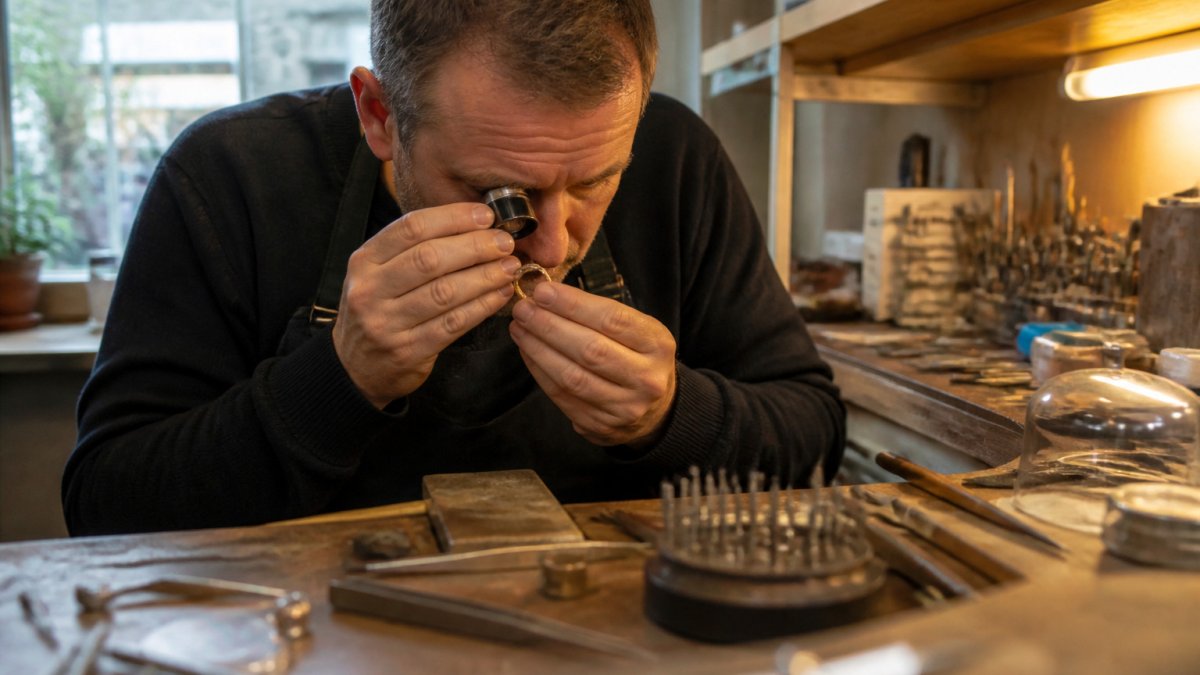
This assessment usually covers:
- Checking the metal purity and whether it is solid or plated
- Testing whether stones are loose, cracked or replaced
- Spotting old solder joints that may weaken during repair
- Recording the piece's condition before any work begins
Watch out: Never clean or polish an antique piece before it has been assessed. Some finishes and patinas are part of its value, and removing them cannot be undone.
The Damage That Calls for Specialist Intervention
Some damage is minor and can be handled with simple care. Other damage needs an expert, and attempting it at home or in a generic shop often makes things worse.
Common problems that need a specialist include:
- Worn or broken prongs: Stones can fall out if the setting is not rebuilt properly.
- Cracked or thin shanks: Rings can snap if they are pulled or resized carelessly.
- Loose or missing stones: Replacing a stone needs a matching cut and a sound setting.
- Heavy wear on engraved surfaces: Polishing can erase fine detail.
Antique Ring Repair: Why Shank, Prong and Setting Work Is Delicate
Rings take the most stress, which is why ring repair is so exacting. The shank, the band that holds the head, bears the weight of every knock and twist.
Antique ring repair asks a restorer to work around old solder, thin metal and stones that may be original to the piece. A small error in heat or pressure can crack the band or loosen a stone.
For a comparison of how newer rings are constructed, see our guide to Modern Eternity Ring Setting Styles: A Complete Guide. It shows why older settings call for different techniques.
Antique Jewellery Cleaning: Where Home Methods Go Wrong
Cleaning is where many well-meaning owners cause harm. Household cleaners, hot water, and strong abrasives can all damage an antique piece.
A common mistake is using an ultrasonic cleaner on pieces with loose stones or soft pearls. The vibration can dislodge settings within seconds.
Safer habits for everyday care:
- Wipe gently with a soft, dry cloth
- Store pieces separately to prevent scratches
- Keep pearls and soft stones away from chemicals and perfume
- Leave deep cleaning to a professional
Inside the Jewellery Restoration Process, Step by Step
A typical restoration follows a clear sequence. Each step protects the piece for the next one.
- Assess: Examine the piece and record its condition.
- Plan: Agree the scope of work and any changes with the owner.
- Stabilise: Secure loose stones and weak joints first.
- Repair: Rebuild settings, shanks or clasps with matched techniques.
- Finish: Polish carefully, keeping the original character intact.
- Check: Test security and wear before returning the piece.
For a related look at a common fix, read How to Repair a Broken Necklace Chain Step by Step.
A typical restoration follows a clear sequence, and each step protects the piece for the next one.
| Step | What to do | Note |
|---|---|---|
| Assess | Examine the piece and record its condition | Before any work begins |
| Plan | Agree the scope of work with the owner | Include any changes |
| Stabilise | Secure loose stones and weak joints | Done first |
| Repair | Rebuild settings, shanks or clasps | Use matched techniques |
| Finish | Polish carefully | Keep original character |
| Check | Test security and wear | Before return |
Frequently Asked Questions
Why should antique jewellery be restored by an expert?
Antique pieces often contain older alloys, hand-cut stones and settings that were never designed to be repaired with modern tools. An experienced jeweller can identify the metal and construction before any work begins, which lowers the risk of cracking, overheating a stone or wearing away engraving. Specialist knowledge also helps decide whether a repair should be done at all, or whether stabilising the piece is the more respectful choice.
Can antique jewellery be damaged by improper cleaning?
Yes. Ultrasonic cleaners and harsh chemical dips can loosen glue-set stones, strip patina from engraved detail and dissolve soft materials such as shell or horn in some pieces. Abrasive polishing can also soften sharp edges and erase hallmarks that help date and value the item. A jeweller will test each material before choosing a method, and will usually recommend gentle hand cleaning for heirloom pieces until they have been properly examined.
How long does antique jewellery restoration take?
Timescales vary widely with the amount of work involved. A simple clean and polish can often be handled quickly, while structural repairs, replacing missing stones or rebuilding a setting take longer because each stage needs time. Pricing depends on the piece, the work required and the materials involved, so please contact Morgan Banks directly for a quote and an estimated timeline for your item.
What should I ask a jeweller before restoring an heirloom?
Ask whether they have experience with the specific era and type of piece you own, and how they will identify the metals and stones before starting. Ask what will be changed, what will be kept original, and whether any part of the work is irreversible. It is also sensible to ask how the piece will be insured and returned to you, and whether they will provide written notes on the work carried out.
Booking Your Heirloom Assessment at Morgan Banks
If you own an antique piece that needs attention, the first step is an honest assessment. At Peter George banks trading as Morgan Banks, we have been working with fine jewellery since 1935, and we can look at your piece and explain the options before any work begins. Visit our site to find out more about our approach to bespoke jewellery and watches.
