
Last Updated: October 29, 2026
Quick Summary
An eternity ring setting is the method used to hold the stones in place around a band, and it determines how secure, comfortable and sparkling the ring is day to day. The main options are claw, channel, pavé and low-profile styles, each trading security against brilliance. Choose the setting based on how you use your hands.
- Claw settings expose the most stone to light but need prongs checked at least yearly.
- Channel settings protect stones between metal walls and are the easiest to wipe clean.
- Full eternity rings give continuous sparkle but can only be resized within a narrow range.
- Half eternity rings are often more comfortable because plain metal sits against the finger.
- Match the setting to your daily activity, the metal to the upkeep you accept, and the stone size last.
Table of Contents
- What Makes an Eternity Ring Setting and Why It Matters
- Full vs Half Eternity Ring: Choosing the Right Coverage
- Claw Set Eternity Ring: Security, Sparkle and Maintenance
- Channel Set Eternity Ring: Comfort for Everyday Wear
- Pavé, Grain and Modern Low-Profile Settings Compared
- Matching Your Setting to Lifestyle, Metal and Stone Size
- Eternity Ring Resizing: What Is Possible and What to Check
- Booking Your Bespoke or Off-the-Shelf Eternity Ring at Morgan Banks
- Frequently Asked Questions
What Makes an Eternity Ring Setting and Why It Matters
An eternity ring setting is the method used to hold stones in place around a band, and it determines how secure, comfortable and sparkling a ring will be every day. The decision is rarely about looks alone when choosing between settings.
Think of the setting as the working part of the ring rather than decoration.
The stone's position matters too. Many buyers focus on carat weight and overlook where the stones sit relative to the palm side of the finger, which affects comfort during typing, gripping and sleep.
Full vs Half Eternity Ring: Choosing the Right Coverage
A full eternity ring has stones set all the way around the band, while a half eternity ring carries stones across only the top half. Full eternity rings give the most continuous sparkle, but they cost more and need more precise sizing.
Here is a practical way to decide. If the ring will be worn alone or stacked with a slim engagement ring, a full eternity band gives a balanced look from every angle.
A half eternity band in yellow gold shows how partial coverage can still look generous, with round brilliant diamonds set across the top and the rest of the band left smooth. You can see it here: view the 18ct yellow gold pavé set 2 row curve diamond eternity ring, priced at £1,695.00.
Claw Set Eternity Ring: Security, Sparkle and Maintenance
A claw set eternity ring holds each stone with small metal prongs, which exposes more of the stone to light. This is the setting most often chosen for brilliance, because the open structure lets light enter from many angles.
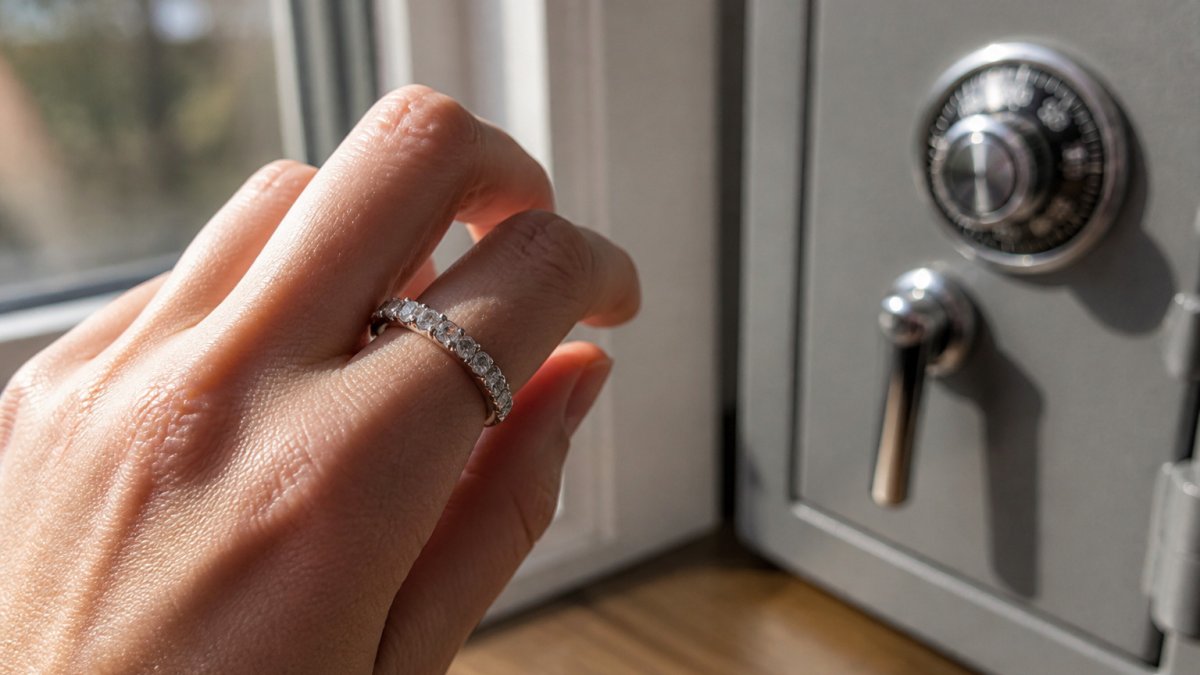
Watch out: prongs that look slightly loose are easy to miss, and a stone lost from a claw set is often the first sign of wear.
An 18ct white gold seven stone band, set with 0.72ct of round brilliant diamonds, is a good example of a classic claw design. View the 18ct white gold 7 stone diamond eternity ring for the full specification.
Channel Set Eternity Ring: Comfort for Everyday Wear
A channel set eternity ring places stones in a groove between two metal walls, so the stones are protected rather than exposed. This makes it the more practical choice for daily wear, since there are fewer prongs to snag and the band sits smoothly against the other fingers.
Channel settings do limit how much light reaches the stones from the side, so they can look less brilliant than claw set designs at the same weight. Many people accept that trade-off for the security gained, especially in active jobs or for anyone who wears rings through gardening, housework or sport.
Pavé, Grain and Modern Low-Profile Settings Compared
Pavé, grain and modern low-profile settings are where most of the recent design energy sits, and they behave very differently from claw and channel styles.
Modern low-profile designs are the other half of this category. Instead of lifting stones above the band, they sink them so the table of each diamond sits close to the metal.
To compare these styles honestly, judge them on four axes rather than on photographs alone:
- Stone security: channel and bezel-style settings protect stones best; pavé and grain sit in the middle; open claw exposes the most stone. Tiny pavé stones can work loose without obvious warning, so annual inspection matters more here than on larger stones.
- Sparkle: claw and French pavé give the most light return; standard pavé and grain are close behind; low-profile and channel settings trade some brilliance for protection.
- Comfort: low-profile, channel and bezel-style bands sit smoothest against adjacent fingers; high claw settings can catch on the neighbouring finger during typing or gripping.
- Maintenance: pavé and grain need gentle cleaning with a soft brush because dirt collects around the beads; channel is the easiest to wipe clean; claw needs prong checks at least annually.
Stone-by-stone construction also affects long-term ownership. Shared-prong settings hold several stones with one set of prongs, which is efficient but means one loose prong can affect more than one stone. Individually set pavé is slower to make but easier to repair stone by stone. Channel settings are the most repairable of the small-stone options because the metal walls can be re-tightened without removing every stone. Ask your jeweller how a repair would be handled before you commit, particularly on a full eternity band where the stones run all the way around.
18ct Yellow Gold Pave Set 2 row curve Diamond Eternity Ring .31ct →
An 18ct white gold curved band in a micro-claw setting, with 0.35ct of diamonds and a 2.10mm band width, is a useful example of a low-profile modern design. See the 18ct white gold curved wedding ring and compare it with the wider claw designs above.
Matching Your Setting to Lifestyle, Metal and Stone Size
Most guides tell you to 'match the setting to your lifestyle' and stop there. A more useful approach is to profile how you actually use your hands, then choose the setting that survives that routine. The table below is the framework we use in consultations; it is a starting point, not a rule.
| Daily profile | Best-suited settings | Why | Watch-outs |
|---|---|---|---|
| Desk work, typing, frequent glove use | Low-profile pavé, channel, bezel-style | Smooth surface, no prongs to catch | Tiny pavé stones need annual checks |
| Active wear, gym, gardening, housework | Channel, bezel, half-eternity with plain metal at the palm | Stones sheltered from knocks | Less side sparkle than claw |
| Healthcare, food, cleaning (frequent hand-washing) | Channel or low-profile; platinum or 18ct gold | Easy to clean, fewer dirt traps | Avoid open claw with small stones |
| Occasional wear, statement look | Claw, French pavé, larger single stones | Maximum light return | Prong inspection at least yearly |
| Low-maintenance preference | Channel, bezel, half-eternity | Fewest moving parts to check | Resizing still limited on full eternity |
Metal choice interacts with that profile.
Stone size changes the calculation too. Larger stones in a claw setting are easier to inspect and repair stone by stone, which is why claw remains popular for 0.50ct-and-above bands.
A simple rule: match the setting to the activity, the metal to the upkeep you will accept, and the stone size to how much you want to spend.
Eternity Ring Resizing: What Is Possible and What to Check
Eternity rings are harder to resize than plain bands because stones run around the whole circumference. Many full eternity designs can only be resized within a narrow range, and some cannot be altered at all without rebuilding the setting.
Check the band width, the gap between stones and whether the stones extend to the inside of the ring. Half eternity rings are often more flexible, since the plain section of metal can be adjusted without disturbing the stones. A jeweller can assess the options and advise whether a change is practical for your chosen design.
Booking Your Bespoke or Off-the-Shelf Eternity Ring at Morgan Banks
Choosing a setting is easier when you can see the rings in person. Our team in Kendal can talk you through coverage, metal and comfort, and advise on resizing before you commit.
To begin, browse our wedding and eternity rings. Newsletter subscribers receive 5% off a first purchase.

Frequently Asked Questions
What are the different settings for eternity rings?
The most common eternity ring settings are claw (also called four-claw or shared claw), channel, pavé, grain and bezel. Claw settings lift each stone above the band for maximum light, channel settings sit stones between two metal walls for a smooth profile, and pavé and grain settings use tiny beads or grains to hold stones closely together. Each setting trades off sparkle, security, comfort and cleaning differently, so the right choice depends on how the ring will be worn day to day. Our team can talk through these options in store before you commit.
What is the most secure setting for an eternity ring?
Channel and bezel settings generally offer the most protection for stones because they enclose the diamond edges within metal. Claw settings are secure when properly made and checked regularly, since the claws hold each stone at its girdle. Pavé and grain settings rely on small beads that can wear over time, so they need periodic inspection. Whichever setting you choose, have the claws and stone security checked at each service rather than assuming the ring is safe indefinitely.
What is the difference between a full and half eternity ring?
A full eternity ring has stones set all the way around the band, while a half eternity ring covers only the front half. A full eternity offers continuous sparkle and a symmetrical look, but it is usually more expensive and can be harder to resize. A half eternity ring costs less for the same stone size, sits comfortably against an engagement ring, and is often easier to adjust. Our 18ct yellow gold pavé set two row curve diamond eternity ring, at £1,695.00 with 0.31ct of diamonds and 50% coverage, is an example of a partial-coverage design.
Are channel-set eternity rings comfortable for everyday wear?
Channel-set eternity rings are generally comfortable for everyday wear because the stones sit flush within the band with no protruding prongs to catch on clothing or snag on fabric. The smooth, low profile also works well alongside an engagement ring. Comfort still depends on band width, fit and the quality of the finish, so a correctly sized ring is essential. A ring that is too tight or too loose will feel uncomfortable regardless of setting.
Can an eternity ring be resized?
Many eternity rings can be resized, but full eternity rings are the most difficult because the stones run all the way round the band. Resizing a full eternity typically means adding or removing metal in a section that can be altered without disturbing the stones, and it is not always possible for every design or stone size. Half eternity rings are usually easier to adjust. Before buying, ask the jeweller whether the specific design can be resized and how much movement is practical, and treat that as part of your purchase decision.
Which eternity ring setting makes diamonds look larger?
Claw and bezel settings tend to make individual diamonds look more prominent. Claw settings maximise the amount of light reaching each stone, while shared-claw or pavé designs with closely spaced stones create a continuous band of sparkle that can read as a larger overall piece. Stone size and cut matter as much as setting, so a well-cut round brilliant will look brighter than a poorly cut stone of the same carat weight.
Are claw-set eternity rings practical for daily wear?
Claw-set eternity rings are practical for daily wear when the claws are well made, the stones are secure and the ring is checked regularly. Claws can catch on knitwear or hair, so they need more attention than a channel setting. Regular inspection, gentle cleaning and avoiding heavy manual tasks while wearing the ring will extend its life. If you work with your hands or lead an active lifestyle, a channel or grain setting may suit you better.
How do you choose an eternity ring setting to match a wedding band?
Match the setting style and metal of your eternity ring to your wedding band so the pieces sit together comfortably. Matching metal colour, such as 18ct white gold with white gold, is the simplest approach. For a stacking look, a low-profile channel or pavé setting sits closer to an engagement ring than a high claw setting.
