
Quick Summary
The best wedding ring metal depends on durability, colour, cost, skin sensitivity and whether you may need resizing. Platinum and gold are the traditional choices, while titanium, palladium and tungsten carbide offer alternatives with different trade-offs.
- Check the hallmark: 9ct, 14ct or 18ct tells you the gold content.
- 9ct gold is harder and more durable than 18ct gold, which holds richer colour.
- Titanium is very light and nickel-free, but is almost impossible to resize.
- Tungsten carbide resists scratches well, but it is brittle and cannot be resized.
- Rank your priorities first, then compare two or three metals directly.
Table of Contents
- How Wedding Ring Metals Differ and What to Compare
- Platinum vs Gold Wedding Ring: Durability, Colour and Cost
- 9ct vs 18ct Gold Wedding Ring: Purity, Wear and Value
- Titanium Wedding Band Pros and Cons
- Palladium and Tungsten: Alternatives Worth Considering
- Best Metal for a Wedding Ring by Lifestyle, Allergies and Resizing
- Choosing Your Wedding Ring Metal and Booking a Fitting
- Frequently Asked Questions
How Wedding Ring Metals Differ and What to Compare
Last Updated: November 8, 2026
Choosing a wedding ring metal is one of the few jewellery decisions you will live with every day. At Peter George banks trading as Morgan Banks, the same questions come up again and again: which metal lasts, which one suits sensitive skin, and what it will cost to keep it looking good.
A wedding ring metal is the alloy a band is made from, and the alloy decides how it wears, how it looks and what it costs. Most bands are made from gold, platinum, palladium or titanium, with tungsten carbide also sold for people who want maximum scratch resistance.
Before comparing metals, decide what you care about most. Use these criteria to judge every option in this guide:
- Durability: how well the metal resists scratches, dents and bending
- Colour and finish: how it looks when new and how it ages
- Cost: the purchase price and the cost of ongoing care
- Skin compatibility: whether the alloy suits sensitive skin
- Resizing and repair: whether a jeweller can adjust the ring later
Keep these in mind as we go through each metal. The sections that follow apply the same criteria to every option, so you can compare them fairly.
Watch out: the purity stamp matters more than the metal name. A ring marked 9ct, 14ct or 18ct tells you the gold content, so always check the hallmark before you buy.
Platinum vs Gold Wedding Ring: Durability, Colour and Cost
Platinum and gold are the two traditional choices, and they differ in ways that affect daily wear. Platinum is generally regarded as a denser metal than gold.
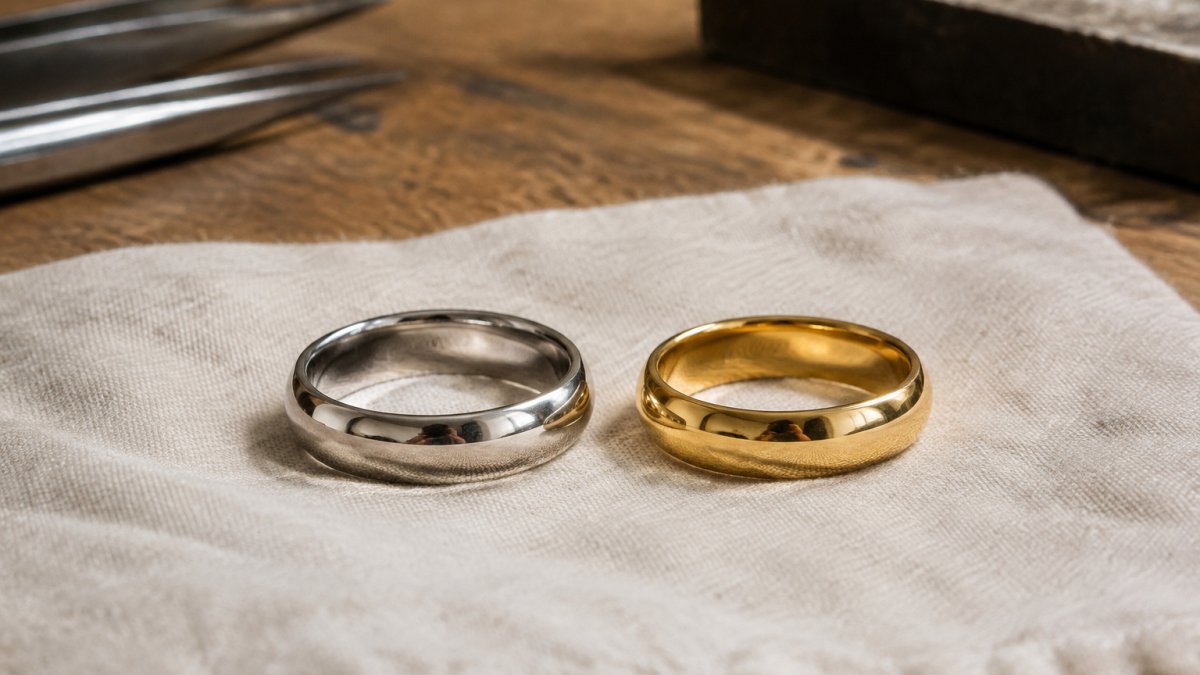
Platinum is naturally white. Gold comes in several colours, which we cover in the next section.
Our platinum half eternity diamond ring, a 0.12ct round brilliant set in platinum, is priced at £1,400.00. Our 18ct white gold 3mm satin wedding ring is priced at £665.00, and our 9ct white gold 4mm AML band is priced at £450.00.
!Platinum and yellow gold wedding bands resting side by side on a pale linen cloth in a warm jewellery workshop
Gold Options: Yellow, White and Rose
Gold comes in three main colours.
- Yellow gold is the traditional choice. It is warm in tone and tends to show fewer scratches than white gold, though it can look dull as it wears.
- White gold is gold alloyed with white metals such as palladium or nickel. It looks similar to platinum, but it is usually less expensive.
- Rose gold gets its colour from added copper. It has a soft pink tone and suits warmer skin tones.
The table below sets out how the two traditional choices compare on the points that matter most day to day.
| Metal | Colour | Price point |
|---|---|---|
| Platinum | Naturally white | £1,400.00 (half eternity diamond ring) |
| 18ct white gold | White | £665.00 (3mm satin band) |
| 9ct white gold | White | £450.00 (4mm AML band) |
Price comparison of wedding bands by metal (GBP)
9ct vs 18ct Gold Wedding Ring: Purity, Wear and Value
The number before "ct" tells you how much pure gold the alloy contains. 9ct gold is 37.5% gold, while 18ct gold is 75% gold. Pure 24ct gold is too soft for everyday rings, which is why jewellers blend it with other metals.
The higher the carat, the richer the colour, but the softer the metal. 18ct gold looks more luxurious and holds its colour well, yet it scratches more easily than 9ct gold. 9ct gold is harder than 18ct gold.
In practice, the difference shows up in three places:
- Purity: 18ct gold contains roughly twice as much gold as 9ct
- Wear: 9ct is more durable for active lifestyles
- Value: 9ct costs less, and 18ct has a higher resale value
Our 9ct white and yellow gold wedding band in size T is priced at £750.00. Our 9ct white gold band is £450.00, and our 18ct white gold satin ring is £665.00.
Titanium Wedding Band Pros and Cons
Titanium is a metal used in wedding bands, and it is worth understanding how it behaves before you commit.
Pros:
- Very light, so it is comfortable for all-day wear and easy to forget you are wearing it
- Highly resistant to scratches and corrosion, and it will not tarnish in normal use
- Usually the most affordable option for a solid metal band
- Suitable for many people with sensitive skin, as it is nickel-free
- Holds a brushed or satin finish well, which hides fine marks
Cons:
- Almost impossible to resize by conventional means, so get the size right first time
- Hard to repair if it bends or cracks, and many jewellers will not attempt a structural repair
- Lacks the warmth and traditional look many couples want
- Difficult to cut off in an emergency without specialist tools
Palladium and Tungsten: Alternatives Worth Considering
Palladium and tungsten sit at opposite ends of the wedding ring market. Palladium and tungsten carbide are two further metals sometimes used for wedding rings.
Palladium
Pros:
- Naturally white, so no replating is needed to maintain colour
- Lighter than platinum, which some wearers find more comfortable
- Usually less expensive than platinum at purchase
- Nickel-free, so suitable for many sensitive skins
- Develops a soft patina in the same way platinum does
Cons:
- Softer and more prone to scratching than platinum
- Harder to resize than gold, and not every workshop will attempt it
- Less widely stocked than gold or platinum, so choice of width and finish is narrower
- Resale and scrap value are lower than platinum
Tungsten Carbide
Tungsten carbide is extremely hard and resists scratches far better than gold or platinum. It is a compound rather than a pure metal, and it is finished to a very high polish that keeps its shine with minimal care.
Pros:
- Exceptional scratch resistance, so it stays looking new for longer
- Holds a high polish with very little maintenance
- Usually inexpensive relative to precious metals
- Heavy and solid in the hand, which some wearers prefer
Cons:
- Brittle: a hard knock can crack or chip the band
- Cannot be resized or easily repaired
- Cannot be soldered, so it cannot be modified or combined with other metals
- Difficult to cut off in an emergency without specialist equipment
- Not a precious metal, so it has little resale or scrap value
Best Metal for a Wedding Ring by Lifestyle, Allergies and Resizing
The right metal depends on how you live.
If you are unsure, ask our team for advice before you buy.
Choosing Your Wedding Ring Metal and Booking a Fitting
Start by ranking your priorities: durability, colour, cost, skin compatibility and the chance you will need to resize. Once you have settled on a metal, this sizing guide for small hands explains how to choose a ring that fits before you book a fitting. Use that ranking to narrow the list to two or three metals, then compare them directly.
Our wedding and eternity collection includes platinum, 9ct and 18ct options. Speak to our team in Kendal if you would like help choosing.
Choosing a wedding ring metal comes down to balancing looks, durability, skin comfort and budget. Peter George banks trading as Morgan Banks has been advising couples on these choices since 1935, and we are glad to help you find the band that suits how you live.
Frequently Asked Questions
What is the best metal for a wedding ring?
There is no single best metal. Platinum is naturally white and is generally the most expensive of the common options. 18ct gold and 9ct gold are both available from the business in a range of colours. Titanium is not a metal the business currently lists. Choose based on your budget, how physically active you are, whether you have metal sensitivities, and whether you may need the ring resized in future.
Is platinum better than gold for a wedding ring?
Platinum is naturally white. Gold is available in yellow, white and rose tones. Platinum is generally the more expensive of the two, while gold is generally the more affordable option.
Is titanium a good choice for a wedding band?
Titanium is a good choice if you want a lightweight, strong ring at a lower price. It resists scratches well and is comfortable for active lifestyles. The main drawback is that it generally cannot be resized, so you need an accurate fit from the start, and it is difficult to repair if damaged. It is also hard to cut off in an emergency, which is worth considering if you work with machinery or have medical needs.
