
Table of Contents
- Moissanite vs Diamond for Wedding Bands: Key Differences at a Glance
- Moissanite Hardness on the Mohs Scale and Everyday Durability
- Brilliance, Fire and Colour: How the Two Stones Actually Look
- Lab-Grown Diamonds vs Moissanite: What Sets Them Apart
- Cost, Value and Resale: What Your Money Buys
- How to Clean Moissanite Wedding Bands and Keep Them Sparkling
- Pairing Stones with Metals: Platinum, White Gold and Mixed Finishes
- Frequently Asked Questions
Last Updated: September 27, 2026
Moissanite vs Diamond for Wedding Bands: Key Differences at a Glance
Choosing between moissanite and diamond for a wedding band comes down to three practical questions: how hard the stone is, how it handles light, and what you want to spend. This guide from Peter George banks trading as Morgan Banks, fine jewellers since 1935, sets out the real differences so you can decide with confidence.
| Feature | Moissanite | Diamond |
|---|---|---|
| Composition | Silicon carbide | Carbon |
| Mohs hardness | 9.25 | 10 |
| Brilliance | High, with rainbow fire | High, white brilliance |
| Colour range | Near-colourless to faint tint | Colourless to near-colourless |
| Typical cost | Lower | Higher |
| Resale value | Limited | Established market |
Composition and Origin: Silicon Carbide vs Carbon
Moissanite is a lab-grown form of silicon carbide, first identified in meteorite fragments and now produced in controlled laboratory conditions. Diamond is crystalline carbon, formed naturally deep underground or grown in a lab.
Moissanite Hardness on the Mohs Scale and Everyday Durability
Moissanite sits at 9.25 on the Mohs scale, above sapphire (9) and ruby (9) and below only diamond at 10. For a band worn every day, that is comfortably adequate. But the Mohs scale only measures one thing: how well a stone resists being scratched by another mineral. It says nothing about how a ring survives twenty years of door handles, gym equipment, dishwashing and desk edges.
What actually wears on a wedding band
Three things age a stone-set band, and only one of them involves the stone:
- Prong and claw wear. The metal holding the stone is softer than the stone. Over years, claws thin and flatten at the tips. This is the single most common cause of a lost stone, and it happens to diamond bands just as readily as moissanite ones.
- Facet-edge abrasion. Moissanite's facet edges can round very slightly over decades of contact with harder grit (sand, masonry dust, some ceramics). The effect is a subtle softening of the crisp sparkle rather than visible damage, and it is usually only noticeable under a loupe.
- Metal loss on the band itself. Platinum wears by displacement, developing a soft patina and moving metal rather than losing it, so it can be re-polished almost indefinitely. Gold, especially 9ct, loses a small amount of material with every polish, so a heavily worn 9ct band has a finite number of refinishes before the shank thins.
Why setting style matters as much as the stone
A channel-set or bezel-set band protects the stone edges entirely and is the most forgiving choice for someone who works with their hands. A claw-set eternity band exposes every stone to knocks, so it needs more frequent inspection. A 1/3-set band, where stones cover only the top third of the ring, is a practical middle ground: you get the sparkle where it shows, and the plain lower shank takes the wear.
Realistic expectations by wear pattern
- Desk and light-duty wear: a moissanite band will look effectively unchanged for many years with an annual clean and claw check.
- Active or manual work: expect claw tightening every 12 to 18 months, and consider a bezel or channel setting.
- Swimming and cleaning: chlorine and household bleach attack gold alloys and can loosen settings over time. Remove the band for these tasks regardless of the stone.
The honest summary: moissanite's hardness is not the limiting factor in a wedding band's lifespan. The setting, the metal, and how you wear it are.
Brilliance, Fire and Colour: How the Two Stones Actually Look
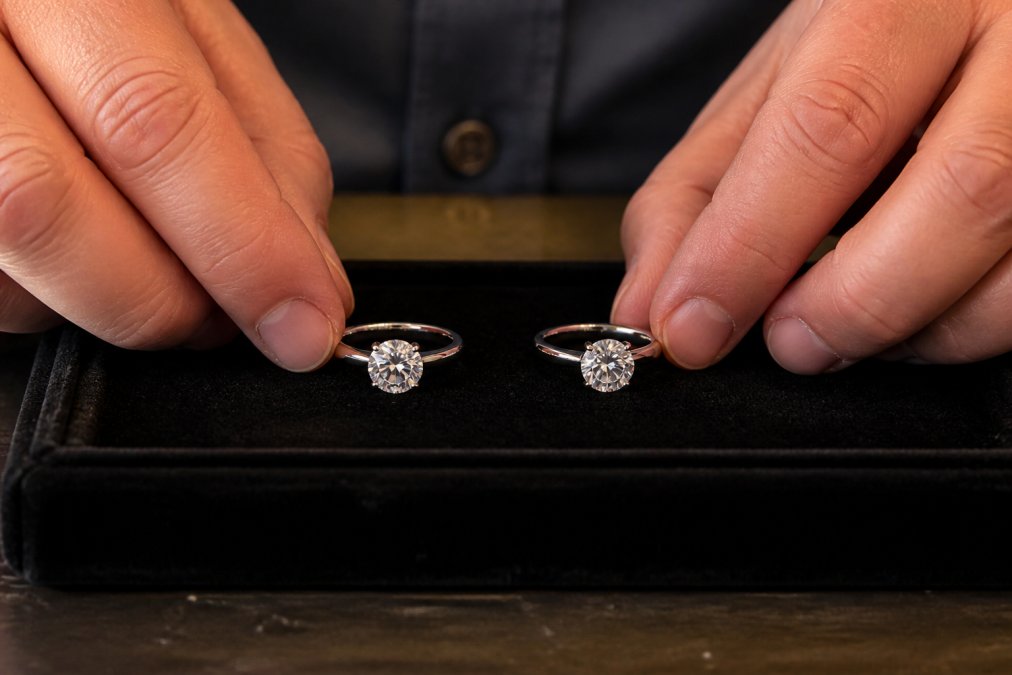
Moissanite and diamond look different in daylight, and that difference is the deciding factor for many buyers. Diamond returns white brilliance with balanced sparkle. Moissanite throws more dispersion, which you see as rainbow flashes and stronger scintillation.
Lab-Grown Diamonds vs Moissanite: What Sets Them Apart
Lab-grown diamonds vs moissanite is not a case of one being fake. Both are real gemstones with different chemistry. A lab-grown diamond is chemically identical to a mined diamond, so it tests as diamond on standard gemological equipment.
The practical split looks like this:
- Lab-grown diamond: same material as mined diamond, lower cost than natural, established resale route
- Moissanite: harder than most gems, more fire, lower cost again, limited resale
- Mined diamond: highest cost, strongest resale history, traditional choice
Cost, Value and Resale: What Your Money Buys
Cost is where moissanite and diamond separate most sharply, and it is also where most guides stop short. The useful question is not "which is cheaper" but "what does the saving actually buy you, and what do you give up in return."
Platinum Diamond Eternity 1/3 set .20ct →
The cost gap in practice
At the same visual size, a moissanite stone typically costs a small fraction of a comparable diamond. In a wedding band context, that gap is often smaller than people expect, because the band's metal and the setting work make up a large share of the price. A plain 4mm 9ct gold band and a diamond-set eternity band of the same width can differ by well over a thousand pounds, and most of that difference is stones and setting labour, not the shank.
- a full eternity band in moissanite,
- a 1/3-set band in diamond, or
- a plain band with money left for the wedding itself.
What the saving costs you: resale and liquidity
This is the part most guides avoid. Diamonds have an established secondary market, but the retail-to-resale gap is steep: a new diamond ring typically resells for a fraction of its retail price, because the retail price includes the retailer's margin, the setting, and the metal work. You rarely recover what you paid.
How to think about value
- Wearability: how comfortably it sits, how well the setting protects the stones, and how the metal ages.
- Sentiment: the ring you actually want to look at every day.
- Liquidity: what it would fetch if you ever sold it.
At Morgan Banks, our platinum and gold wedding bands show how setting and metal change the price:
| Ring | Metal | Stone Detail | Price |
|---|---|---|---|
| Platinum Diamond Eternity 1/3 Set .20ct Band | Platinum | 1/3 set.20ct | £1,610.00 |
| Platinum Diamond Eternity 1/3 Set Curved .30ct Band | Platinum | Curved.30ct | £1,950.00 |
| 18ct White Gold Curved Wedding Ring .35ct | 18ct white gold | Micro-claw set.35ct | £1,800.00 |
| Wedding Band 9ct Rose/White Gold 4mm | 9ct rose/white gold | Plain 4mm | £460.00 |
| AML Wedding Ring 9ct White Gold 4mm | 9ct white gold | Plain 4mm | £450.00 |
How to Clean Moissanite Wedding Bands and Keep Them Sparkling
Follow this routine:


- Fill a bowl with warm water and a drop of mild washing-up liquid
- Soak the ring for 10 to 15 minutes
- Brush gently around the setting and under the stone with a soft toothbrush
- Rinse under warm running water with the plug in
- Pat dry with a lint-free cloth
- Check claws for movement before wearing again
Professional cleaning once a year keeps the metal bright and catches wear early. This is also the moment to have the setting checked and re-polished.
Pairing Stones with Metals: Platinum, White Gold and Mixed Finishes
Pairing stones with metals changes how the whole ring reads. Platinum is dense, naturally white, and holds a setting firmly, which suits a diamond eternity band worn daily. White gold offers the same look at a lower cost, though it needs re-plating over time as the rhodium finish wears.
Frequently Asked Questions
Is moissanite good for a wedding band?
Yes. Moissanite is a practical choice for a wedding band because it resists scratching in daily wear and keeps its sparkle well. Its hardness sits just below diamond on the Mohs scale, so it handles knocks and bumps from everyday activities. Many couples choose moissanite for the lower cost and ethical sourcing, then pair it with a platinum or gold band for a durable finish. Regular cleaning with warm soapy water keeps it looking its best.
What is the downside of moissanite?
The main downsides are resale value and colour. Moissanite has very little resale value compared with natural diamond, so it is best bought as a keep-forever piece rather than an investment. In some lighting it shows a warmer or slightly greenish tint, especially in larger stones. It also has more rainbow flashes than diamond, which some people love and others find distracting. These trade-offs matter less if you prioritise budget and everyday wear.
Is moissanite durable enough for an everyday wedding band?
It is. Moissanite ranks around 9.25 on the Mohs scale of hardness, so it resists scratches from daily wear far better than softer stones. It can chip if struck hard at the wrong angle, but that risk is low in normal use. For a wedding band that will be worn continuously, moissanite set in platinum or 18ct gold offers a strong, lasting combination. Inspect the setting every few months to check the stone remains secure.
How does the price of moissanite compare to diamonds?
Moissanite costs a fraction of natural diamond of the same size, often 80-90% less. Lab-grown diamonds sit between the two, costing more than moissanite but less than natural stones. At Morgan Banks, diamond eternity bands such as the Platinum Diamond Eternity 1/3 Set .20ct Band are priced at £1,610, while the 9ct gold All My Love wedding rings start at £450. If budget is a priority, moissanite lets you buy a larger stone or a more elaborate setting for the same spend.
Does moissanite lose its sparkle over time?
No, moissanite does not lose its sparkle. Its brilliance comes from the stone's structure, not a coating, so it stays bright with normal wear. What dulls a ring over time is surface grime, soap residue and skin oils, which form a film that blocks light. Cleaning with warm water, mild soap and a soft brush restores the shine. Avoid harsh chemicals and ultrasonic cleaners if the stone has any surface-reaching fractures or the setting is fragile.