
Table of Contents
- What Ethical Diamond Sourcing Means for Bespoke Rings in 2026
- Step 1: Set Your Priorities Before You Speak to Any Supplier
- Step 2: Questions to Ask a Jeweller About Diamond Sourcing
- Step 3: How Diamond Provenance Is Traced and Verified
- Step 4: Lab-Grown Diamonds for Bespoke Rings Compared with Mined Stones
- Step 5: Costs, Timelines and What Affects Your Quote
- Step 6: Risks, Red Flags and When Not to Remodel or Reset
- Step 7: Choosing a Jeweller and Protecting Your Valuable Stones
- Frequently Asked Questions
Last Updated: October 7, 2026
What Ethical Diamond Sourcing Means for Bespoke Rings in 2026
Ethical diamond sourcing is the practice of buying stones only from suppliers who can document their origin, their cutting, and their trade route.
Two things drive the shift. First, lab-grown stones now offer identical optical and chemical properties to mined diamonds, often at a lower price.

Below, we break the process into seven steps, from setting your priorities to protecting your stones after the work is done.
Step 1: Set Your Priorities Before You Speak to Any Supplier
Decide what matters most before you walk into a showroom. Couples who arrive with a clear brief get better advice and fewer pushy sales conversations.
Work through this list first:
- Budget: a firm figure, not a range you will stretch later
- Stone type: mined, lab-grown, or a mix of both
- Metal: platinum, yellow gold, or white gold
Write your answers down. A supplier who respects your list is a supplier worth keeping. One who ignores it is not.
Step 2: Questions to Ask a Jeweller About Diamond Sourcing
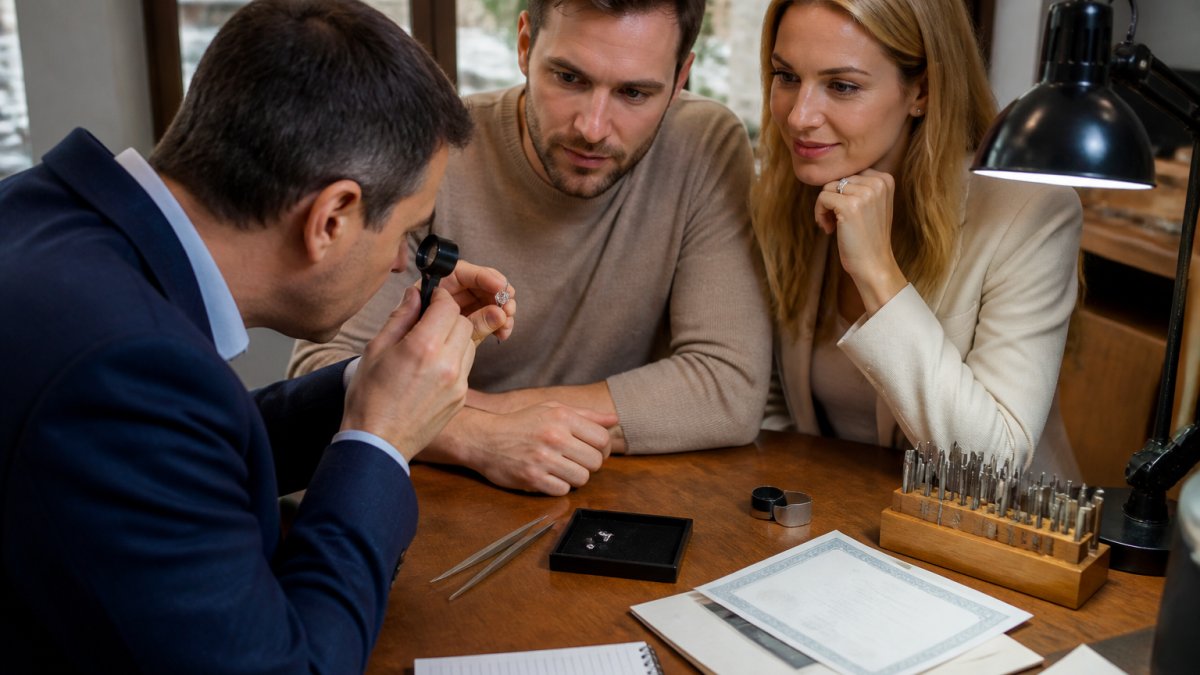
The right questions to ask a jeweller about diamond sourcing are the ones that force a specific answer. Vague replies tell you more than confident ones.
Start here:
- Where was this stone mined or grown?
- Which laboratory graded it, and can I see the report?
- Can you show me the original invoice from your supplier?
A good jeweller answers all five without hesitation. A poor one deflects to the setting, the price, or the romance of the moment.
Certification and Documentation to Request
Ask for the grading report, the supplier invoice, and a written statement of origin. The grading report confirms the stone's weight, colour, clarity, and cut. The invoice shows the supply chain.
Check that the report number matches the stone and the paperwork. If any of the three is missing, treat it as a warning sign rather than a minor gap.
Step 3: How Diamond Provenance Is Traced and Verified
Diamond provenance is the documented record of a stone's journey from mine or laboratory to your ring. It is verified through a chain of certificates, invoices, and audited supply systems rather than a single document. The practical test is not whether a supplier has paperwork, but whether the paperwork joins up.
The verification chain, link by link
The chain usually runs like this:
- The mine or laboratory issues an origin record for the rough stone
- The cutter logs the rough stone and the finished stone, including any weight lost in polishing
- The dealer passes the stone on with matching paperwork
- The jeweller records the purchase and reconciles it against the certificate
- You receive copies of everything, not just the grading report
Each link must match the last. A break anywhere in the chain weakens the whole claim. In practice, most breaks appear at step two, because cutting and polishing is where stones change hands most often and where documentation is most easily lost.
What you can actually check yourself
You do not need to be a gemmologist to verify a claim. Three checks cover most of the ground:
- Match the certificate number to the stone. Every reputable laboratory report carries a unique number. Ask the supplier to show you the report and the stone together, then look the number up on the issuing laboratory's own database. If the number does not return a result, stop.
- Check the measurements, not just the grade. A report lists the stone's exact measurements in millimetres. Ask the jeweller to measure the stone in front of you. A mismatch means the report belongs to a different stone.
- Ask for the supplier invoice. This is the document most buyers never see. It shows who the jeweller bought from, when, and at what price. A jeweller who will not show it is asking you to take the rest on trust.
What the Kimberley Process covers and what it misses
The Kimberley Process Certification Scheme was set up to stop rough diamonds from funding conflict. It covers rough stones crossing borders between participating countries.
It does not cover cutting, polishing, or retail. It says nothing about labour conditions in a polishing workshop, and nothing about environmental damage at a mine site. That is why the scheme is a floor, not a ceiling.
What sits above the Kimberley Process
Buyers who want more than the minimum should look for additional assurance layered on top. The common ones are:
- Laboratory-grown stones carry a growth report from the same laboratories that grade mined stones, which makes the origin record simpler because the stone never left a controlled facility.
- Mine-to-market traceability programmes used by some larger suppliers record a stone at each handover, so the chain can be audited rather than merely asserted.
- Independent audits of a supplier's purchasing records, carried out by a third party rather than the supplier itself.
None of these is a guarantee. Each one narrows the gap between what a supplier claims and what can be demonstrated. The right question is not "are you ethical?" but "what can you show me, and who checked it?"
The unique angle: provenance is a chain of custody, not a certificate
Most guides treat provenance as a document you receive at the end. It is better understood as a chain of custody you can test at each stage. If a supplier can walk you through every handover, mine or lab, cutter, dealer, jeweller, and produce a document for each one, you have something worth trusting. If they can only produce a grading report, you have a description of the stone, not its history.
Step 4: Lab-Grown Diamonds for Bespoke Rings Compared with Mined Stones
Lab-grown diamonds for bespoke rings are chemically and optically identical to mined stones. The difference lies in origin, price, and the paperwork trail, not in how they look or wear.
Platinum 3 stone Oval Lab Grown Diamond Ring 1.6ct D vvs →

| Feature | Lab-Grown | Mined |
|---|---|---|
| Origin | Grown in a laboratory | Extracted from the earth |
| Composition | Identical to mined | Identical to lab-grown |
| Traceability | Easier to document | Depends on the supply chain |
| Certification | Same laboratories grade both | Same laboratories grade both |
| Price | Generally lower | Generally higher |
Neither option is automatically more ethical. A poorly documented lab-grown stone is no better than a poorly documented mined one. What matters is the paperwork behind the specific stone in front of you.
Step 5: Costs, Timelines and What Affects Your Quote
Bespoke ring costs depend on the stone, the metal, the setting, and the complexity of the design. Two rings with similar stones can differ sharply once the setting work is priced. This is the section most guides skip, and it is the one buyers ask about first.
What actually drives the quote
The main factors are:
- Stone size, quality, and origin. Lab-grown stones are generally priced lower than mined stones of comparable size and grade. Within mined stones, price rises steeply with carat weight because larger rough stones are rarer.
- Metal choice. Platinum is denser than gold, so a platinum setting uses more metal by weight and costs more in both material and labour. Yellow gold and white gold sit below it; white gold also needs rhodium plating, which is a recurring cost rather than a one-off.
- Setting style. A simple claw setting involves less workshop time than a shoulder-set or channel-set band, where each stone is individually seated and secured.
How to read a quote
Ask for a written quote that separates the stone, the metal, and the labour. A single lump sum hides where the money goes and makes it impossible to compare two suppliers fairly.

A useful quote breaks down into four lines:
- Stone, the diamond or gemstone itself, with its certificate reference
- Metal, the weight and type of metal, priced per gram
- Labour, setting, finishing, and any hand work
- Extras, engraving, rhodium plating, resizing, and insurance valuation
If a supplier will not separate these, ask why. There is no good reason to refuse.
Timelines
Timelines usually run from a few weeks to a few months. The variables are predictable:
- Stones already in stock move fastest, because there is no sourcing delay
- Stones that need sourcing add time, and the delay depends on the supplier's network
- Complex designs add workshop hours, and a busy workshop adds queue time
Ask for a written timeline with named stages, design approval, stone sourcing, casting, setting, finishing, collection, rather than a single delivery date. A supplier who can only give you one date has not thought about the process.
The unique angle: budget for the whole ring, not just the stone
Most buyers fixate on the stone and treat everything else as an afterthought. In practice, the setting, metal, and finishing can account for a substantial share of the final price, and they are the parts most easily changed to bring a design back inside budget.
Our own platinum three-stone oval lab-grown diamond ring shows how a documented, certified stone sits inside a finished piece at a clear price.
Step 6: Risks, Red Flags and When Not to Remodel or Reset
Some pieces should be left alone. If an heirloom has significant historic or sentimental value as it stands, remodelling can destroy more than it preserves.
Watch for these red flags:
- No certificate, or a certificate that does not match the stone
- Pressure to decide the same day
- Refusal to put anything in writing
Walk away if any of these appear. There is always another supplier.
Step 7: Choosing a Jeweller and Protecting Your Valuable Stones
Pick a jeweller with a long trading history, written terms, and a clear process for handling your stones. Ask how they store pieces in progress, who works on them, and what insurance covers them while they are with the workshop.
Before you hand anything over:
- Photograph the piece from every angle
- Get a written description of each stone
- Confirm the insurance position in writing
At Morgan Banks, bespoke commissions run through a documented process from first sketch to final polish. You can browse our lab-grown diamond engagement rings to see how certified stones are presented before you commit.
Frequently Asked Questions
How can I check whether a diamond supplier is ethical?
Ask for written evidence of provenance and certification. Reputable suppliers provide Kimberley Process certificates, GIA or IGI grading reports, and details of the mine or cutting centre. Check whether the supplier publishes a sourcing policy and can name the countries involved. In the UK, the Kimberley Process is enforced through retained EU law and UK customs regulations. A supplier who cannot answer basic provenance questions is a red flag.
Are lab-grown diamonds more ethical than mined diamonds?
Lab-grown diamonds avoid the land disturbance and mining labour concerns associated with extracted stones, and they are traceable from the point of creation. However, they still require significant energy, so the sustainability of the producer matters. For bespoke rings, lab-grown options such as the Platinum 3 stone Oval Lab Grown Diamond Ring 1.6ct D vvs at £2,250 offer a documented, conflict-free origin with full IGI certification.
What diamond certificates should I ask to see?
Request a grading report from an independent laboratory such as GIA, IGI or HRD. The report should confirm the four Cs (carat, colour, clarity, cut) and include a unique report number you can verify online. For lab-grown stones, ensure the certificate states 'laboratory-grown' explicitly. Also ask for a Kimberley Process certificate for mined stones. Keep copies with your insurance documents.
Can a jeweller trace a diamond back to its source?
Full mine-to-finger traceability is rare for smaller stones, but larger diamonds increasingly come with provenance documentation. Suppliers using blockchain or proprietary tracking systems can sometimes show the mine, cutting centre and polisher. For bespoke commissions, ask your jeweller what level of traceability they can guarantee. If they cannot trace beyond the dealer, that is worth knowing before you commit.
Choosing ethical diamond suppliers takes time, and the paperwork can feel endless. But it is the only way to know what you are buying. Morgan Banks has guided couples through bespoke commissions since 1935, with certified stones, documented sourcing, and a workshop process that protects your piece at every stage. Start your commission with us and get a ring you can trace from stone to setting.