
Table of Contents
- The Custom Jewellery Process: Why Timelines Vary
- Bespoke Jewellery Design UK: How the Design Phase Unfolds
- Stages of Bespoke Jewellery Making: From Casting to Final Polish
- Custom Engagement Ring Timeline: What to Expect Week by Week
- What Slows a Custom Jewellery Commission Down
- How to Speed Up Your Bespoke Order: A Client Checklist
- Frequently Asked Questions
Last Updated: September 17, 2026
The Custom Jewellery Process: Why Timelines Vary
Most couples assume a bespoke commission takes a few weeks. In reality, a hand-crafted piece typically moves through design, casting, stone setting, and hallmarking before it ever reaches your hand.
At Peter George banks trading as Morgan Banks, we have guided clients through bespoke commissions since 1935. The honest answer to how long does custom jewellery take to make is six to twelve weeks for most pieces. A simple band sits at the shorter end. An intricate engagement ring with sourced stones pushes toward the longer end.
Why the range? Because a bespoke piece is not pulled from a shelf. Every stage depends on decisions you make, the materials you choose, and how quickly feedback flows back and forth.
Below, we break the process into its stages. You will see where the weeks actually go, and how to keep your commission moving.
Bespoke Jewellery Design UK: How the Design Phase Unfolds
The design phase is where a bespoke commission is won or lost. It usually takes one to three weeks, and it sets the tone for everything that follows.
Design Consultation and Initial Sketches
A design consultation is the first formal step in any bespoke commission. It is a conversation about the piece you want, the budget you have, and the occasions it needs to suit.
Expect to discuss:
- The style you have in mind, from classic solitaire to something more sculptural
- Your preferred metal, such as 9ct yellow gold or platinum
- Stone preferences, including cut, colour, and carat
- Finger size and how the piece will sit when worn
CAD rendering and Client Approval
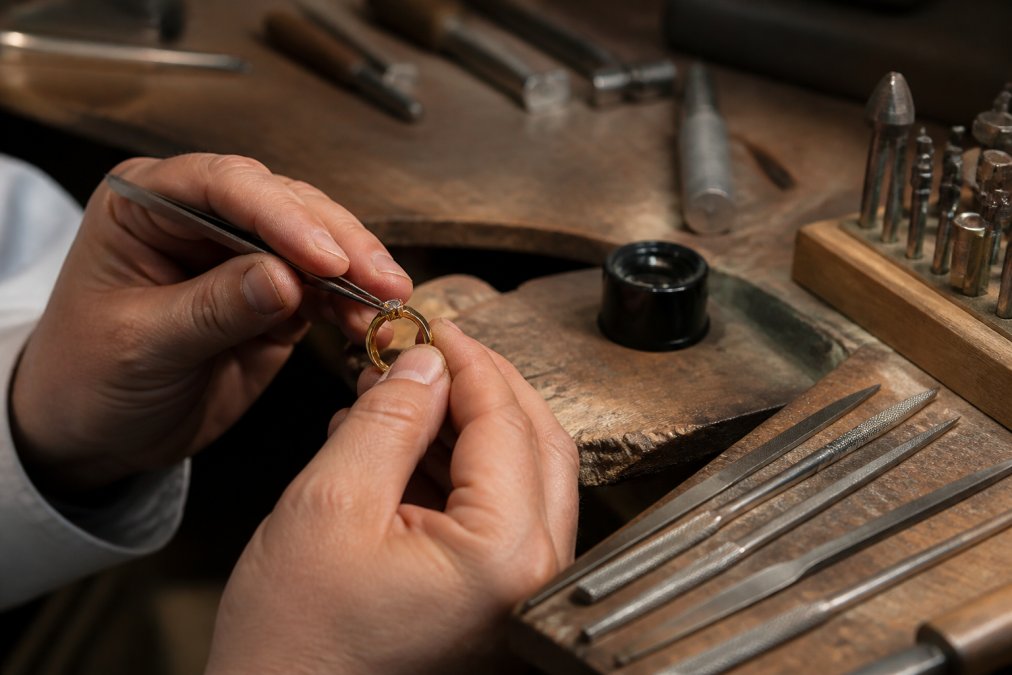
Stages of Bespoke Jewellery Making: From Casting to Final Polish
The manufacturing stage is where craft takes over. This phase usually runs three to six weeks, depending on complexity and stone sourcing.
Casting, Stone Setting and Hallmarking
The casting process turns your approved CAD model into metal. A wax model is created, encased, and then replaced by molten gold, platinum, or silver.
Quality Control, Polishing and Final Inspection
Polishing brings out the finish, from a high shine to a brushed matte. It is also where small imperfections get caught.
Quality assurance at this stage covers:
- Stone security, checked under magnification
- Claw and prong alignment
- Surface finish consistency
- Comfort on the finger or wrist
- Final inspection against the approved design
Custom Engagement Ring Timeline: What to Expect Week by Week
A custom engagement ring timeline is easier to plan when you can see it laid out. The table below shows a typical twelve-week commission, with the realistic range for each stage rather than a single optimistic figure.
| Stage | Typical Duration | What Happens | What Can Stretch It |
|---|---|---|---|
| Design consultation and sketches | 1-2 weeks | Discuss style, budget, metal and stones | Waiting on a partner's ring size or a family stone to be assessed |
| CAD rendering and approval | 1-2 weeks | 3D model produced, revisions agreed | Each revision round adds 2-4 working days; more than three rounds is unusual |
| Stone sourcing | 1-3 weeks | Diamonds or gemstones located and checked | A specific cut, colour or carat may need to be brought in from a supplier's stock |
| Casting and setting | 2-3 weeks | Metal cast, stones set by hand | Intricate settings, multiple stones, or a channel-set band add bench time |
| Hallmarking | 1-2 weeks | Assay office tests and marks the metal | Distance to the assay office and seasonal queues affect turnaround |
| Polishing and final inspection | 1 week | Finish applied, quality checked | A failed check sends the piece back a step |
| Shipping and collection | 2-5 days | Insured delivery or collection arranged | Special delivery to a remote postcode can add a day |
Why Stone Sourcing Is the Wildcard
Most timelines assume the stone is sitting in a vault. Often it is not. If you want a particular cut, colour or carat, your jeweller may need to source it from a supplier, a dealer, or a client trade-in. That process can take days or weeks depending on availability.
Permanent Jewellery Appointment £10 →
A few practical points worth knowing:
- Lab-grown stones are usually quicker to source than natural stones of the same specification, because supply is more predictable.
- Natural coloured gemstones (sapphires, emeralds, rubies) vary enormously in availability. A specific shade may only appear a few times a year.
- Recycled or fair-mined metals can add time if your jeweller does not hold stock and needs to order from a refiner.
- Heirloom stones need to be assessed, sometimes re-cut, and re-set. That assessment alone can take a week.
Hallmarking: The Legal Step You Cannot Skip
Any precious metal item sold in the UK above the legal weight thresholds must be hallmarked by one of the UK assay offices before it can be sold. This is a legal requirement under the Hallmarking Act 1973.
What Slows a Custom Jewellery Commission Down
Delays rarely come from the workshop. They come from the gaps between stages, and from two forces most articles never mention: seasonal demand and material sourcing.
Seasonal Demand: When the Bench Is Full
Bespoke workshops do not run at a constant pace. Demand clusters around predictable dates, and when the bench is full, every stage takes longer.
- September to December, engagement season peaks, and Christmas commissions fill the diary.
- January to mid-February, Valentine's Day drives a second surge, often overlapping with Christmas orders still in progress.
- May to August, wedding season, when wedding bands and gift commissions compete for the same bench time.
Material Sourcing: The Weeks Nobody Talks About
Most timelines treat materials as a given. In practice, sourcing is where commissions quietly lose time.
- Rare gemstones. A specific sapphire colour, an unheated ruby, or a particular emerald origin may need to be located through trade channels. That can take days or weeks.
- Recycled and fair-mined metals. These are increasingly popular, but not every jeweller holds stock. Ordering from a refiner adds lead time.
- Platinum. Platinum alloys can have longer supply chains than gold, particularly for specialist finishes.
- Heirloom stones. A family stone needs to be assessed, sometimes re-polished, and re-set. The assessment alone can take a week.
The Other Common Causes
- Slow client feedback. Every day a CAD model sits unapproved is a day the bench sits idle. This is the single biggest controllable delay.
- Complexity of design. Intricate settings, multiple stones, and unusual shapes all add bench time. A halo setting can add a week over a simple solitaire.
- Revision rounds. Two or three CAD revisions are normal. Beyond that, the design brief may need revisiting.
A rush order is sometimes possible. It usually means paying for priority bench time and a faster hallmarking turnaround. It works best when the design is already approved and the stone is already in stock.
How to Speed Up Your Bespoke Order: A Client Checklist
You cannot control the workshop. You can control your side of the process, and that is where most of the time is saved.
Use this checklist to keep your commission moving:
- Decide your budget range before the first consultation
- Bring reference images of styles you like
- Know the finger size, or get it measured early
- Confirm the metal and stone preferences in one sitting
- Respond to CAD renders within two working days
- Limit revisions to one focused round where possible
- Approve the final design in writing
- Ask about hallmarking timescales upfront
- Confirm delivery or collection arrangements early
- Start the process at least twelve weeks before your deadline
Frequently Asked Questions
What factors influence the production time of custom jewellery?
The main factors are design complexity, material and stone sourcing, and how quickly you respond to design approvals. A simple band takes less time than a piece with intricate stone setting or hand engraving. If a specific gemstone has to be sourced, that adds days or weeks. Seasonal demand, especially around Christmas and Valentine's Day, can also extend lead times at busy workshops.
Is it possible to rush a bespoke jewellery commission?
Yes, many jewellers offer a rush order service for an additional fee, but it depends on workshop capacity and how complex the design is. A simple design with stones already in stock can sometimes be completed in two to three weeks. Intricate pieces or those requiring special stone sourcing are harder to rush. Ask about rush options before you commit to a deadline.
What is the difference between CAD design and hand-forging timelines?
CAD design involves creating a digital model, which you can review and approve before casting begins. It usually adds a few days for rendering and revisions but gives you a precise preview. Hand-forging skips the digital stage and works the metal directly, which can take longer for complex shapes and offers less opportunity for design changes once started. Both approaches can produce excellent results.
At what stage of the process are gemstones sourced?
Gemstone sourcing typically happens after the design is approved but before casting or setting begins. For a custom engagement ring, the centre stone is often selected early so the setting can be built around its exact dimensions. If you want a specific cut or colour, sourcing can take one to three weeks. Choosing a stone from existing stock speeds up the timeline considerably.