
Table of Contents
- Understanding Bespoke Engagement Ring Costs
- Engagement Ring Price Factors in 2026
- Average Cost of Bespoke Engagement Rings
- The Bespoke Ring Design Process Timeline
- Creating Your Budget Strategy
- Hidden Costs and Long-Term Considerations
- Bespoke vs Semi-Bespoke: Cost Comparison
- Ethical Sourcing and Lab-Grown Diamond Costs
- Frequently Asked Questions
Last Updated: September 4, 2026
Budgeting for bespoke engagement rings 2026 requires a clear-eyed look at what drives price: the stone, the metal, and the labour behind the design. Unlike buying off-the-shelf, a custom commission puts you in control of every pound, but only if you understand where that money goes. At Peter George banks trading as Morgan Banks, we have guided couples through bespoke commissions since 1935, and the most common mistake we see is allocating funds without understanding the trade-offs between carat weight, quality, and setting complexity. This guide breaks down the real costs, the design timeline, and a practical budget strategy so you can commission a ring that honours both your relationship and your financial plan.
Understanding Bespoke Engagement Ring Costs
A bespoke engagement ring is a one-of-a-kind piece designed and crafted entirely around your specifications, from the initial sketch to the final polish. The cost reflects three core components: the centre stone, the precious metal and setting, and the jeweller's craftsmanship. Retail markup on high-street pieces often hides these individual costs, whereas a bespoke commission gives you price transparency, letting you see exactly what you are paying for at each stage.

Engagement Ring Price Factors in 2026
Several market trends are shaping engagement ring price factors in 2026. Demand for distinctive, personalised designs continues to grow, yet the underlying cost drivers remain consistent: stone quality, metal weight, and the intricacy of the setting. Understanding these levers lets you adjust your budget without sacrificing the overall look you envision.
Diamond Carat Weight and Clarity
Carat weight and clarity are the two largest variables in any diamond ring. A larger stone at a lower clarity grade can cost the same as a smaller, flawless stone, so you must decide which matters more to you. For example, a 0.51ct emerald cut at G VVS2 offers exceptional brilliance, but stepping down slightly in clarity to VS1 or VS2 allows you to increase carat weight within the same budget. Colour grade also plays a role; a near-colourless F or G stone delivers visual impact at a more accessible price than a truly colourless D.

Metal Choice and Setting Design
The metal you choose significantly affects both cost and long-term durability. Platinum, prized for its density and hypoallergenic properties, commands a premium over 18k gold, yet it holds stones more securely and develops a natural patina over time. Setting style is the other major factor: a solitaire setting is the most economical, while a vintage halo or cluster design increases both labour and the number of accent stones required. A complex design with intricate milgrain detailing or hand-engraving adds hours of skilled work, which is reflected in the final price.
Average Cost of Bespoke Engagement Rings
There is no single "average" price for a bespoke engagement ring because the final figure depends entirely on your choices. To give you a realistic starting point, our own collection shows the range: a platinum emerald cut ring with a 0.26ct F VS2 stone is £1,650, while a more substantial 0.52ct princess cut at F VS1 sits at £4,200. A vintage cluster design with a 0.72ct centre stone reaches £5,800. These pieces illustrate how carat weight, cut, and design complexity move the price, and they offer a useful benchmark for what your own commission might cost.

The Bespoke Ring Design Process Timeline
Planning for a bespoke ring means planning for time as well as budget. A full commission typically takes several weeks from first consultation to final delivery, so start the process at least two to three months before you intend to propose. The timeline below outlines the key stages and what to expect at each.
Initial Consultation and Design
The process begins with an initial consultation where you discuss your vision, budget, and any reference images. Your jeweller will present sketches or a 3D model so you can approve the design before any metal is cut. This stage is critical: it is where you finalise the stone, metal, and setting style, and where the jeweller confirms the exact quote. Most reputable jewellers will not begin work without your written approval of the design and the price.
Crafting and Quality Checks
Once the design is approved, the crafting phase begins. The ring is made by hand, with the head manufactured to fit your chosen centre stone precisely. Quality checks occur throughout, and the finished piece is hallmarked according to UK regulations before you collect it. This attention to detail is what separates a bespoke piece from a mass-produced ring, and it is why the craftsmanship commands a premium.
Creating Your Budget Strategy
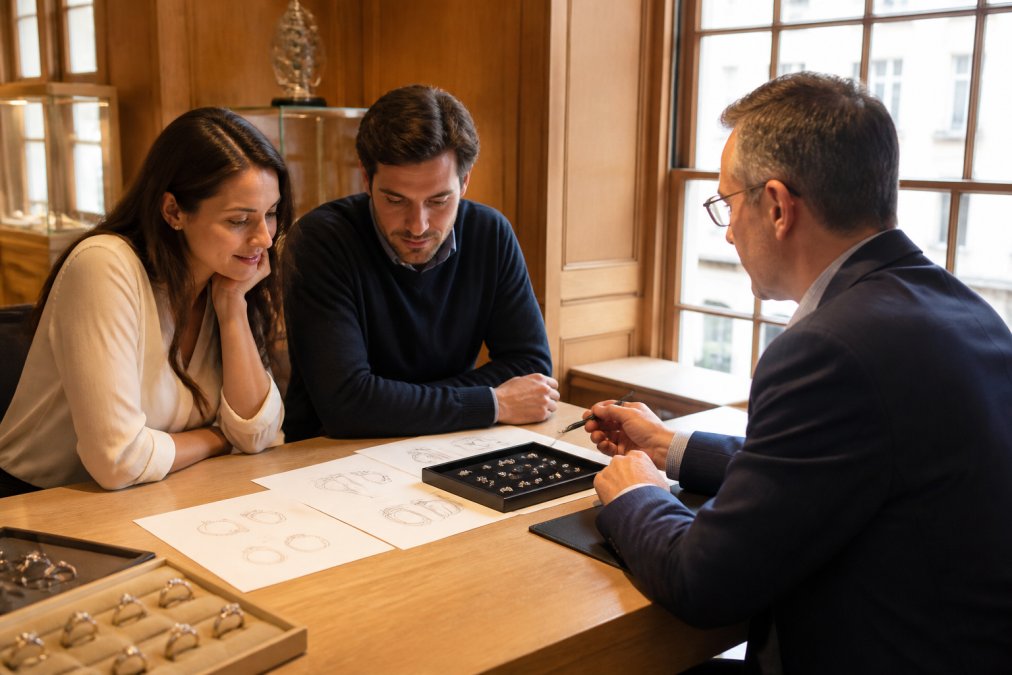
A realistic budget strategy starts with what you can afford, not what marketing suggests you should spend. Ignore the outdated rule of spending three months' salary; the right figure is one that does not compromise your other financial goals, such as a house deposit or your wedding fund. Once you set a total budget, you can allocate it between the stone and the setting in a way that maximises the visual impact you want.
Here is a simple framework to guide your allocation:
- Define your total ceiling based on savings and disposable income, not credit.
- Decide your priority: a larger centre stone or a more elaborate setting.
- Reserve 10-15% for hidden costs such as insurance and future resizing.
- Get a written quote that itemises stone, metal, and labour before committing.
Setting Stone vs Setting Allocation
A common question is how to split your budget between the diamond and the setting. As a general rule, allocate 60-70% of your budget to the centre stone, as it is the focal point and the primary driver of value. The remaining 30-40% covers the metal, the setting design, and any accent stones. If you prefer a statement halo or a detailed vintage setting, you may need to shift more toward the setting and choose a slightly smaller centre stone to stay within budget.
Payment Plans and Deposit Structures
Most bespoke jewellers require a deposit to begin work, typically 30-50% of the total, with the balance due on completion. This structure protects both parties: it secures your place in the workshop and covers the cost of materials before the craftsman begins. Some jewellers offer staged payments, allowing you to spread the cost across the design and crafting phases. Always confirm the payment schedule in writing before the commission starts, so there are no surprises at collection.
Hidden Costs and Long-Term Considerations
The price of the ring itself is only part of the financial picture. A bespoke piece is an investment, and protecting it requires planning for insurance, valuation, and future maintenance. These ongoing costs are small relative to the initial commission, but they are essential for peace of mind.
Insurance, Valuation, and Resale Value
Immediately after collection, you should have the ring insured. Most home insurance policies require a professional valuation certificate, which a reputable jeweller can provide (fca.org.uk). This valuation, based on the current replacement cost, is what your insurer will use to settle any claim. While a bespoke ring holds strong sentimental value, its resale value is typically lower than what you paid, as the second-hand market rarely recovers the full cost of custom craftsmanship. Buy for the lifetime of the piece, not as a financial investment.
Maintenance and Future Repairs
Precious metals and diamonds require periodic care. Plan for annual cleaning and inspection to check that prongs are secure and the setting is sound. Over time, platinum may need re-polishing to restore its lustre, and a prong that wears thin should be re-tipped before you risk losing a stone. Budgeting a small annual amount for maintenance, often less than 1% of the ring's value, protects your piece for decades of daily wear.
Bespoke vs Semi-Bespoke: Cost Comparison
If a fully bespoke commission feels out of reach, a semi-bespoke option offers a middle ground. A semi-bespoke ring uses an existing setting design, which you then customise by choosing your own centre stone and metal. This route reduces labour costs significantly because the setting is not designed from scratch, yet it still gives you a ring tailored to your taste and your finger size.
| Option | Design Flexibility | Typical Cost Range | Best For |
|---|---|---|---|
| Fully Bespoke | Complete from sketch | Higher (from £4,200) | Unique, complex designs |
| Semi-Bespoke | Choice of stone and metal | Moderate (from £1,650) | Custom look, lower budget |
Ethical Sourcing and Lab-Grown Diamond Costs
Ethical sourcing is an increasingly important factor in budgeting for bespoke engagement rings 2026. A lab-grown diamond offers the same chemical and optical properties as a natural stone but typically costs less, making it an attractive option for couples who want a larger carat weight within a fixed budget (peer-reviewed research). Natural diamonds, by contrast, carry the premium of their rarity and the assurance of ethical mining practices. Your choice here is personal, but it materially affects the price, so discuss both options with your jeweller to understand the quality and provenance of each.
Budgeting for a bespoke engagement ring is about balancing emotion with financial discipline. The process rewards couples who plan ahead, ask the right questions about carat weight, metal, and design complexity, and protect their purchase with proper insurance and care. With over nine decades of craftsmanship, the team at Peter George banks trading as Morgan Banks offers expert guidance through every stage, from the initial consultation to the final hallmark. Get started with us and commission a ring built to last a lifetime.
Frequently Asked Questions
How much should I budget for a bespoke engagement ring in 2026?
Bespoke engagement ring costs vary significantly based on stone quality, metal choice, and design complexity. A modest bespoke ring can start from £1,650 for smaller diamonds in platinum with simple settings. Mid-range pieces can be around £4,200, whilst premium bespoke designs with high-quality diamonds can reach £5,800. Your budget should reflect both the centre stone's carat weight and clarity grade, plus the complexity of the setting design and metalwork involved.
What factors influence the price of a bespoke engagement ring?
Several key factors affect bespoke ring pricing: diamond carat weight and colour/clarity grades are primary cost drivers; metal choice (platinum costs more than 18k gold); setting design complexity and labour hours required; the jeweller's craftsmanship level; and whether you source the diamond independently or through the jeweller. Additional costs include design consultations, 3D modelling, hallmarking, insurance valuation, and any special requests like ethical sourcing or lab-grown stones.
How long does the bespoke ring design process timeline take?
A typical bespoke engagement ring commission takes several weeks from initial design approval to final delivery. The timeline includes: initial consultation, design sketches and revisions, 3D modelling and approval, and the actual crafting and quality checks. Starting the process at least two to three months before your target date provides a comfortable buffer for revisions and unforeseen delays.
Is the 3 months' salary rule still relevant for engagement rings?
The 3 months' salary guideline is largely outdated and doesn't reflect modern financial priorities. Many couples now budget based on personal circumstances, lifestyle goals, and financial security rather than a fixed multiplier. For bespoke rings specifically, focus on what you can comfortably afford without compromising other financial goals. What matters is choosing a budget that aligns with your values and financial situation.
What are the differences between bespoke and semi-bespoke engagement rings?
Fully bespoke rings are entirely custom-designed from scratch, offering complete creative control over every aspect, stone, metal, setting style, and design details. Semi-bespoke options use pre-designed settings or frameworks that you customise with your choice of stone and minor modifications. Semi-bespoke typically offers customisation with faster delivery, whilst fully bespoke allows unlimited personalisation but costs more. Choose bespoke for truly unique designs; semi-bespoke if you want customisation with faster delivery.
Should I choose a lab-grown or natural diamond for my bespoke ring?
Lab-grown diamonds can cost less than natural diamonds of equivalent carat weight and quality, making them an excellent budget-friendly option for bespoke rings. They are chemically identical to natural diamonds and equally durable. Natural diamonds appeal to those valuing rarity and investment potential, though resale value varies. Ethical sourcing is often easier to verify with lab-grown stones. Both are excellent choices, your decision should reflect your values regarding cost, environmental impact, and whether you view the ring as an investment piece.
What payment options are available for bespoke engagement ring commissions?
Most jewellers offer flexible payment structures for bespoke commissions. Typical arrangements include: a non-refundable deposit to secure the design and begin work, a second payment upon design approval and before crafting begins, and a final payment upon completion. Discuss payment schedules during your initial consultation to find an option that suits your financial situation. Always clarify refund and amendment policies in writing.
How should I allocate my budget between the stone and the setting?
A common allocation is 60-70% of your total budget towards the centre stone and 30-40% towards the setting, metal, and labour. However, this varies based on your priorities. If you prefer a larger stone, allocate more towards the diamond and choose a simpler setting. If design complexity and craftsmanship matter most, invest more in the setting. For bespoke work, discuss this allocation with your jeweller, they can advise how to maximise visual impact within your budget and suggest stone/setting combinations that offer the best value.