
Last Updated: November 4, 2026
Quick Summary
Wedding ring hallmarking is the set of stamped marks that shows a ring's metal content and who vouched for it. Check three compulsory marks on the inside band: a sponsor's mark, a fineness mark such as 750, and an assay office mark. Missing marks are a warning sign.
- Check the inside of the band, where most hallmarks are struck.
- A fineness number such as 375, 585 or 750 gives metal purity in parts per thousand.
- The four UK assay offices are London, Birmingham, Sheffield and Edinburgh.
- Verify the sponsor's mark against the assay office's searchable register before paying.
- Ask whether a resized or repaired ring was re-hallmarked, and check the fineness mark is still present.
Table of Contents
- What a Hallmark Tells You Before You Buy
- The Three Compulsory Marks on a UK Wedding Ring
- UK hallmark symbols explained, step by step
- How to identify gold purity marks with a loupe
- Date letters, optional marks and resized or repaired rings
- Hallmarking requirements for precious metals and what the law says
- Booking Your Wedding Ring Consultation at Morgan Banks
- Frequently Asked Questions
What a Hallmark Tells You Before You Buy
Wedding ring hallmarking is the small set of stamped marks that tells you what a ring is made of and who vouched for it. Morgan Banks has been a fine jeweller in Kendal since 1935, and the hallmark is a good first thing for any buyer to check.
A hallmark is a legal guarantee of precious metal content, not a decoration (Hallmarking: practical guidance - summary). In the United Kingdom, the Hallmarking Act 1973 and the government's hallmarking guidance sets out which marks must appear on precious metal items sold in the UK.
Before you buy, look for three things: a fineness mark, a sponsor's mark and an assay office mark. Together they show the metal's purity, who put the ring on sale, and which independent assay office tested it.
Here is a quick way to start:
- Check the ring's inside band, where most marks are stamped
- Look for a number such as 585 or 750 next to a metal symbol
- Confirm the sponsor's mark and assay office mark are present
- Ask the seller to show you the marks before paying
The Three Compulsory Marks on a UK Wedding Ring
Every precious metal wedding ring sold in the UK needs three compulsory marks. Missing marks are a warning sign, so take your time.
Sponsor's mark explained
The sponsor's mark identifies the business that sent the item for assay. It is usually a few initials, sometimes inside a shape. The sponsor takes legal responsibility for the item's description.
Fineness mark and parts per thousand
The fineness mark states the metal's purity as parts per thousand. For example, 375 means 37.5% pure gold, 585 means 58.5%, and 750 means 75%. Platinum is usually marked 950. A lower number does not mean a poor ring; it tells you the alloy content.
Assay office mark
The assay office mark shows which independent office tested the metal. The four UK assay offices are London, Birmingham, Sheffield and Edinburgh. Each uses its own symbol, such as a crown for London or an anchor for Birmingham.
The three compulsory marks each tell you something different about a ring, as summarised below.
| Mark | What it shows | Example |
|---|---|---|
| Sponsor's mark | The business that sent the item for assay | Initials, sometimes inside a shape |
| Fineness mark | Metal purity in parts per thousand | 375 = 37.5% gold; 750 = 75% |
| Assay office mark | Independent office that tested the metal | Crown (London); anchor (Birmingham) |
UK hallmark symbols explained, step by step
Work through the ring in this order. With a loupe and good light it takes under five minutes, and it is the same sequence an assay office would expect you to follow.
- Find the inside of the band. Most hallmarks are struck there, usually on the flat section opposite the setting. On very narrow bands the marks may run around the curve, so rotate the ring slowly under the loupe rather than tilting it.
- Identify the metal symbol first. Sterling silver carries the lion passant; platinum carries the orb and cross; palladium carries the head of Pallas Athene; gold carries no metal symbol of its own, so the fineness number does the work. A crown is sometimes used on platinum in place of the orb, depending on the assay office and date.
- Read the fineness number beside the symbol. Gold is marked 375, 585, 750, 916 or 990; platinum 950 (occasionally 999); palladium 500 or 950; silver 925 or 958. The number is parts per thousand, so 750 means 75% pure gold.
- Find the assay office symbol and check it against the official list. The four offices use: London (a leopard's head, and since 1975 a crown for gold and silver), Birmingham (an anchor), Sheffield (a rose) and Edinburgh (a castle). A mark you cannot match to one of these four is a reason to stop and ask questions.
- Locate the sponsor's mark, usually two or three initials in a shaped outline, and the date letter if one is present. The sponsor's mark is the one you can verify independently: each assay office publishes a searchable register of sponsor marks, so you can confirm the initials belong to a real, registered business before you pay.
Watch out: worn or resized rings can lose sharp marks. If a stamp looks smudged, ask for a closer look rather than guessing, and never accept a verbal assurance in place of a legible mark.
Seeing the marks without a jeweller's bench
Most buyers do not own a loupe, and phone cameras have improved enough to close much of the gap. A practical approach:
- Use a 10x loupe if you have one; 10x is the standard magnification assay offices work to, and higher powers narrow the field of view too much for a curved band.
- On a smartphone, switch to the main rear lens (not the ultra-wide), enable macro mode if available, and hold the phone 3-5 cm from the band with the ring resting on a dark, non-reflective surface. Tap to focus on the mark and use the 2x or 3x zoom rather than moving closer, which usually loses focus.
- Light the mark from the side rather than straight on. Raking light throws the stamped edges into relief, which is what makes a worn mark readable.
- Photograph each mark separately and enlarge the image. A mark that looks like a smudge at arm's length often resolves into a clear number once enlarged.
How to identify gold purity marks with a loupe
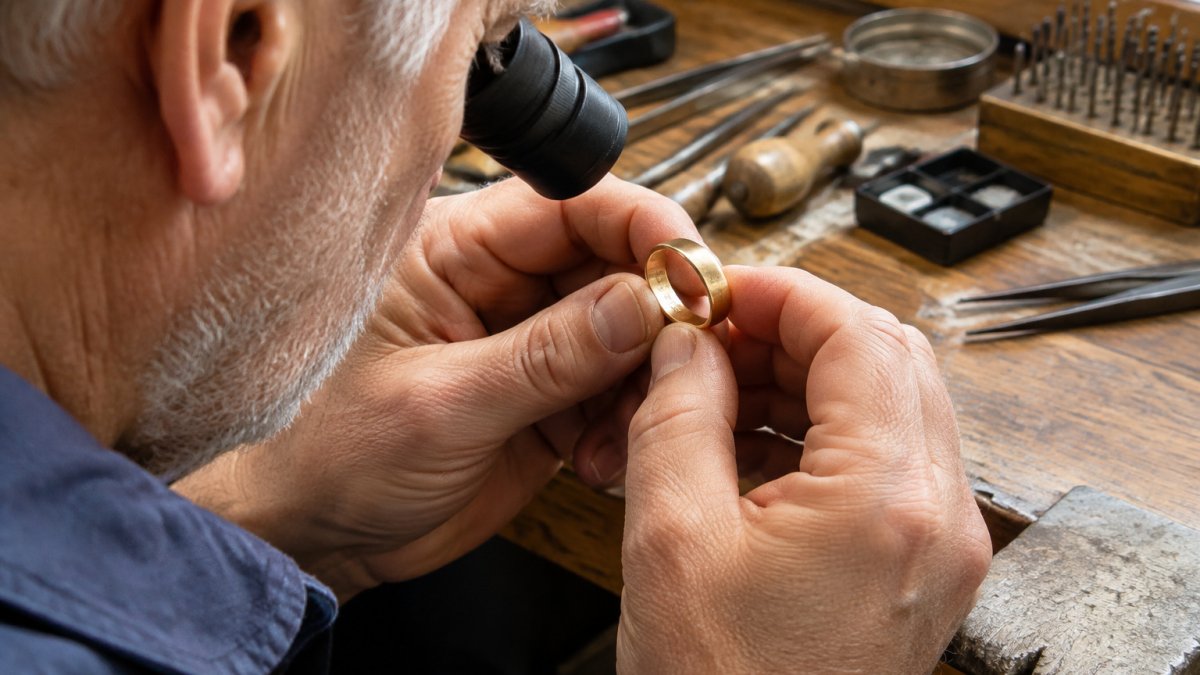
A jeweller's loupe, usually 10x magnification, can help you read marks that look blurred to the naked eye. Hold the ring steady, bring the loupe close, and check each mark in turn.
Platinum and Yellow Gold Wedding Ring Size Y LE →
Gold purity marks are the fineness numbers. Check that the number matches the metal stated next to it. A 9ct ring should carry 375, while an 18ct ring carries 750. Compare what you see with the seller's paperwork.
Date letters, optional marks and resized or repaired rings
A date letter shows the year the item was assayed. Each letter cycle is a fixed period, so use an official date letter chart rather than guessing.
Optional marks, such as a retailer's own mark, do not replace the compulsory three. Resized or repaired rings can lose original marks or gain new ones. If a ring has been resized, ask the jeweller whether it was re-hallmarked, and check that the fineness mark still sits on the band.
Hallmarking requirements for precious metals and what the law says
Under the Hallmarking Act 1973, precious metal items above the minimum weight must be hallmarked before they are offered for sale. Very small items can fall below the weight thresholds, which is why some fine chains and tiny stone settings may carry no marks. A wedding ring is almost always well above the threshold, so a missing hallmark on a ring is a genuine warning sign rather than an exemption.
The Act also places duties on the dealer, not just the maker, and it is an offence to describe an unhallmarked item as gold, silver, platinum or palladium (legislation.gov.uk). That is why a reputable seller will show you the marks without being asked, and why a seller who deflects the question is telling you something.
How to verify a mark independently
A hallmark is only as good as your ability to check it, and the verification route is public:
- Each of the four assay offices maintains a searchable register of sponsor marks. Search the sponsor's initials and confirm the business is registered and trading.
- Compare the fineness number against the metal the seller has stated. A ring described as 18ct should read 750; 9ct should read 375; platinum should read 950.
- If a mark looks inconsistent, ask the seller for the assay office's own description of the item, or ask them to send it for re-assay before you pay.
Resized, repaired and re-hallmarked rings
This is where buyers most often get caught out. Resizing can cut through or obliterate the original marks, and a ring that has been altered may need re-hallmarking. Laser marking is sometimes used for repairs, but a laser mark can look shallower and less crisp than an original strike. If a ring has been resized, ask whether it was re-hallmarked, by which assay office, and check that the fineness mark still sits on the band rather than on a soldered-in section.
Watch out: a hallmark confirms metal content, not stone quality, setting security or workmanship. It is a guarantee of purity and origin, and nothing more, so treat it as one check among several rather than a substitute for a proper inspection.
A hallmark gives you a recognised check on the metal content, whereas without marks you rely on the seller's word.
Booking Your Wedding Ring Consultation at Morgan Banks
Our team can talk you through hallmarks and help you choose a ring that suits your budget and style. Explore our book a wedding ring consultation service, or browse our all my love wedding rings in platinum and yellow gold, from £1,995.00. For a plain 9ct option, the 9ct rose and white gold wedding band is priced at £460.00, and our 9ct white gold 4mm band starts at £450.00.


Frequently Asked Questions
What are the three compulsory marks on a UK hallmark?
A UK hallmark carries three compulsory marks: the sponsor's mark, which identifies the maker or importer who submitted the item; the fineness mark, which states the metal's purity in parts per thousand (for example 375 for 9ct gold or 750 for 18ct gold); and the assay office mark, which shows the independent assay office that tested and marked the piece. A date letter is also usually struck, though it is not one of the three compulsory marks. Check all three before paying, and ask the jeweller to show you the marks if they are faint.
Is it illegal to sell jewellery without a hallmark in the UK?
Under the Hallmarking Act 1973, precious metal items above the legal minimum weight must be hallmarked before they are sold in the UK, and it is an offence to sell unmarked articles that should carry a hallmark. Certain items are exempt, and some smaller pieces fall below the weight thresholds. If you are unsure whether a ring should carry a hallmark, ask the seller directly and request the assay office details in writing before you buy.
How can I tell if my gold wedding ring is real?
Start by looking for a fineness mark such as 375, 585, 750 or 916 and a recognised assay office mark. Use a jeweller's loupe to check the stamps are clear and crisp rather than shallow or uneven. A hallmark alone does not prove authenticity, so buy from a reputable jeweller who can show the assay details, and have a valuation or testing done if the ring has no marks or has been altered.
What does the date letter on a hallmark mean?
The date letter shows the year the item was assayed and marked. Each assay office uses its own letter sequence and cycle, so the same letter can represent different years at different offices. Use a current UK date letter chart from the assay office to decode it. The date letter helps you establish the age of an item, which matters for antique and pre-owned rings, but it does not on its own confirm the metal's purity.
