
Table of Contents
- Why Handmade Jewellery Design Still Matters in 2026
- Bespoke Jewellery Design: What Sets It Apart
- The Custom Engagement Ring Process: From Sketch to Stone
- How to Commission Handmade Jewellery: A Step-by-Step Guide
- Design Ideas: From Botanical Motifs to Personalised Engraving
- DIY vs Professional Commissioning: Which Path Suits You?
- Ethical Sourcing, Recycled Materials, and Investment Value
- Frequently Asked Questions
Last Updated: September 21, 2026
Why Handmade Jewellery Design Still Matters in 2026
Handmade jewellery design means creating wearable pieces by hand: an artisan shapes metal, sets stones, and finishes every surface in a studio rather than on a factory line. At Morgan Banks, we have watched this approach hold its ground since 1935.
Mass production can copy a shape, but not the decisions a maker makes at the bench. A hand-finished piece carries small irregularities a mould cannot reproduce, exactly what buyers now seek out in a market flooded with identical castings.
Below, we explain what separates handmade jewellery design from off-the-shelf buying, how commissioning works, and where the real value sits.
Bespoke Jewellery Design: What Sets It Apart
Bespoke jewellery design means creating a piece from scratch around one client's specifications rather than altering an existing design. The client sets the brief and the maker solves it.
Independent Makers vs High Street Brands
An independent maker works at a bench, often alone or in a small studio, taking on a limited number of commissions each year. A high street brand works from a fixed catalogue and a supply chain built for volume.
If you want a design that already exists, the high street is faster and cheaper. If you want a piece reflecting a particular idea, an independent maker is the only route.
Traditional Techniques and Materials
Traditional techniques such as hand-piercing, filing, soldering, and stone setting remain the backbone of studio work. A maker cuts a seat for each stone by hand so it sits flush, then polishes the metal around it, slow work, and the reason a hand-set piece looks different under light.
Materials range from sterling silver and recycled gold to gemstones chosen stone by stone. The Hallmarking guidance from the Assay Offices of Great Britain explains why precious metal items sold here must carry a hallmark, which is your assurance of metal purity. A hallmark is not decoration. It is a legal record of what the piece is made of.
The Custom Engagement Ring Process: From Sketch to Stone
The custom engagement ring process runs through five stages: consultation, sketch, 3D rendering, casting or fabrication, and stone setting. You approve a design before any metal is cut.
That answers the question we hear most often: How do I know the bespoke ring you design will actually look like what I'm imagining? Can I see sketches or a 3D model before you start making it? You see it first.
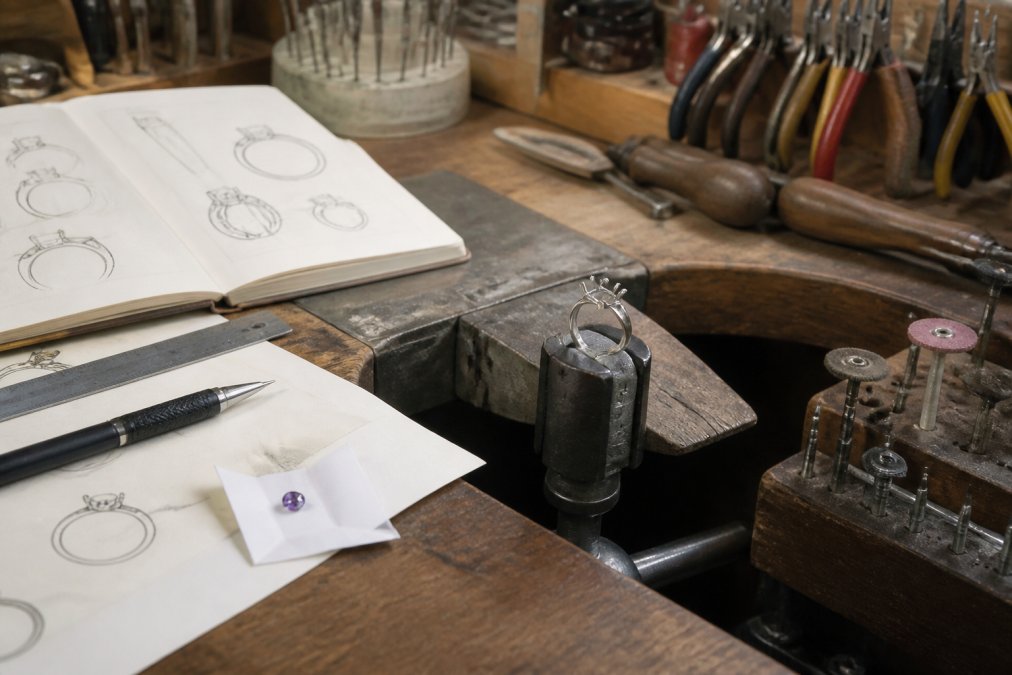
- Consultation. You describe the style, budget, and any stone you already own. The maker asks about hand size, wear patterns, and lifestyle.
- Sketch. Hand drawings translate your brief into a shape you can react to. Most real decisions happen here.
- 3D render or wax model. You see the piece in three dimensions and request changes before anything is cast.
- Fabrication. The maker casts or hand-builds the band, then files and solders it.
- Setting and finishing. The stone is set, the metal polished, and the piece hallmarked.
Expected result: a finished ring that matches an approved design, not an approximation of one.
How to Commission Handmade Jewellery: A Step-by-Step Guide
Commissioning handmade jewellery means briefing a maker, approving a design, and paying in stages. Most commissions take several weeks to a few months depending on complexity.
The process can run remotely: measurements can be taken at a local jeweller and sent on, and sketches and renders reviewed by email or video call. This addresses the question: I'm not local to Kendal, so how does the process work if I want a custom ring made? Do I have to visit in person multiple times, or can we do this remotely?
What to Prepare Before Your First Consultation
Arriving prepared shortens the process and usually reduces the final cost, because fewer design revisions are needed.
Mixed Metal Curved Feather Bracelet →
- Two or three reference images of styles you like, and one you dislike
- Your budget range, stated plainly
- Ring size, or a ring that already fits
- Any inherited stones or metal you want reused
- Your deadline, and whether it is fixed
- Notes on daily wear: manual work, sport, or gloves
| Stage | Typical Duration | What You Approve |
|---|---|---|
| Consultation | 1 session | Brief and budget |
| Sketch | 1-2 weeks | Overall design |
| 3D render or wax | 1-2 weeks | Proportions and detail |
| Fabrication | 3-6 weeks | Metal and finish |
| Setting and hallmarking | 1-2 weeks | Final piece |
Design Ideas: From Botanical Motifs to Personalised Engraving
Botanical motifs, geometric metalwork, and personalised engraving are the three most requested directions in studio work right now. What follows is an editorial read on where they are heading, not a catalogue.
Botanical Motifs: Specificity Beats Symmetry
The strongest botanical work follows a real plant rather than a generic leaf. A maker can take a cutting from your garden, trace its silhouette, and translate the line into a band or pendant. The result reads as deliberately asymmetric, because the plant itself was asymmetric.
Geometric Metalwork: Where the Trend Is Moving
The architectural direction is shifting from hard, uniform angles towards softened geometry: a hexagonal band with rounded corners, a square pendant with a brushed rather than mirrored face. The reason is wearability, a true sharp edge catches on clothing and shows every knock, so a maker radii the corners by hand even when the design reads as angular.
Personalised Engraving: The Quiet Option, Done Properly
Engraving is the least visible and most personal element of a piece. A date, coordinates, a short phrase, or a child's handwriting, cut inside a band or on the reverse of a pendant, is seen only by the wearer, and that privacy is the point.
How to Brief a Design Direction
Bring two or three reference images of styles you like and one you dislike, the dislike is often more useful, telling the maker which direction to avoid. Then describe the piece in plain language: what it is for, how often it will be worn, and what it should feel like in the hand. A maker can translate that into a sketch far more reliably than a list of technical terms.
DIY vs Professional Commissioning: Which Path Suits You?
DIY jewellery making suits simple pieces and patient beginners. Professional commissioning suits anything involving precious stones, precise sizing, or a deadline.
Ethical Sourcing, Recycled Materials, and Investment Value
Ethical sourcing means knowing where your metal and stones came from, and being able to ask without an evasive answer. The useful part is what comes next: how you verify a claim, and what gives a handmade piece value over time.
How to Verify a Sourcing Claim
A credible maker can answer three questions without hesitation. Where was the metal refined? Where was the stone cut and polished? And can the answer be traced through documentation rather than memory?
Recycled Gold and Silver: What Changes, What Does Not
Recycled gold and recycled silver are chemically identical to newly mined metal: the same alloy, working properties, and behaviour under the torch. What changes is the supply chain behind them, not the material in your hand.
The Investment Value of a Handmade Piece
Be realistic about what investment means here. A handmade piece holds value better than a mass-produced one because it is unique, traceable, and made in small numbers, but it is not a financial instrument and should not be bought as one.
Frequently Asked Questions
What are the current trends in handmade jewellery design?
Recycled metals and ethical sourcing are central to handmade jewellery design in 2026. Botanical motifs, asymmetrical gemstone settings, and personalised engraving remain popular. Buyers increasingly seek one-of-a-kind pieces that reflect their values, favouring artisan-made work over mass-produced alternatives. Sustainable luxury and traceable raw materials now influence design choices as much as aesthetics.
How long does the bespoke jewellery design process take?
A bespoke commission typically takes four to eight weeks from initial consultation to finished piece. The design phase, including sketches and a 3D model for approval, usually takes one to two weeks. Fabrication and gemstone setting add another three to six weeks depending on complexity. Hand-finished pieces with intricate metalwork or custom-cut stones may take longer, so plan ahead for engagement deadlines.
What should I consider when commissioning a custom engagement ring?
Start with a clear budget and decide on the metal and gemstone. During the custom engagement ring process, ask to see sketches or a 3D model before fabrication begins. Confirm the hallmarking, warranty, and aftercare terms. If you are not local, ask whether the consultation can be done remotely. A reputable jeweller will guide you through stone selection and ring sizing without pressure.
Is handmade jewellery a good investment compared to mass-produced pieces?
Handmade pieces often hold value better because of their craftsmanship and limited production. Heirloom-quality construction, hallmarked precious metals, and one-of-a-kind design contribute to long-term worth. While not a financial asset in the traditional sense, a well-made bespoke ring or pendant can be passed down and retains sentimental and material value far longer than high-street alternatives.