
Table of Contents
- What Bespoke Jewellery Design Actually Means
- The Role of a Master Jeweller in a Bespoke Commission
- The Custom Engagement Ring Process: From Brief to Hallmark
- Bespoke Jewellery Design in the UK: Ethical Sourcing and What to Ask
- How Much Does Bespoke Jewellery Cost?
- Technical Limitations and Honest Expectations
- Maintenance, Aftercare, and Long-Term Value
- Conclusion
Last Updated: August 27, 2026
What Bespoke Jewellery Design Actually Means
Bespoke jewellery design is the process of creating a one-of-a-kind piece from scratch, built entirely around the client's vision, measurements, and chosen materials. Nothing is pulled from a display case. Nothing is adapted from a standard template. The piece exists because you commissioned it, and for no other reason.
At Morgan Banks, a fine jewellery specialist established in 1935, this is precisely the kind of work we understand best. The distinction matters because the word "bespoke" is used loosely in the industry. Some retailers use it to mean "we can engrave your initials." True bespoke jewellery design means a master jeweller starts with a blank brief and ends with a hallmarked piece that has never existed before.
The process draws on centuries of craft tradition. According to the Goldsmiths' Company, the UK's historic authority on precious metals and hallmarking, bespoke commissions represent the highest expression of the jeweller's craft, requiring skills that take years to develop at the bench. That context matters when you're deciding whether to commission a piece or buy off the shelf.
The appeal is straightforward: a tailor-made piece fits your story, your aesthetic, and often your finger size, in a way that mass-produced jewellery simply cannot. For engagement rings in particular, bespoke is the only route to something genuinely irreplaceable.
The Role of a Master Jeweller in a Bespoke Commission
Most guides focus on the design side of a bespoke commission and underplay the technical craft. That's a mistake.
A master jeweller is not simply an artisan who follows instructions. They advise on what is structurally achievable, which metals will hold a particular setting securely, and how a design will wear over decades rather than just look good in a sketch. The design brief you bring to the initial consultation is the starting point, not the specification.
In a serious bespoke service, the master jeweller acts as a technical editor. They will tell you if a claw setting is too delicate for daily wear, if a chosen gemstone is too fragile for a particular cut, or if a design element that looks elegant in a CAD render will be uncomfortable on the hand. This is expertise you cannot replicate by browsing an online configurator.
The jewellery bench is where the commission becomes real. Casting, setting, and polishing are all done by hand, and the quality of that handcrafted work determines whether the finished piece matches the promise of the design. Craftsmanship at this level is the reason a bespoke commission takes weeks, not days.
The Custom Engagement Ring Process: From Brief to Hallmark
The custom engagement ring process follows a structured sequence. Understanding each stage helps you set realistic expectations for timelines, revisions, and the final result.

Initial Consultation and Design Brief
The design brief is the foundation of every successful bespoke commission. This is the conversation where you describe the design aesthetic you have in mind, the budget you are working with, and any practical requirements such as the wearer's lifestyle or existing jewellery they want the piece to complement.
A skilled jeweller will ask questions you haven't thought to answer. What metals does the recipient usually wear? Do they work with their hands? Are there any gemstones with personal significance? The more specific your brief, the more precisely the design can be tailored.
For clients who are not local, this consultation can often be conducted remotely. A detailed conversation by video call, combined with photographs and reference images, can establish a thorough brief without requiring an in-person visit at this stage.
Sketching, CAD Design, and Wax Modelling
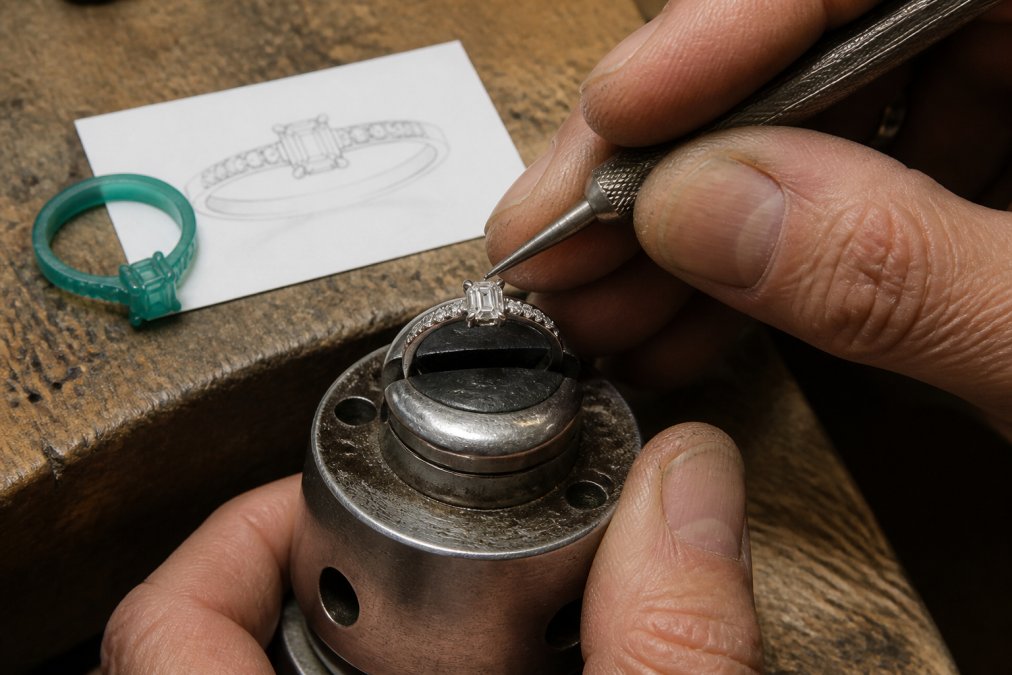
Once the brief is agreed, the jeweller produces technical drawings. These early sketches capture the proportions, the stone positions, and the overall silhouette of the piece. They are the first moment the commission moves from conversation to something visible.
CAD design follows. Computer-aided design software allows the jeweller to model the piece in three dimensions, refining details that are difficult to convey in a hand sketch. You can view the design from every angle, check stone proportions, and request adjustments before any precious metal is committed.
From the approved CAD model, a wax model is produced. This physical prototype is the most useful tool in the process for clients: you can hold it, wear it on your finger, and understand the scale in a way that a screen image cannot replicate. Revisions at the wax stage are straightforward. Revisions after casting are expensive. This is why the wax model stage exists.
Casting, Setting, and Polishing at the Jewellery Bench
With the wax model approved, the jeweller moves to casting. The wax is used to create a mould, and the chosen precious metal, whether platinum, white gold, yellow gold, or rose gold, is cast into the form. The raw casting then goes through a sequence of bench work: filing, refining the surface, and preparing the settings.
Stone setting is among the most technically demanding stages. Each gemstone is secured by hand, whether in claw, bezel, pavé, or channel settings. The setter works under magnification, and the security of each stone depends entirely on their skill.
Polishing brings the piece to its finished state. Once complete, the piece must be submitted for hallmarking. As required by the UK Hallmarking Act 1973, administered by the Assay Office, all precious metal items sold in the UK above a minimum weight threshold must carry an approved hallmark. This is your legal guarantee of the metal's purity, and it is not optional.
Bespoke Jewellery Design in the UK: Ethical Sourcing and What to Ask
Ethical sourcing is one of the angles that luxury brand pages consistently gloss over, and it deserves a direct answer.
Gemstone sourcing has a complicated history. Diamonds, in particular, have been associated with conflict financing in certain regions. The Kimberley Process Certification Scheme, the international standard for conflict-free diamonds provides a baseline assurance, but many clients now ask for more: specific provenance, recycled precious metals, or lab-grown alternatives.
A reputable bespoke jeweller should be able to answer questions about where their stones come from. If they cannot, that is worth noting. Specific questions to ask include:
- Are your diamonds Kimberley Process certified?
- Can you source recycled or Fairtrade gold?
- Do you offer lab-grown gemstone alternatives?
- Can you trace the origin of a specific stone if I request it?
Sustainability in bespoke jewellery design is not a niche concern. Many clients commissioning engagement rings in 2026 place significant weight on ethical sourcing, and a jeweller who takes this seriously will have clear, confident answers rather than vague reassurances.
How Much Does Bespoke Jewellery Cost?
Bespoke jewellery costs more than equivalent off-the-shelf pieces, and the reasons are worth understanding rather than simply accepting.
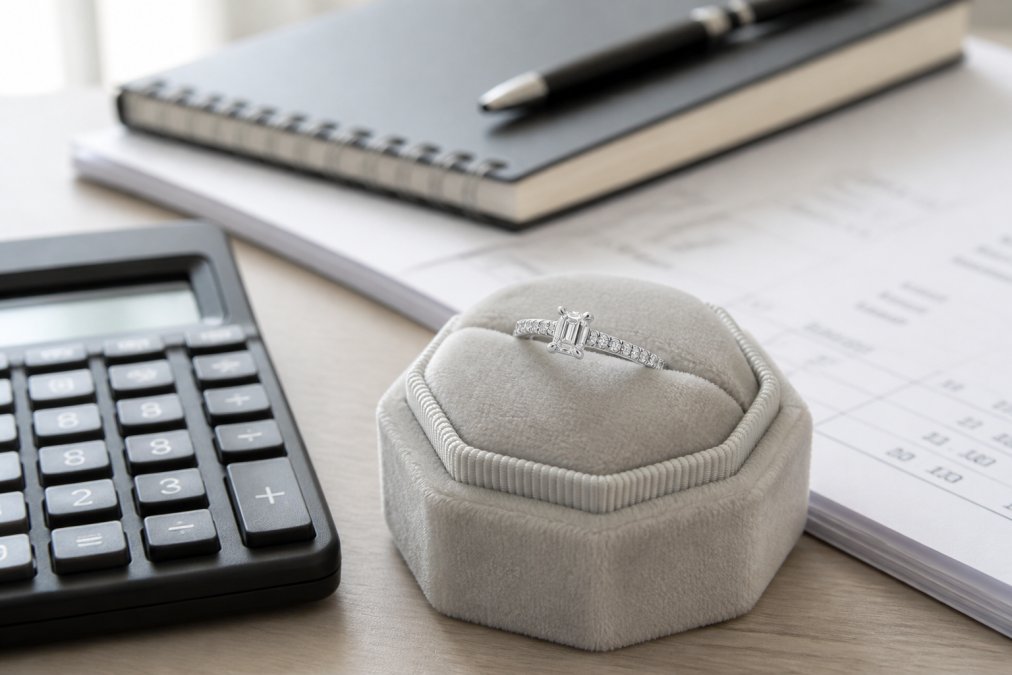
The price of a bespoke commission reflects the cost of the materials, the jeweller's time across multiple stages, CAD design and wax modelling, stone sourcing, and the bench work involved in handcrafting the finished piece. Each of those stages has a real cost that a production-line ring does not incur.
For a bespoke engagement ring, the range is broad. A straightforward solitaire in white gold with a modest diamond will cost considerably less than a complex multi-stone design in platinum. As a reference point, Morgan Banks offers a Platinum Emerald Cut Engagement Ring .25ct F VS2 with Round Brilliant Shoulders .25ct G SI at £1,900. That gives a sense of what a quality platinum piece with certified stones looks like at the entry level of a bespoke service.
| Factor | Lower Cost | Higher Cost |
|---|---|---|
| Metal | 9ct or 18ct gold | Platinum |
| Centre stone | Smaller, lower grade | Larger, higher grade |
| Design complexity | Simple solitaire | Multi-stone, intricate setting |
| Stone sourcing | Standard supply | Specific provenance or lab-grown |
| Lead time | Standard queue | Expedited commission |
The honest answer to whether bespoke is worth the premium is this: if the piece matters, it is. A ring you wear every day for the rest of your life is not the place to optimise for the lowest possible cost.
Technical Limitations and Honest Expectations
This is the part most guides skip entirely.
Not every design is achievable. Some ideas that look striking in a sketch or a mood board are structurally impractical. Very fine claw settings on stones heavier than a certain carat weight will not hold securely over time. Extremely thin band profiles in softer gold alloys will deform with regular wear. Some gemstones, including many emeralds and opals, are too fragile for everyday ring wear regardless of how they are set.
A good jeweller will tell you this before you commit. A less scrupulous one will make what you ask for and let you discover the problems later. The design consultation exists partly to filter out ideas that will not survive contact with real-world wear.
Lead time is the other honest expectation to set. A properly executed bespoke commission typically takes several weeks from approved brief to hallmarked piece. Rushing the process compresses the stages where errors are caught. If you have a specific date in mind, build your timeline backwards from that date and add a buffer.
Maintenance, Aftercare, and Long-Term Value
A bespoke piece is an investment in more than sentiment. Treated correctly, a well-made handcrafted ring or pendant will outlast its owner. Treated carelessly, even a beautifully made piece will show its age prematurely.
Routine maintenance for fine jewellery includes professional cleaning every twelve to eighteen months, inspection of claw settings for wear, and re-polishing as needed. Claws are the most vulnerable component of any stone-set piece: they wear gradually with daily contact, and a claw that has thinned significantly will eventually fail. Catching this at an inspection is straightforward. Replacing a lost stone is expensive and, in the case of a one-of-a-kind piece, sometimes irreplaceable.
Resale value is a question worth addressing directly. Bespoke jewellery does not carry the same resale liquidity as a recognised brand piece. The craftsmanship has real value, but a one-of-a-kind design is harder to price on the secondary market than a standardised piece. If resale value is a primary consideration, that is worth factoring into the decision between bespoke and a well-known branded piece.
Where bespoke genuinely outperforms off-the-shelf over the long term is in repairability. Because the piece was made by a skilled jeweller, it can be repaired, resized, and restored by a skilled jeweller. Mass-produced pieces with proprietary settings or unusual alloys can be difficult to work on. A traditionally made bespoke commission, documented with technical drawings and CAD files, can be reproduced or restored with confidence.
For guidance on caring for precious metal jewellery, the National Association of Jewellers' consumer advice on jewellery care provides practical, independent recommendations on cleaning, storage, and when to seek professional inspection.
The decision to commission a bespoke piece is rarely straightforward, but the process itself is less opaque than it appears. Morgan Banks has been guiding clients through bespoke jewellery design since 1935, with the expertise to take a brief from initial concept through CAD design, handcrafted bench work, and hallmarking to a finished piece that is genuinely one of a kind. If you are ready to begin a commission, or simply want to explore what is possible within your budget, speak with our team and take the first step toward a piece made entirely for you.
Frequently Asked Questions
What does 'bespoke' mean in the context of fine jewellery?
Bespoke jewellery is custom-made from scratch to a client's specific brief. Unlike off-the-shelf pieces, a bespoke commission begins with your design concept, your choice of metal, gemstones, and aesthetic, and is handcrafted by a master jeweller to match. The result is a one-of-a-kind piece that no one else owns. The term comes from tailoring, where fabric was 'bespoken for' a specific customer, and the same principle applies to bespoke jewellery design.
How long does the bespoke jewellery design process take from start to finish?
Lead times vary depending on complexity, but most bespoke commissions take several weeks from initial consultation to finished piece. Simple designs with standard precious metals and readily available gemstones sit toward the shorter end. Intricate settings, rare gemstone sourcing, or pieces requiring multiple rounds of CAD design approval will extend the timeline. Always discuss your deadline at the first consultation so your jeweller can manage the schedule realistically.
How much does it cost to commission a bespoke engagement ring?
Bespoke jewellery cost depends on the metal, gemstone quality, and design complexity. A platinum engagement ring with a certified diamond can start from around £1,900, such as our [Platinum Emerald Cut Engagement Ring .25ct F VS2 with Round Brilliant Shoulders .25ct G SI](https://morganbanks.co.uk/products/platinum-emerald-cut-engagement-ring-25ct-f-vs2-with-round-brilliant-shoulders-25ct-g-si), and rise significantly for larger stones or intricate settings. The bespoke process itself adds craftsmanship value over a mass-produced equivalent, but you gain a tailor-made piece with documented provenance. Ask your jeweller for a detailed quote after the design brief is agreed.
Can I see a sketch or 3D model before the ring is made?
Yes. A reputable bespoke jewellery designer will show you technical drawings and, in most cases, a CAD design or 3D-printed wax model before any precious metal is cast. This approval stage is standard practice and protects both parties. You should never commit to the full commission fee without reviewing and approving the design at this stage. If a jeweller skips this step, treat it as a warning sign and ask explicitly for a visual sign-off before work begins.
This article was written using GrandRanker