
Table of Contents
- What Makes an Engagement Ring Eco-Friendly?
- Fairtrade Gold vs Recycled Gold: Which Is More Ethical?
- Lab-Grown Diamonds vs Mined Diamonds: Purity, Alloys and Trade-Offs
- Our Eco-Friendly Engagement Rings for Women
- The Bespoke Engagement Ring Design Process, Step by Step
- How to Measure Ring Size at Home
- Conclusion
- Frequently Asked Questions
Last Updated: October 2, 2026
What Makes an Engagement Ring Eco-Friendly?
An eco-friendly engagement ring is one whose metal and stones are sourced, refined and set with a documented, reduced impact on people and the planet.
The metal matters more than most buyers expect: gold mining is energy-intensive, and conditions vary enormously between industrial operations and artisanal and small-scale mining. The stone matters just as much, because a lab-grown diamond avoids extraction entirely.

At Morgan Banks, we have been making and restoring fine jewellery since 1935, and the questions we hear have shifted.
Below, we break down the two routes, the certification that actually means something, and the five rings in our own collection that meet the standard.
The Two Main Routes: Mined and Lab-Grown
Every ring follows one of two paths. Mined material is extracted from the earth, then cut, polished and traded through a supply chain that can involve many hands. Lab-grown material is created in a controlled facility, then cut and polished the same way. The practical difference comes down to three things:
- Traceability: a lab-grown stone's origin is recorded at creation; a mined stone's journey depends on every party in the chain
- Environmental impact: extraction moves significant volumes of rock and uses water and energy at scale
- Price: lab-grown stones typically cost less per carat, freeing budget for a larger centre stone or finer metal
Neither route is automatically "ethical". A lab-grown diamond set in untraceable gold is only half the story.
Fairtrade Gold vs Recycled Gold: Which Is More Ethical?
Fairtrade gold and recycled gold solve different problems and are not directly comparable.
Fairtrade gold is certified under a standard that sets requirements for fair wages, safe working conditions and restrictions on child labour within artisanal and small-scale mining communities. The Fairtrade Foundation's gold standard sets out the premium paid back to mining communities and the environmental requirements producers must meet. The premium is paid on top of the market price and is ring-fenced for community projects, which is why Fairtrade gold typically carries a visible cost premium over conventional metal. If your priority is social responsibility and supporting mining communities directly, this is the route that does it.
Recycled gold is refined from existing precious metals drawn from jewellery, industrial scrap and the secondary market, so no new extraction takes place.
So which is more ethical? If you care about the people who dig, Fairtrade. If you care about land disturbance and carbon footprint, recycled.
Traceability: Where Each Route Breaks Down
The two routes fail in different places, and knowing where tells you what to ask.
Fairtrade's weak point is coverage. Certification applies to specific mining operations, so a Fairtrade ring should be traceable to a named co-operative or mine.
Recycled gold's weak point is provenance. There is no equivalent certification body for recycled metal.
The Greenwashing Problem in Recycled Gold
Recycled gold has a marketing problem, and buyers should know about it before paying a premium.
The term "recycled" is not tightly regulated the way Fairtrade certification is. A supplier can describe metal as recycled without documenting its origin, refining date, or what proportion of the ring is genuinely secondary material. Some rings labelled recycled contain a mix, with only the visible band made from reclaimed metal; others are called recycled because the manufacturer bought scrap from a refiner, with no audit trail connecting scrap to finished piece. Here is what to ask instead of accepting the label:
- What proportion of the metal by weight is recycled?
- Who refined it, and can the refiner confirm the source?
- Is the claim independently audited or self-declared?
- Does the refiner hold a recognised responsible-sourcing certification?
A jeweller who can answer those four questions is not greenwashing. One who cannot is asking you to take the word "recycled" on faith.
Is Fairtrade More Expensive Than Recycled?
Yes, in most cases, and the gap is not trivial. Fairtrade gold carries a premium because the certified premium is paid back to mining communities and certified supply is limited relative to demand. Recycled gold usually sits closer to the standard market price, because refining secondary metal is a mature, high-volume process.
Carbon Footprint: Mining vs Recycling
The carbon comparison is where the two routes diverge most sharply, and where most guides stay vague.
The energy intensity of gold production is dominated by extraction and primary refining: moving and processing ore, then recovering metal through smelting and refining, consumes far more energy per gram than re-refining existing metal.
Published lifecycle comparisons commonly find recycled gold carries a substantially lower carbon footprint per gram than newly mined gold, though the exact figure depends on the refiner's energy mix and the mined comparator (pubmed.ncbi.nlm.nih.gov). The direction is consistent; the precise number is not, so treat any single percentage as indicative and ask which study or refiner data it comes from.
For Fairtrade gold the picture is more nuanced: certification improves working conditions and community outcomes but does not eliminate extraction, so its energy profile stays closer to conventional mined gold than to recycled.
Technical Purity and Alloy Behaviour
There is no metallurgical difference between recycled and Fairtrade gold once both are refined to the same fineness. An 18ct recycled band and an 18ct Fairtrade band contain the same 75% pure gold and behave identically at the bench, same casting temperature, same working properties, same colour when alloyed with the same metals.
The differences that matter to a wearer are in the alloy, not the origin. White gold is rhodium-plated for its bright finish, and that plating wears over time, requiring re-finishing. Yellow gold at 18ct holds its colour without plating. Platinum is denser and naturally hypoallergenic. Those choices affect durability and maintenance far more than whether the gold was mined or reclaimed.

How to Verify Ethical Gold Claims
Verification is the step most buyers skip, and it separates a genuine ethical purchase from a marketing one.
- Ask for the refiner's name. Both Fairtrade and credible recycled supply chains can name the refiner. If the answer is vague, the claim is weak.
- Ask for the certification document. Fairtrade claims should be backed by a certificate referencing the specific mining operation. Recycled claims should be backed by a refiner's statement of origin or a responsible-sourcing certification.
- Ask for the percentage. A ring that is 100% recycled metal is a different proposition from one that is 30% recycled. Get the number in writing.
- Check the stone separately. Metal certification says nothing about the diamond. A certified metal paired with an untraceable stone is only half an ethical ring.
Lab-Grown Diamonds vs Mined Diamonds: Purity, Alloys and Trade-Offs
Purity and grading. Lab-grown stones are routinely graded for colour and clarity, and high grades are common because the growth environment is controlled.
Platinum 3 stone Oval Lab Grown Diamond Ring 1.6ct D vvs →
Metal alloys. Platinum is naturally hypoallergenic and, in pure form, extremely dense and durable.
The trade-off. A lab-grown stone buys more carat for the same money; a mined stone carries a resale market lab-grown stones do not have in the same way.
Carbon Footprint: Lab-Grown vs Mined
The environmental case for lab-grown stones rests on energy, not chemistry. A mined diamond requires moving and processing large volumes of ore to recover a small number of stones, and extraction dominates its energy profile. A lab-grown diamond skips extraction entirely, with energy demand concentrated in the growth reactor.

The comparison is not as simple as "lab-grown always wins", because it depends on where the electricity comes from.
The practical takeaway: ask where the stone was grown and what energy source the facility uses. A supplier who can answer both is working with a genuinely lower-impact supply chain; one who cannot is relying on the general assumption that lab-grown is greener.
Technical Purity and Alloy Differences
A lab-grown diamond and a mined diamond of the same grade are indistinguishable to a gemmologist without specialised equipment. The growth method, HPHT or CVD, affects the internal characteristics a laboratory looks for, but not the wearer's experience.
What affects durability is the metal and the setting. Platinum is denser than gold and resists wear better over decades, which is why it is often chosen for a ring worn daily.
How to Verify Lab-Grown and Ethical Claims
Verification follows the same principle as metal: ask for the document, not the description.
- Check the grading report. A lab-grown stone should carry an independent report with a unique number. Match that number against the stone and the report issuer's database.
- Ask about the growth location. Knowing where a stone was grown is the equivalent of knowing where gold was mined. It is the first question in any traceability conversation.
- Ask about the facility's energy source. This is the difference between a genuinely low-carbon stone and a marketing claim.
- Separate the metal claim from the stone claim. A certified stone in untraceable metal is only half an ethical ring, and vice versa.
Pros and Cons at a Glance
Lab-grown stones offer more carat for the money, a lower extraction footprint and a traceable origin recorded at creation, but not the same resale market as mined stones. Mined stones offer a traditional resale market and a different emotional proposition for some buyers, but carry the extraction footprint and a supply chain dependent on every party in it.
Our Eco-Friendly Engagement Rings for Women
Each ring below pairs a lab-grown diamond with a precious metal, so no new diamond extraction is involved. We have grouped them by what they suit rather than by price alone.
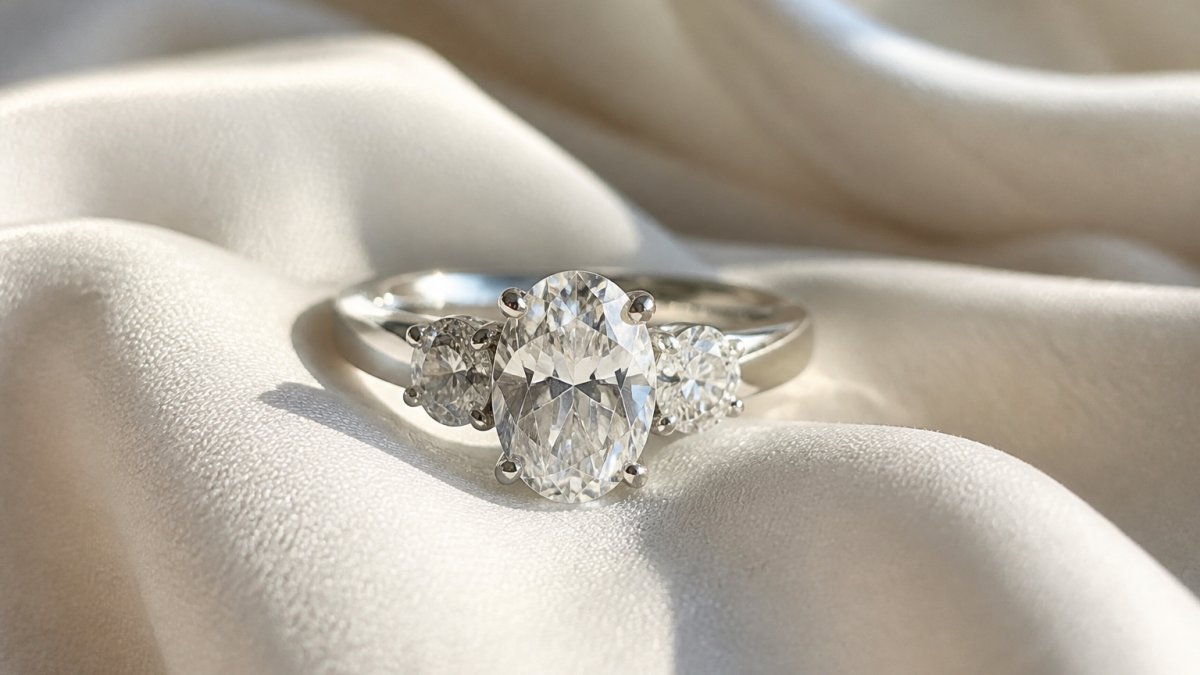
Platinum Single Stone Lab Grown Diamond Ring, 2.50ct takes the opposite approach: one large centre stone framed by natural shoulder stones, graded E colour and VS1 clarity in platinum.
18ct Yellow Gold Platinum Head Oval Cut Lab Grown Diamond Ring, 2.00ct uses the same mixed-metal construction with an oval centre stone, graded D colour and VVS2 clarity.
Ring Comparison Table: Price, Metal and Diamond Specs
| Ring | Metal | Centre Stone | Colour / Clarity | Price |
|---|---|---|---|---|
| Platinum 3 Stone Oval | Platinum | 1.6ct oval | D / VVS2 | £2,250 |
| 18ct Yellow Gold 3 Stone Emerald | 18ct yellow gold | 2.43ct emerald | E / VVS2 | £3,150 |
| Platinum Single Stone | Platinum | 2.50ct round | E / VS1 | £2,295 |
| Yellow Gold Platinum Head Emerald | 18ct gold, platinum head | 2.00ct emerald | D / VS2 | £1,995 |
| Yellow Gold Platinum Head Oval | 18ct gold, platinum head | 2.00ct oval | D / VVS2 | £2,275 |
All five carry IGI certification and are available in the finger sizes listed on each product page.
The Bespoke Engagement Ring Design Process, Step by Step
A bespoke commission follows a defined sequence, and you can see the design before any metal is cut. The bespoke engagement ring design process runs through five stages:
- Consultation. You describe the style, budget and any stone preferences. Bring photos of rings you like, even if they are from different designers.
- Design and sketch. We produce a drawing of the proposed ring so you can react to the proportions before anything is made.
- Stone selection. You review available lab-grown diamonds against your chosen cut, colour and clarity.
- Approval. Nothing is cast until you sign off on the design and the stone.
- Making and finishing. The ring is cast, set and polished, then checked before collection.
If you are not local, stages one to four can be handled remotely; only the final fitting benefits from being in person.
How to Measure Ring Size at Home
You can get a usable ring size at home with a strip of paper and a ruler. The method is accurate to within about half a size, close enough to start a conversation and confirm later. Here is the process:
- Cut a strip of paper about 10cm long and 1cm wide.
- Wrap it around the base of the finger, just below the knuckle, snug but not tight.
- Mark the point where the paper overlaps.
- Lay the strip flat and measure from the end to the mark in millimetres. That is the circumference.
- Compare the measurement against a ring size chart to find the corresponding letter.
Three things skew the result. Fingers swell in heat and shrink in cold, so measure at room temperature. The widest point is usually the knuckle, not the base, so measure both and take the larger. A wide band fits tighter than a narrow one, so go up half a size for wide designs.
Conclusion
Choosing between mined and lab-grown, Fairtrade and recycled, is genuinely harder than the marketing suggests, and labels alone will not tell you which ring is which.
Morgan Banks has been making fine jewellery since 1935, and every ring in this collection pairs a certified lab-grown diamond with a precious metal, backed by expert guidance on cut, clarity and sizing and an IGI report for each stone.
Frequently Asked Questions
Is recycled gold the same as real gold?
Yes. Recycled gold is chemically identical to newly mined gold, because gold is an element that cannot degrade. It is melted down and refined back to full purity, so a recycled 18ct piece carries exactly the same gold content as one made from freshly mined metal. The difference lies in where the metal came from and how much new extraction it required.
What is the difference between Fairtrade gold and recycled gold?
Fairtrade gold is newly mined but certified, meaning artisanal and small-scale mining communities receive a guaranteed minimum price and a premium for social projects. Recycled gold involves no new mining at all, so it avoids the environmental impact of extraction. Some buyers prefer Fairtrade because it supports mining communities directly; others pick recycled because it keeps existing precious metals in circulation.
Are lab-grown diamonds considered eco-friendly?
Lab-grown diamonds avoid the land disturbance and heavy water use of large-scale mining, and they carry full traceability because they are created in controlled facilities. They are not automatically carbon-neutral, since growing them uses significant energy, so the electricity source matters. Look for documentation confirming origin and grading, such as an IGI certificate, before deciding.
How can I verify the ethical credentials of an engagement ring?
Ask for the certification paperwork. A reputable jeweller will supply diamond grading reports with unique certificate numbers, and for gold they should confirm whether the metal is Fairtrade certified or recycled. Hallmarking is a legal requirement for precious metal items sold in the UK, so check the assay office mark alongside any sustainability claim. If a seller cannot explain where the metal and stones came from, treat the claim with caution.
Is recycled gold as durable as newly mined gold?
It is equally durable, because the refining process restores the metal to its original purity before it is alloyed. An 18ct yellow gold ring made from recycled stock will wear, scratch and hold its shape exactly like one made from newly mined gold. Durability depends on the alloy mix and the setting design, not on whether the gold was mined or recycled.