
Table of Contents
- What Makes an Engagement Ring Sustainable?
- The Environmental Cost of Traditional Mining
- Lab-Grown vs Natural Diamonds: What's the Difference?
- Recycled Gold Engagement Rings and Precious Metals
- How to Identify Conflict-Free Diamonds and Gemstones
- The Benefits of Choosing Sustainable Engagement Rings for Your Future
- Sustainable Engagement Rings: Pricing and Options at Morgan Banks
- Frequently Asked Questions
Last Updated: September 16, 2026
What Makes an Engagement Ring Sustainable?
A sustainable engagement ring is one whose diamonds and metals are sourced, produced and finished in ways that limit environmental damage and protect the people involved. This guide from Morgan Banks, a fine jeweller in Kendal trading since 1935, explains what separates a genuinely sustainable engagement ring from one that simply carries a green label.
Sustainability in fine jewellery rests on four things: where the stones came from, how the metal was recovered, whether the people who mined and cut them were paid and protected, and whether you can prove any of it on paper.
The Environmental Cost of Traditional Mining
Large-scale diamond and gold mining moves enormous volumes of rock for very small returns, and the damage is concentrated where the mining happens. Open-pit operations reshape landscapes, consume water and leave tailings that must be managed for decades.
Gold is the bigger problem. Recovering a single gold ring requires shifting tonnes of ore, and much of the world's gold comes from small-scale operations where mercury and cyanide separate metal from rock, reaching rivers and soil.
According to the United Nations Environment Programme on mercury in artisanal gold mining, artisanal and small-scale gold mining is the largest single source of human-made mercury emissions globally. That is not a footnote in the supply chain. It is the supply chain.
Diamond mining carries a different footprint. Most modern large-scale operations are mechanised and water-intensive, and the industry has invested in rehabilitation bonds and closure planning. The environmental case against mined diamonds is real, but it is more about land, water and long-term site management than chemical discharge.
Why the Metal Usually Matters More Than the Stone
A one-carat diamond sits in several grams of gold or platinum, and that metal carries the heavier burden per ring. The reason is ore grade: gold is found at concentrations measured in grams per tonne of rock, while diamond-bearing kimberlite yields stones by the carat. Recovering the metal therefore moves far more material per finished gram than recovering the stone.
The stone is the visible choice; the metal is the volume choice. Swapping a mined stone for a lab-grown one changes one decision. Swapping mined gold for recycled or certified gold changes the larger share of the ring's embodied impact.
What the Numbers Actually Look Like
Precise per-carat figures vary widely by mine, method and study boundary, so treat any single number with caution. What is consistent across published life-cycle assessments is the direction and order of magnitude:
- Mined natural diamonds carry a materially higher carbon intensity per carat than lab-grown stones, largely because lab-grown production is electricity-driven and can be powered by low-carbon grids.
- Recycled gold avoids the mining stage entirely, so its embodied impact is dominated by refining and re-alloying rather than extraction.
- Platinum is more energy-intensive to mine than gold per gram, which makes recycled platinum a proportionally larger saving.
- Water use and land disturbance are the impacts where mined diamonds and mined gold diverge most sharply from their recycled and lab-grown alternatives.
If a supplier quotes a carbon figure, ask what it covers: extraction only, or extraction plus cutting, polishing, refining and transport. A number without a boundary is marketing, not measurement.
Where the Damage Lands
Environmental cost is not evenly distributed. Artisanal gold mining clusters in regions with weak enforcement, so mercury and cyanide exposure falls hardest on small communities rather than large operators who can afford containment. Diamond mining is more consolidated, so its impacts are more about water draw, land rehabilitation and closure liabilities.
That asymmetry is why certification schemes matter. A Fairmined gold guarantee speaks to small-scale extraction conditions; a Responsible Jewellery Council audit speaks to chain-wide practice. Neither replaces your own questions at the counter, but both give you something checkable.
Lab-Grown vs Natural Diamonds: What's the Difference?
Lab-grown diamonds are real diamonds produced in a laboratory rather than extracted from the earth. They share the same chemical composition, crystal structure and optical properties as mined diamonds, and are graded on the same scales by the same laboratories.
The difference is origin, not substance. A gemmologist cannot tell them apart with a loupe; identification requires laboratory equipment that detects trace growth patterns.
Platinum 3 stone Oval Lab Grown Diamond →
Two production methods dominate.
Cost and Quality Compared
Lab-grown diamonds typically cost substantially less than mined stones of equivalent carat, colour and clarity, and the gap widens as carat weight increases. Production scales with equipment, not with the geological luck of finding a large rough stone.
| Factor | Lab-Grown Diamond | Natural Mined Diamond |
|---|---|---|
| Origin | Grown in a laboratory | Extracted from the earth |
| Composition | Identical to mined diamond | Identical to lab-grown |
| Certification | IGI, GIA and similar | IGI, GIA and similar |
| Price at equal grade | Lower | Higher |
| Carbon intensity per carat | Generally lower, grid-dependent | Generally higher, mine-dependent |
| Resale market | Developing | Established |
| Typical best for | Larger stones on a set budget | Buyers who value rarity |
The Carbon Footprint Question
Lab-grown diamonds are not automatically low-carbon, they are lower-carbon than mined stones on most published life-cycle comparisons, but the size of the gap depends on how the electricity used to grow them was generated.
Resale, End-of-Life and the Circularity Angle
Where lab-grown stones differ most from mined ones is not quality or appearance, it is the secondary market. The pre-owned market for lab-grown diamonds is younger and thinner, so a lab-grown stone will not hold value like a comparable mined stone. If resale matters, buy the ring you intend to keep.
Recycled Gold Engagement Rings and Precious Metals
Recycled gold is refined gold that already exists above ground, recovered from old jewellery, industrial scrap and electronic waste, then purified and re-alloyed to the same fineness as newly mined metal. Chemically and legally, it is identical to mined gold.
How to Identify Conflict-Free Diamonds and Gemstones
Conflict-free means the stone did not finance armed conflict or violence between the mine and the finished ring. Proving it requires documentation that follows the stone, not a verbal assurance at the counter.
A practical checklist for the counter:
- Ask for the diamond certificate and confirm the number is laser-inscribed on the girdle
- Check whether the stone is graded by an independent laboratory
- Ask which responsible-sourcing standard the retailer or supplier holds
- Request written confirmation of the metal's origin, recycled or certified
- Ask how the ring was finished and whether the workshop is audited
The Benefits of Choosing Sustainable Engagement Rings for Your Future
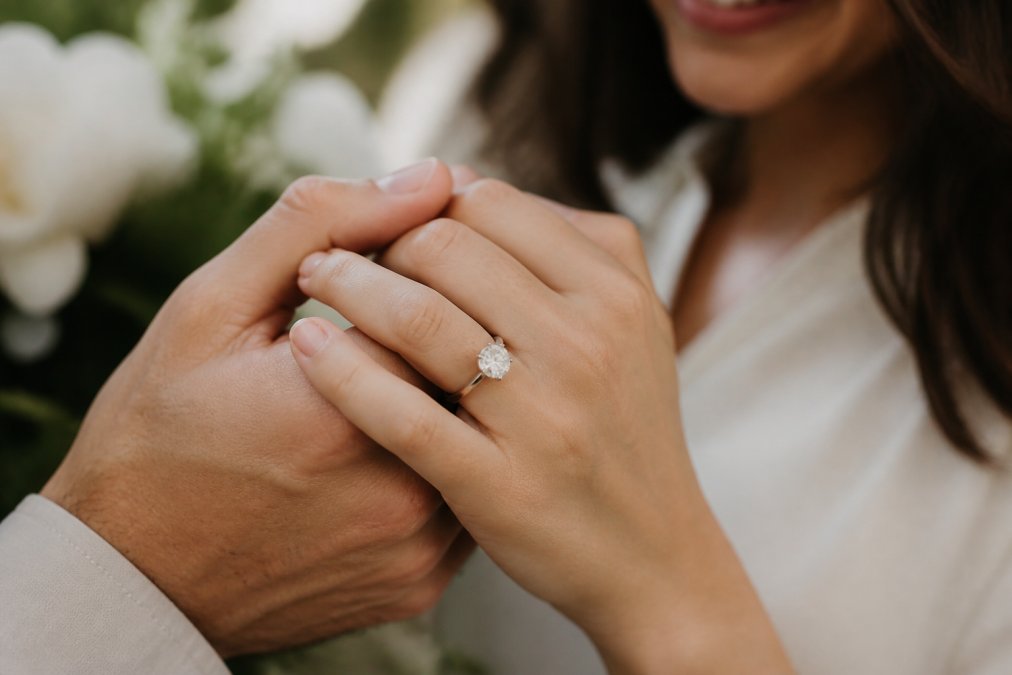
The benefits of choosing sustainable engagement rings are practical as well as ethical: documented provenance, better long-term value retention on certain stones, and a ring you can repair and pass on rather than replace. Sustainability and longevity are the same argument.
Resale Value and the Circular Economy
Resale value depends on the stone, the certificate and the market, not on marketing. Mined diamonds have a long-established secondary market; lab-grown diamonds trade at a discount because supply is expanding.
Sustainable Engagement Rings: Pricing and Options at Morgan Banks
Sustainable engagement rings at Morgan Banks start at £1,295 and range to £3,150, with every piece set with certified lab-grown diamonds and made in platinum or 18ct gold. Each stone carries an IGI certificate, so the grading is verifiable rather than asserted.
- Best for a first engagement ring: the 0.66ct brilliant cut at £1,295
- Best for a distinctive shape: the 1.6ct oval three-stone at £2,250
- Best for maximum size: the 3.50ct emerald cut at £3,150
- Best for a classic solitaire: the 2.50ct single stone at £2,295
Frequently Asked Questions
What is the 3 month ring rule?
The three-month salary rule is a traditional guideline suggesting you should spend the equivalent of three months' pay on an engagement ring. This rule originated from a clever marketing campaign in the 1930s and has no basis in financial planning. In practice, couples now spend far more varied amounts, often prioritising a meaningful design over an arbitrary figure. A sustainable engagement ring from Morgan Banks starts at £1,295, proving you can choose quality and ethics without following outdated spending formulas.
How can I verify the ethical credentials of an engagement ring?
Ask for certification documentation. For lab-grown diamonds, look for grading reports from the International Gemological Institute (IGI), which confirm origin and quality. For gold, ask whether it is recycled or Fairmined certified. Reputable jewellers will provide full supply chain transparency, including where the metal and stones were sourced. At Morgan Banks, every lab-grown diamond ring comes with an IGI certificate detailing its specifications, so you can confirm its ethical and technical credentials before you buy.
Are recycled gold and lab-grown diamonds truly sustainable?
They are significantly more sustainable than newly mined alternatives. Recycled gold avoids the environmental damage of mining, which generates large volumes of waste and uses toxic chemicals. Lab-grown diamonds require far less energy and land than mined stones, and they produce a fraction of the carbon emissions. No option is entirely without impact, but choosing recycled gold and lab-grown diamonds reduces your ring's environmental footprint and avoids supporting unethical mining practices.
Why is choosing a pre-loved or vintage engagement ring considered sustainable?
A pre-owned ring requires no new mining or manufacturing, so its environmental cost has already been paid. Choosing vintage or pre-loved pieces keeps precious metals and gemstones in circulation, supporting a circular economy. It also often means you get a larger or higher-quality stone for your budget. Morgan Banks offers a curated collection of previously enjoyed luxury watches, and the same principle applies to jewellery: buying pre-owned is one of the most effective ways to reduce the demand for newly extracted materials.