
Last Updated: November 12, 2026
Quick Summary
Conflict-free diamonds are stones not used to fund armed conflict, and a label alone does not prove it. To verify one, ask for its country of origin in writing, request a supplier declaration that matches the stone, check the Kimberley Process paperwork covers that stone, and confirm the chain of custody.
- Less than 1% of the world's diamonds meet Brilliant Earth's Beyond Conflict Free standard.
- Kimberley Process certificates cover rough shipments, not necessarily your individual polished stone.
- A grading report confirms identity and quality, but it does not prove origin.
- Ask how many trading steps a stone passed through and whether each can be named.
- Vague answers about origin or paperwork are a signal that the evidence is thin.
Table of Contents
- What Conflict-Free Diamonds Are and Why the Label Matters
- What the Kimberley Process Does and Does Not Guarantee
- Step-by-Step Checklist to Verify a Specific Diamond
- How to Read a Diamond Origin Certificate and Chain-of-Custody Evidence
- Questions to Ask a Jeweller About Diamond Sourcing
- Lab-Grown Diamonds and Ethical Sourcing: How They Compare
- Booking Your Conflict-Free Engagement Ring Consultation
- Frequently Asked Questions
What Conflict-Free Diamonds Are and Why the Label Matters
Conflict-free diamonds are stones that were not used to fund armed conflict, and identifying them takes more than trusting a label. Finding the right answer starts with knowing what the label actually promises.
The phrase matters because most diamond buyers assume a stone is ethical unless told otherwise. That assumption is not always safe. Less than 1% of the world's diamonds meet Brilliant Earth's own Beyond Conflict Free standard, a figure the company publishes as its own benchmark (Brilliant Earth's Beyond Conflict Free standard).
Conflict diamonds and the term blood diamonds
Conflict diamonds, often called blood diamonds, are rough stones sold to finance rebel groups or armed forces. The term describes where the money went, not the quality of the stone itself.
- The stone itself looks and performs exactly like any other diamond
- The harm happens in the mining and trading chain
- A label alone cannot show which chain a stone passed through
How diamonds can fund armed conflict
Armed groups have sold rough diamonds to pay for weapons, recruits and supplies during civil wars. Stones moved through smuggling routes and mixed trading channels, which hid their origin. This is why buyers need to ask where a diamond came from, not just whether it is labelled conflict-free.
What the Kimberley Process Does and Does Not Guarantee
The Kimberley Process is the main international certification scheme for rough diamonds. Its official site reports a 99.8% global trade coverage figure for participants (Kimberley Process official statistics). That broad coverage is useful, but it is not the same as proof for one stone.
Limits and criticisms of the Kimberley Process
Critics argue that scheme compliance does not settle wider concerns. Human rights and worker welfare issues in mining fall outside its core definition. A Human Rights Watch report on jewellery supply chains, covering 13 major brands with combined revenue of over US$30 billion, pointed to gaps in how companies scrutinise sourcing (Human Rights Watch report on jewellery supply chains).
- Kimberley Process paperwork covers rough shipments, not every later step
- Human rights and environmental concerns are not fully addressed by the scheme
- A certificate from one supplier may not show the full chain of custody
Step-by-Step Checklist to Verify a Specific Diamond
Use this checklist before you buy. Work through each step, write down the answers, and keep copies of every document you are shown.
- Ask for the diamond's origin in writing. Note the country and, if the seller knows it, the mine or region. A verbal answer is not evidence. Ask for the country of origin to be stated on the invoice or supplier declaration so it is tied to the stone you are buying.
- Request the supplier declaration. This is the document in which the supplier states what it knows about the stone's trading history. Check that it names the supplier, the date, the stone's weight and its reference number, and that those details match the stone and any grading report.
- Check for a Kimberley Process statement. The Kimberley Process Certification Scheme covers rough diamond shipments between participants. Ask whether the statement covers this specific stone or parcel, and note that a certificate for a parcel is not proof about an individual polished stone inside it.
- Look for a laboratory report. A grading report from a recognised laboratory confirms identity and quality, carat weight, colour, clarity and, for lab-grown stones, the fact that they are lab-grown. It does not confirm origin, so treat it as a separate check rather than a sourcing document.
- Ask about chain of custody. Find out how many hands the stone passed through between mine and shop, and whether the retailer can name each one. A short, named chain is easier to check than a long, anonymous one.
- Compare the paperwork with the stone. Match the reference number, weight and, where given, the measurements on the documents against the stone itself. A mismatch is a reason to stop and ask why.
- Ask what happens if the answer is no. A jeweller who cannot supply a document should be able to explain why and say what alternative evidence they can offer. If the only answer is that the stone is "conflict-free" because the shop says so, that is not verification.
Watch out: a Kimberley Process certificate is issued for rough diamond shipments, so by the time a stone is polished and set in a ring the certificate may refer to a parcel rather than your diamond.
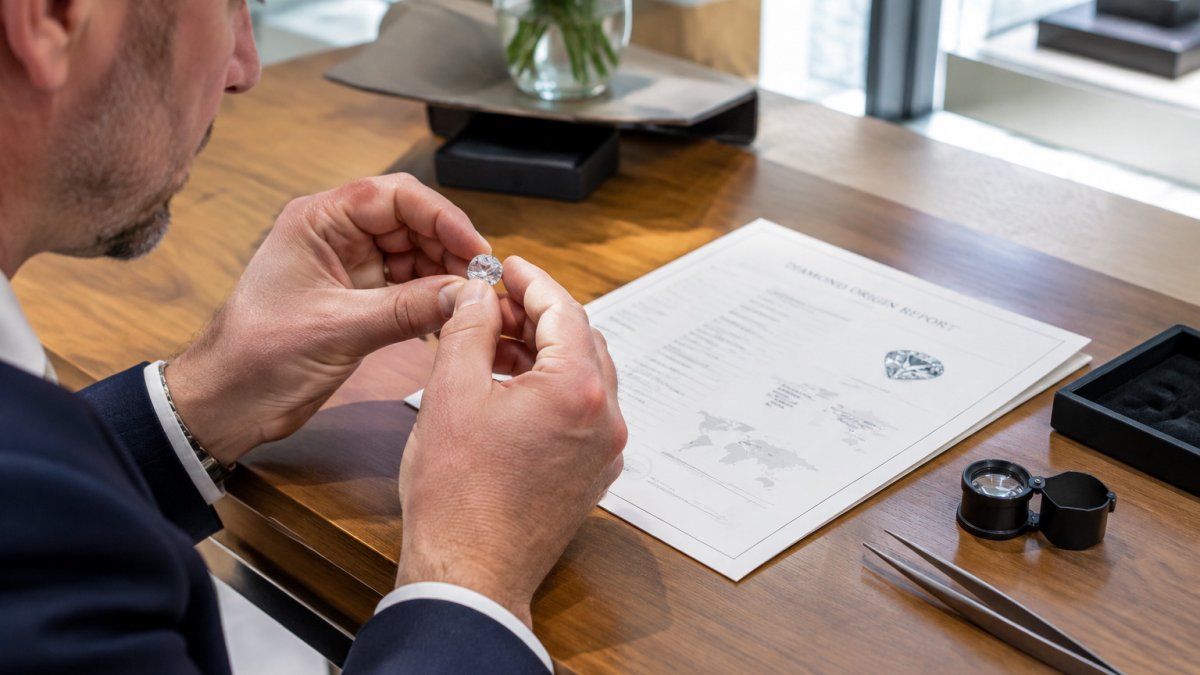
What each document can and cannot prove
It helps to separate the documents by what they actually establish:
- Grading report: proves the stone's identity and quality grades; does not prove origin or ethical sourcing.
- Supplier declaration: records what the supplier says about the stone's history; its value depends on how well the supplier is known to the retailer and how specific the statement is.
- Kimberley Process certificate: confirms a rough shipment moved through the scheme; does not by itself cover later polishing, trading or setting steps.
Sample questions and how to read the answers
- "Which country did this diamond come from?", A specific country is a better answer than "Africa" or "our supplier is ethical".
- "Can you show me the supplier declaration for this stone?", The document should name the stone or parcel, not just the shop's general policy.
- "Does the paperwork cover this exact diamond or a general batch?", Batch-level paperwork is common, but the jeweller should be honest about the difference.
A vague answer is not necessarily dishonest, but it is a signal that the evidence is thin. If a jeweller cannot say where a stone came from or what their paperwork covers, consider another seller or another stone.
How to Read a Diamond Origin Certificate and Chain-of-Custody Evidence
Origin paperwork comes in several forms, and they do not all prove the same thing. Reading them well means knowing which claim each document supports and where the evidence stops.
Country of origin, mine of origin and supplier declarations
- Country of origin states the country where the diamond was mined. It is the most common origin claim and the easiest to put in writing, but it says nothing about the conditions under which the stone was produced.
- Mine of origin is more specific and much harder to evidence. It requires records that follow the stone from a particular mine through sorting, trading and polishing. Only a minority of stones carry this level of documentation.
- Supplier declaration is a statement from the supplier about what it knows of the stone's history. Its strength depends on how specific it is and on how well the retailer knows the supplier. A declaration that names the stone, the supplier and the date is more useful than a general policy statement.
A common pattern is for a retailer to hold a country-of-origin statement and a grading report, and to describe the stone as traceable. That is a fair description of the paperwork, but it is not the same as mine-level traceability.
What chain-of-custody evidence should show
Chain-of-custody evidence records each handover from mine to retailer. Strong records name every trader involved, give dates and weights, and match the stone's reference number at each step.
When you review the evidence, ask:
- Does it name each company in the chain, or only the first and last?
- Do the weights and reference numbers match the stone you are buying?
- Is the evidence specific to this stone, or does it describe a parcel or a general supply policy?
- Does the retailer explain what the evidence does not cover?
Watch out: a certificate that carries a Kimberley Process reference confirms that a rough shipment moved through the scheme. It does not, on its own, establish fair labour, human-rights or environmental performance, and it may not follow the stone through polishing and setting.
How this fits with broader ethical sourcing
Kimberley Process compliance and broader ethical sourcing are different things. The scheme addresses conflict diamonds as defined by its rules; it does not by itself certify fair wages, safe working conditions or environmental standards. If those issues matter to you, ask the jeweller what additional standards their suppliers follow and how they check them. A retailer that can explain the difference between the two is usually the one with the clearer paperwork.
Questions to Ask a Jeweller About Diamond Sourcing
Good jewellers answer these questions plainly. If they cannot, consider another seller.
- Which country did this diamond come from?
- Can you show me the supplier declaration for this stone?
- Does the paperwork cover this exact diamond or a general batch?
- How many trading steps did it pass through?
Use these questions to test how well a jeweller can back up a sourcing claim.
| Question | What a good answer looks like | Warning sign |
|---|---|---|
| Which country did this diamond come from? | A specific country named in writing | Only "Africa" or "our supplier is ethical" |
| Can you show me the supplier declaration for this stone? | A document naming the stone or parcel | Only a general shop policy |
| Does the paperwork cover this exact diamond or a general batch? | Honest difference between stone and batch | Vague answer about coverage |
| How many trading steps did it pass through? | A short, named chain of custody | A long or anonymous chain |
| Do you buy only from suppliers who follow the Kimberley Process? | A clear yes with supporting records | No answer or unclear scheme |
Lab-Grown Diamonds and Ethical Sourcing: How They Compare
Lab-grown diamonds avoid mining, so they sidestep many of the concerns above. Lab-grown suppliers present clear, traceable origins as a key benefit, though these are company claims rather than independently verified industry figures (Stienhardt lab-grown diamond sourcing claims).
For a larger centre stone, the 18ct Yellow Gold 3 stone Emerald Cut Lab Grown Diamond Ring, priced at £3,150.00, carries a combined weight of 3.50 carats. [18ct Yellow Gold 3 stone Emerald Cut Lab Grown Diamond Ring | page:2]
Booking Your Conflict-Free Engagement Ring Consultation
If you are planning an engagement, our team can help you find a ring within your budget. You can also read our expert guide to choosing and buying an engagement ring before you book. [Book a conflict-free engagement ring consultation | page:3]
Frequently Asked Questions
What does conflict-free mean when buying a diamond?
Conflict-free generally means a diamond was not used to fund armed conflict against legitimate governments, as defined by the Kimberley Process Certification Scheme. The term is a minimum standard, not proof of broader ethical sourcing. Buyers who want more assurance should ask for documented origin and supplier declarations, since a general label does not show where a specific stone was mined or how its workers were treated.
Does the Kimberley Process guarantee that a diamond is ethical?
No. The Kimberley Process scope is limited to preventing conflict diamonds from entering legitimate trade. It does not address worker welfare, environmental impact or labour conditions at mines. Treat Kimberley Process compliance as one necessary check within a wider sourcing review.
Are lab-grown diamonds conflict-free?
Lab-grown diamonds are not mined, so they avoid the mining-related sourcing concerns linked to natural stones. Buyers should still confirm the certificate number, the grading laboratory and the retailer's documentation, because marketing claims about origin are only as reliable as the paperwork behind them.
What documents can help verify a diamond's origin?
The most useful documents are a grading report from a recognised laboratory, a supplier declaration covering the stone's origin and a written statement on chain of custody from the seller. A grading report confirms the stone's characteristics, not its mining history, so it should be read alongside origin paperwork. Ask for these documents before purchase and check that the certificate number matches the stone you are buying.
