
Table of Contents
- Why Flush-Fitting Wedding Bands Matter
- Assess Your Engagement Ring Before You Shop
- Straight Wedding Band: The Classic Fit
- Contoured Wedding Band: Curves That Hug the Setting
- Matching a Wedding Band to a Low-Set Engagement Ring
- Custom Wedding Band Design for an Exact Fit
- Trying Bands Together and Checking the Fit
- Frequently Asked Questions
Last Updated: October 17, 2026
Why Flush-Fitting Wedding Bands Matter
A wedding band that sits flush against your engagement ring protects both rings from rubbing, keeps the setting secure, and wears comfortably every day.
Most engagement rings have a raised setting, so a plain straight band pushed against it leaves a visible gap that catches on clothing and hair and lets the rings grind together, wearing down the claws.
Choosing wedding bands that sit flush solves both issues. Below, we explain how to assess your ring, which band style fits which setting, and how to check the fit.
Assess Your Engagement Ring Before You Shop
Shopping by style alone is a common mistake. A straight band that looks perfect in the window may sit a full millimetre from a high-set solitaire, and that gap causes rubbing.
Here is how a ring might be assessed:
- Setting height: the distance from the top of the band to the top of the stone.
- Gallery depth: how far the setting drops below the ring's shoulders.
- Band profile: whether the engagement ring band is flat, rounded, or knife-edged.
Goldsmiths' Company assay office guidance on precious metal hallmarks is a useful reference for understanding the marks on your ring, which tell you the metal and purity before you match a band.
Setting Height and Gallery Depth
Setting height decides everything. A high-set ring leaves room for a straight band to slide underneath. A low-set ring does not, and forcing a straight band against it creates the gap you are trying to avoid.
Gallery depth matters too. If the gallery sits low and close to the finger, a straight band will collide with it, and a contoured or shaped band becomes necessary.
Straight Wedding Band: The Classic Fit
A straight wedding band is the simplest option and works when the engagement ring sits high enough to clear it.
It is our default for high-set solitaires and raised galleries: timeless, easy to resize, and comfortable.
Against a low-set or cluster ring, a straight band will not sit flush: you will see daylight between the rings and the edges will rub.
| Band Style | Best For | Watch Out For |
|---|---|---|
| Straight | High-set solitaires, raised galleries | Gaps against low-set rings |
| Contoured | Low-set, cluster, and shaped settings | Harder to resize later |
| Custom | Irregular or deep settings | Longer lead time |
Contoured Wedding Band: Curves That Hug the Setting
A contoured wedding band curves around the base of the engagement ring's setting so the two sit together with no gap, mirroring the setting's profile so it hugs rather than collides.
This is the right choice for low-set rings, cluster rings, and any engagement ring where a straight band leaves a gap.
Our 18ct White Gold Curved Wedding Ring .35ct is a good example of a shaped band with a micro-claw set curve and a 2.10mm band width.

Matching a Wedding Band to a Low-Set Engagement Ring
A low-set engagement ring is the hardest to match, because there is very little room between the stone and the finger.
The goal is contact, not clearance: the band should meet the setting with no gap and no pressure. Too tight and the rings rub; too loose and you are back to the gap.
For low-set rings, we usually suggest a gentle curve that follows the gallery line.
Why Low-Set Rings Behave Differently
A low-set ring places the girdle of the centre stone within 2-3mm of the finger, leaving almost no vertical clearance for a straight band.
The band must be shaped around the obstruction rather than run past it, mirroring the gallery profile, not just the stone's outline. Too shallow a curve still collides; too deep leaves a visible notch from the side.
Matching the Curve to the Setting Type
Different low-set settings call for different curve profiles:
- Bezel and semi-bezel settings: the metal collar around the stone sits low and wide. A shallow, broad curve that follows the bezel edge usually works, provided the band width does not exceed the bezel width.
- Cluster and halo settings: the stones and their settings create an irregular underside. A contoured band with a deeper, narrower curve is often needed so the band clears the cluster without pressing on the claws.
- Tension and flush settings: the stone sits almost level with the band, leaving no gallery to work around. These usually require a custom shaped band or a band designed to sit slightly apart, and a straight band will almost always leave a gap.
Metal, Width, and Thickness Trade-offs
A band narrower than about 2mm may lack enough metal to hold a deep curve without distorting, while one wider than the engagement ring's shoulders can look unbalanced.
18ct White Gold Princess Cut Curved Diamond Ring .35ct F/G VS1 →
Thickness matters at the join: too thick and the band stands proud of the engagement ring; too thin and it wears through at the contact point. Matching the band thickness to within about 0.2mm of the engagement ring's band gives the cleanest join.
When a Straight Band Can Still Work
A straight band is not automatically wrong for a low-set ring. If the gallery sits just high enough for a slim band to pass beneath without contact, a straight band can sit flush and is easier to resize later. The test is physical: slide a straight band of the intended width against the ring and check for daylight along the join.
What to Do If Neither Straight Nor Contoured Works
Some low-set rings, particularly antique or asymmetric designs, have no standard profile that will sit flush. The choice is then a custom shaped band or a small, deliberate gap. A gap is not always a failure: a band that sits slightly apart can be kinder to delicate claws and easier to maintain.
Custom Wedding Band Design for an Exact Fit
Custom wedding band design is the route to a genuinely exact fit: instead of a stock curve, the band is shaped to the precise profile of your engagement ring so the two meet cleanly along their full length.
This matters most for three cases:
- Rings with an unusual or asymmetric setting.
- Antique or inherited engagement rings with no standard profile.
- Couples who want a matched pair with a specific metal and finish.
The process involves measuring the engagement ring, producing a sketch or model for approval, then making the band to that shape. At Morgan Banks, our bespoke service has shaped wedding bands to individual engagement rings for decades, and we show you the design before any metal is cut.
Trying Bands Together and Checking the Fit
Always try the engagement ring and wedding band on together before you buy. A band that looks correct on its own can sit wrong once paired.
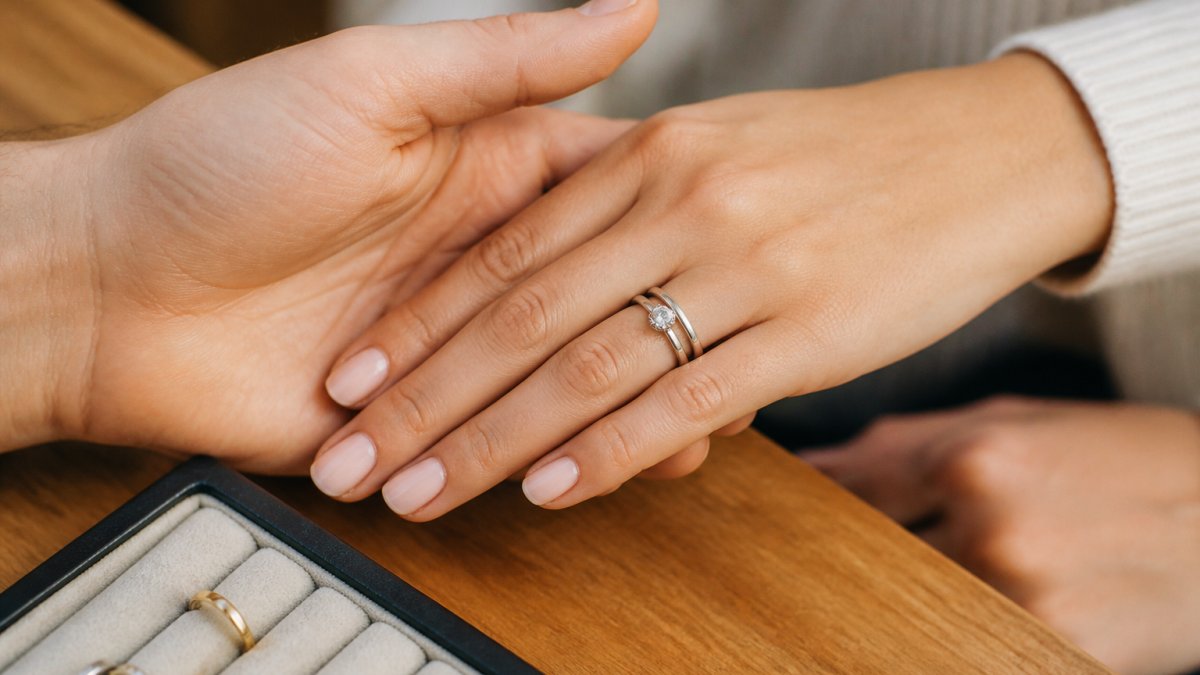
Run through this checklist at the fitting:
- Slide the band against the engagement ring and check for any gap of light.
- Run a fingertip along the join to feel for rubbing or pressure points.
- Check the claws on the engagement ring are not pushed by the band.
- Wear both for a few minutes and make a fist to test comfort.
If you see daylight between the rings, the band is the wrong shape. Do not accept it and hope it settles.
What 'Flush' Actually Means in the Hand
Flush is not the same as touching. Two rings can contact along their full length and still rub, because the contact is under pressure. Equally, a hairline gap of a few tenths of a millimetre can be stable and comfortable if the band follows the setting without pressing on it.
The test is whether the band moves independently. With both rings on, hold the engagement ring still and gently rotate the band.
Material and Finish Considerations at the Fitting
Different metals and finishes change how a flush fit behaves:
- Platinum and 18ct white gold: harder alloys hold a shaped curve better and resist deformation at the contact point. A flush fit in these metals is more likely to stay flush over years of wear.
Stones, Pearls, and Delicate Settings
If the engagement ring has stones along the shoulders or a pearl, the band must not press on them. Pearls are soft and easily marked, and shoulder stones can be loosened by repeated pressure. At the fitting, check that the band contacts metal, not stone or pearl, and that no claw is deflected.
Long-Term Wear and Maintenance
A flush fit concentrates wear at the join, so the contact edges of both rings thin over the years. This is normal, but it means periodic inspection to check for thinning, loose claws, and any change in fit. A contoured band that was flush when new can develop a gap as the edges wear; a a jeweller can usually restore the fit by adjusting the curve or re-polishing the contact faces.
When to Walk Away
If the band binds, presses on a stone or pearl, or leaves a gap wider at one end than the other, the shape is wrong. A contoured band can be adjusted within limits, but a deep curve cannot be reshaped indefinitely without thinning the metal. Reject a poor fit at the fitting rather than discover it after the band is finished and sized.
Frequently Asked Questions
What does it mean for a wedding band to sit flush?
A flush fit means the wedding band rests flat against the engagement ring with no gap between them. This usually requires the band's profile to match the shape of the engagement ring's setting. A straight band suits a low, flat setting, while a contoured band curves around a raised or shaped setting. When bands sit flush, they look like a matched pair and are less likely to rub against each other, which reduces wear over time.
What is the difference between a straight and contoured wedding band?
A straight wedding band has a flat, even profile all the way around. It suits engagement rings with low settings or a flat gallery. A contoured wedding band has a shaped section that curves around the engagement ring's setting, so the two rings sit closely together. Contoured bands are the usual choice for raised or cluster settings. Try both styles alongside your engagement ring before deciding, because the right choice depends on the setting rather than personal taste alone.
Can a wedding band sit flush with a low-set engagement ring?
Yes, a wedding band can sit flush with a low-set engagement ring. This often requires a shaped or contoured band to accommodate the limited space between the stone and the finger. Check the depth of the gallery and the width of the band against the engagement ring. If there is a small gap, a slightly thinner band or a shallow curve can close it. A jeweller can confirm the fit with both rings on your hand.
Can a jeweller adjust an engagement ring to fit a straight wedding band?
In some cases, a jeweller may be able to lower a raised setting or reshape the gallery so a straight band sits closer. This depends on the ring's construction and the stone's setting, and it is not always advisable. Altering an engagement ring can affect its strength and any warranty. Ask for an assessment before committing, and weigh the adjustment against choosing a contoured band, which avoids changing the original ring.
A flush fit protects your engagement ring and makes the pair comfortable to wear for a lifetime. If you are unsure which band shape suits your setting, bring your ring to Morgan Banks and we will assess it with you. Our bespoke service, shaped wedding bands, and 18ct White Gold Curved Wedding Ring .35ct are all made to sit correctly against your ring. Get started with Morgan Banks and wear a pair that fits as it should.