
Table of Contents
- The Real Cost of Skipping Professional Jewellery Cleaning
- DIY vs Professional Cleaning: What Actually Works
- How to Clean Diamond Rings at Home Without Causing Damage
- Professional Jewellery Cleaning Cost: What You're Actually Paying For
- How to Check for Loose Stones in a Ring
- Chemical Compatibility: Which Cleaners Suit Which Metals and Stones
- Long-Term Cost-Benefit: Repair Bills vs Preventative Care
- Frequently Asked Questions
Last Updated: September 30, 2026
The Real Cost of Skipping Professional Jewellery Cleaning
Is professional jewellery cleaning worth it? For most pieces worn regularly, yes, because cleaning is as much about inspection as appearance. At Peter George banks trading as Morgan Banks, we have handled fine jewellery since 1935, and the pattern is consistent: the rings that arrive with loose stones are rarely the ones that were professionally checked each year.
Jewellery cleaning is the process of removing dirt, oils, tarnish and product residue from precious metals and gemstones while verifying that settings remain secure. Skipping it does not just dull a diamond; it hides the early warning signs of a prong bending out of shape.
A build-up of hand cream, soap and skin oils creates a film that dulls brilliance and traps grit against the setting. That grit slowly widens the gap between prong and stone.
DIY vs Professional Cleaning: What Actually Works
Home cleaning handles everyday grime well. Professional cleaning handles structure, and that is the difference that matters.
- DIY strengths: quick, cheap, ideal for weekly maintenance between visits
- DIY limits: cannot tighten prongs, polish deep scratches or check settings under magnification
- Professional strengths: ultrasonic bath, steam cleaning, professional inspection, rhodium plating where needed
- Professional limits: not suitable for every gemstone, so porous stones need alternative methods
A sensible routine uses both. Clean at home often, and book a professional check at least once a year.
How to Clean Diamond Rings at Home Without Causing Damage
The safest home method for a diamond ring is warm water, a drop of mild detergent, and a soft-bristled toothbrush. Work the brush gently around the setting, rinse under warm water with the plug in, and pat dry with a lint-free cloth.
For a low-effort option between deeper cleans, the Connoisseurs Diamond Dazzle Stick is a twist-pen applicator that lifts film from the stone and setting without soaking.

Safe Home Methods for Hard Gemstones
Diamonds, sapphires and rubies tolerate warm soapy water and gentle brushing. Use a dedicated jewellery cleaner rather than washing-up liquid, which can leave residue. The Connoisseurs Precious/Gold Jewellery Cleaner is formulated for gold and platinum settings.

What to Avoid: Chemicals, Ultrasonics and Porous Stones
Skip ammonia, bleach and chlorine. They attack alloys in white gold and can damage certain treatments. Ultrasonic cleaners are safe for diamond and hard stone pieces with secure settings, but they can shake loose stones free in emeralds, opals, pearls and any stone with fractures or porosity.
Professional Jewellery Cleaning Cost: What You're Actually Paying For
Professional jewellery cleaning cost reflects labour and equipment, not just polish. A typical professional clean involves ultrasonic or steam treatment, hand polishing, buffing, and a setting inspection under magnification.
You are paying for three things: the clean itself, the inspection, and the record of your piece's condition.
How to Check for Loose Stones in a Ring
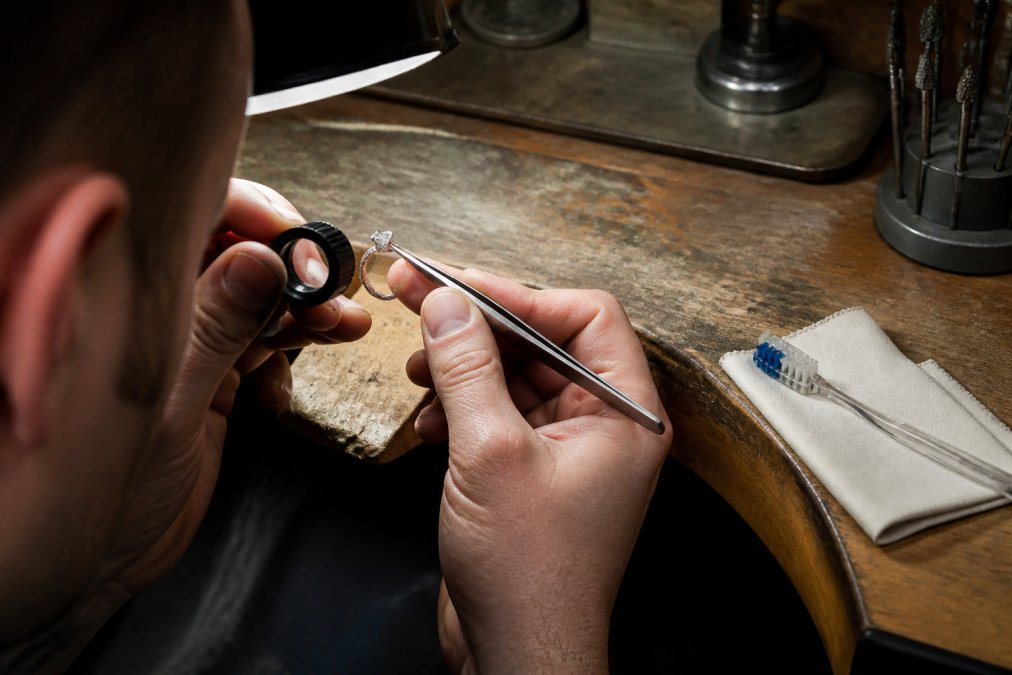
You can check for loose stones at home in under a minute. Hold the ring up to a lamp, look at each prong, and gently press the stone with a fingertip or wooden toothpick. Any movement, rattle or visible gap means stop wearing it and get it inspected.
What Actually Causes a Stone to Fall Out
Prongs do not fail suddenly. They fail through a predictable sequence:
- Tip wear: the rounded end of a prong gradually flattens and thins against clothing, desks and door handles. Once the tip is worn below the girdle of the stone, retention drops sharply.
- Lifting: a knock against a hard surface bends a prong outward by a fraction of a millimetre. The stone still sits in place, so nothing feels wrong, but the grip is gone.
- Grit abrasion: the film of hand cream, soap and skin oil described earlier traps fine grit against the setting. Over months, that grit acts like a lapping compound, slowly widening the gap between prong and stone.
- Metal fatigue: white gold, in particular, work-hardens and becomes brittle with repeated stress. A prong that has been re-tipped several times is more likely to crack than to bend.
What a Jeweller Checks That You Cannot
Under a bench loupe or microscope, a jeweller is looking for specific things, not just 'is it clean':
Connoisseurs Silver Jewellery Cleaner →
- Prong height and profile against the girdle of each stone, checking for tips worn below the safe line
- Setting integrity, claws that have lifted, solder joints that have crystallised, channel walls that have spread
- Clasp and hinge wear on bracelets and necklaces, where a failed catch is the most common cause of loss
- Stone security on every stone, not just the centre, melee and side stones are the ones most often missed at home
- Shank thinning and porosity on older rings, where the band itself is close to failing
The Inspection Value Proposition
The real value of professional cleaning is the inspection, not the shine. A polish makes a ring look new for a week. An inspection is what stops a ring from becoming a lost-stone claim.
Chemical Compatibility: Which Cleaners Suit Which Metals and Stones
Not every cleaner suits every piece. Match the product to the metal and the stone before you soak anything.
| Metal or Stone | Safe Approach | Avoid |
|---|---|---|
| Gold and platinum | Warm water, mild detergent, soft brush | Chlorine, bleach |
| Silver | Silver cleaner, polishing cloth | Abrasive pastes |
| Diamond, sapphire, ruby | Soapy water, ultrasonic if setting secure | Harsh acids |
| Emerald, opal, pearl | Damp cloth only, no soaking | Ultrasonic, ammonia |
| Rhodium-plated white gold | Gentle cleaner, professional re-plating | Repeated abrasive polishing |
Long-Term Cost-Benefit: Repair Bills vs Preventative Care
Preventative care almost always costs less than repair. That is easy to say. The useful version is to compare the two paths side by side over the life of a piece you wear daily.
The Two Paths, Compared
Take an heirloom engagement ring worn every day. Over, say, ten years, the two realistic paths look like this:
Path A, annual professional clean and inspection
- A yearly clean and setting check, often bundled free or at low cost with a repair or purchase, or charged as a modest standalone service
- Occasional small interventions when something is caught early: a re-tip on a worn prong, a tighten on a lifted claw, a re-polish on a scratched shank
- The stone stays in the ring. The ring stays wearable. The metal is maintained rather than replaced.
Path B, no professional inspection
- The same ring is worn daily with no check on prong wear or setting integrity
- At some point a prong fails. The stone is lost, often without the wearer noticing where or when
- The repair is no longer a re-tip. It is a full setting rebuild, plus the cost of replacing the stone itself, which for a diamond of any size is the dominant expense
- If the stone was an heirloom or matched to a pair, replacement may be impossible or require sourcing a matched stone, which carries its own premium
Why the Comparison Is Not Close
The asymmetry is the point. On Path A, the costs are small, predictable and spread over years. On Path B, the cost is a single large bill that arrives without warning, and it is dominated by the stone rather than the labour.
A Simple Decision Framework
Ask three questions about any piece you wear regularly:
- How often is it worn? Daily wear means daily exposure to knocks, grit and metal fatigue. Annual inspection is the sensible baseline.
- How many stones does it have? The more stones, the more settings that can fail, and the more likely a small melee stone goes missing unnoticed.
- How replaceable is it? A mass-produced band is easy to replace. An heirloom, a matched pair or a bespoke commission is not. The less replaceable the piece, the stronger the case for regular inspection.
For guidance on your own pieces, or to book an inspection, the team at Peter George banks trading as Morgan Banks has looked after fine jewellery for generations.
Frequently Asked Questions
How much does professional jewellery cleaning cost?
At Morgan Banks, professional-grade cleaning products start at £10, with the Connoisseurs Silver Jewellery Cleaner and Precious/Gold Jewellery Cleaner both priced at £10.00, the Diamond Dazzle Stick at £11.00 and the Jewellery Foam Cleaner at £10.00. A full in-store clean and inspection is usually included when you bring pieces in for a check, so the cost of keeping jewellery clean is modest compared with repair bills for worn prongs or loose stones.
Can professional cleaning damage my jewellery?
Professional cleaning is safe when the method matches the material. Ultrasonic baths and steam cleaning suit hard stones such as diamond, sapphire and ruby in gold or platinum settings. Porous stones like opal, pearl, emerald and turquoise should never go into an ultrasonic cleaner because vibration and heat can crack them. Tell your jeweller what stones are set in the piece so they can choose the right process, and avoid ammonia or abrasive pastes at home.
How often should I get my engagement ring professionally cleaned?
For a ring worn daily, a professional clean and inspection every six to twelve months is sensible. Between visits, clean it at home every two to four weeks with mild detergent, warm water and a soft-bristled toothbrush, then dry with a lint-free cloth. Rings with pavé settings, heirloom pieces or high-value diamonds benefit from a check every six months because daily wear loosens prongs gradually.
Does professional cleaning include checking for loose stones?
A proper professional clean always includes inspection. The jeweller examines prongs, the setting and the stone under magnification, checks for micro-scratches and tarnish, and tests that each stone is secure. This is the real value: catching a loose stone before it falls out costs far less than replacing a diamond. Ask for the inspection to be confirmed when you collect the piece.