
Table of Contents
- What Makes Diamond Jewellery Sets Worth Choosing
- How to Choose Diamond Clarity and Colour for Your Set
- Metal Types, Settings and Hallmarking Requirements for Gold and Platinum Jewellery
- Diamond Jewellery Sets for Every Occasion
- Ethical Sourcing, Investment Value and Insurance
- Diamond Jewellery Care and Maintenance Tips
- Bespoke Diamond Sets: Working With a Specialist Jeweller
- Conclusion
Last Updated: August 25, 2026
What Makes Diamond Jewellery Sets Worth Choosing
Diamond jewellery sets are coordinated collections of two or more pieces, typically a necklace, earrings, and bracelet, designed to be worn together as a unified expression of style. Matching pieces remove the guesswork from styling, ensuring every element complements the next in metal tone, stone size, and setting design.
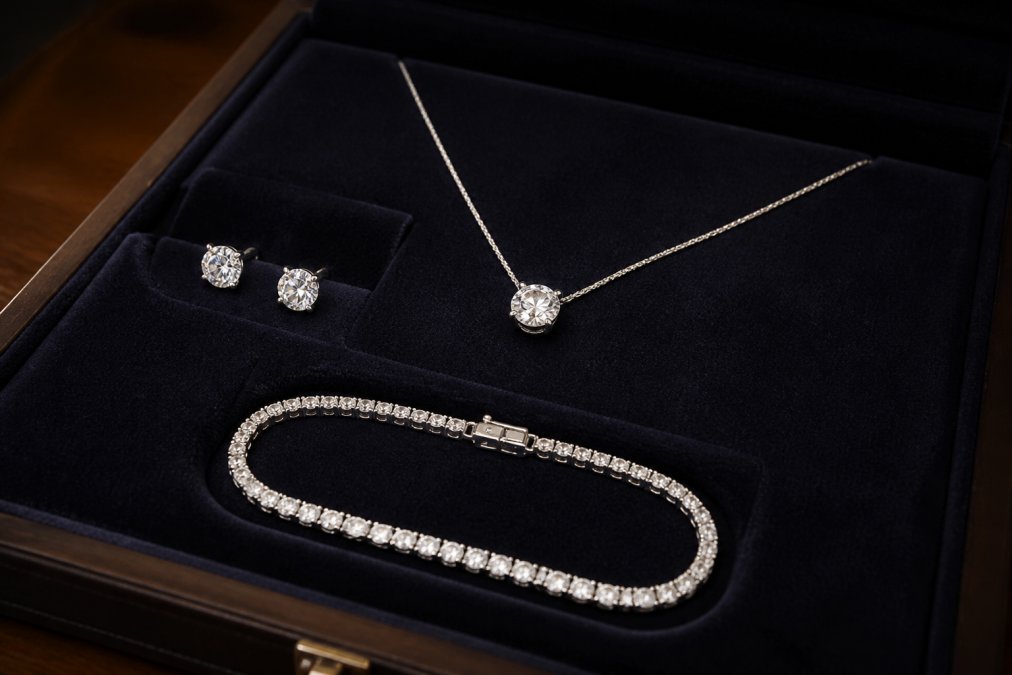
At Morgan Banks, we've guided customers through diamond jewellery purchases since 1935. Sets hold a visual coherence that individually chosen pieces rarely achieve. When the brilliance of a pendant necklace echoes the sparkle of stud earrings in the same cut and carat weight, the result feels considered rather than assembled. For gift buyers, a beautifully presented diamond jewellery set removes every doubt about whether the pieces will suit.
Matching Pieces and Coordinated Styling
The most effective diamond jewellery sets share three things: the same precious metal, the same diamond cut, and a consistent approach to setting style. A set in 18k white gold with round brilliant diamonds in a pavé setting reads as deliberate and polished. Colour grading matters too, if the pendant carries a near-colourless diamond, the earrings should match. A visible difference in colour between pieces worn close together is immediately noticeable.
Popular Set Configurations: Necklace, Earrings and Bracelet
The classic configuration is a pendant necklace paired with stud earrings, often extended with a tennis bracelet to complete what jewellers call a parure. Each element plays a distinct role: the pendant necklace draws the eye to the neckline, stud earrings frame the face without competing, and a tennis bracelet adds movement at the wrist. For those preferring a demi-parure, the two-piece necklace and earrings combination is the most versatile option, transitioning from daywear to evening occasions without adjustment.
| Set Configuration | Pieces Included | Best Occasion |
|---|---|---|
| Demi-parure | Necklace + earrings | Everyday wear, gifts |
| Full parure | Necklace + earrings + bracelet | Formal events, bridal |
| Bridal set | Engagement ring + wedding band | Engagement, wedding day |
| Statement set | Necklace + drop earrings | Gala, black-tie events |
How to Choose Diamond Clarity and Colour for Your Set
Clarity grade describes the presence of inclusions within the stone; colour grading measures how close a diamond is to being truly colourless. Both affect price significantly, but neither needs to be perfect to look beautiful.
For a set worn in normal lighting conditions, clarity grades in the VS2 to SI1 range offer excellent visual quality without the premium attached to FL or IF grades. According to guidance from the Gemmological Association of Great Britain, trained gemmologists assess clarity under 10x magnification; at normal viewing distance, the difference between VS1 and SI1 is undetectable to most wearers.
For colour, the D to G range covers colourless to near-colourless diamonds. Stones in the H to J range show barely perceptible warmth in white metal settings. In yellow gold, H to J diamonds look stunning because the metal's warmth complements the stone.
Carat Weight and Cut: How They Affect Brilliance
Cut is the most misunderstood of the four quality factors. A well-cut one-carat diamond will appear larger and more brilliant than a poorly cut stone of the same weight. For a jewellery set, consistency of carat weight across pieces matters: earring stones that are noticeably heavier than the pendant stone look unbalanced.
The round brilliant cut remains the standard for maximising sparkle, with 57 or 58 facets engineered to return light to the viewer's eye. Princess, cushion, and oval cuts each carry their own character, but for a set where brilliance is the priority, round brilliant is the benchmark.
Lab-Grown vs Natural Diamonds in Jewellery Sets
Lab-grown diamonds are chemically, physically, and optically identical to natural diamonds. The Natural Diamond Council's guidance on lab-grown diamonds confirms that the two are indistinguishable without specialist equipment.
Lab-grown diamonds typically cost considerably less than natural stones of equivalent carat weight, clarity, and colour. For a set requiring multiple matched stones, the savings can be meaningful. Natural diamonds carry the appeal of geological rarity and, for some buyers, stronger long-term resale value. Neither choice is wrong; the decision depends on what the buyer values most.
Metal Types, Settings and Hallmarking Requirements for Gold and Platinum Jewellery
Platinum, 18k gold, and 9k gold are the three metals most common in diamond jewellery sets. Platinum is the densest and most durable, with natural white colour that complements colourless diamonds without risk of the metal's tone affecting the stone. White gold requires rhodium plating to maintain its bright finish; replating every few years is part of maintenance. Yellow gold brings warmth and pairs beautifully with lower colour-grade diamonds.
Hallmarking requirements for gold and platinum jewellery sold in the UK are governed by the Hallmarking Act 1973 and overseen by the British Hallmarking Council. Any gold or platinum item over a specified weight threshold must carry a hallmark from an Assay Office before it can be described as gold or platinum in a sale. Always verify the hallmark when buying a diamond jewellery set, it is your guarantee of metal purity.
Prong, Pavé and Halo: Choosing the Right Setting Style
Setting style determines how diamonds are held in place and how much of each stone is visible.
Prong settings hold the diamond with four or six metal claws, maximising light exposure and brilliance. They are the most classic choice for solitaire pendants and stud earrings.
Pavé settings feature small diamonds set closely together across the surface of the metal, creating a continuous surface of sparkle without dramatically increasing carat weight.
Halo designs surround a central stone with a ring of smaller diamonds, making the centre stone appear larger and more brilliant. For a jewellery set, a halo necklace paired with halo stud earrings creates a cohesive, statement look.
Diamond Jewellery Sets for Every Occasion
Diamond jewellery sets suit a broader range of occasions than many buyers initially assume. For daywear, a simple demi-parure with small round brilliant studs and a delicate pendant necklace in white gold reads as elegant without being overdressed. For evening occasions, larger stones and a full parure including a tennis bracelet make the appropriate statement.
Bridal and Engagement Sets
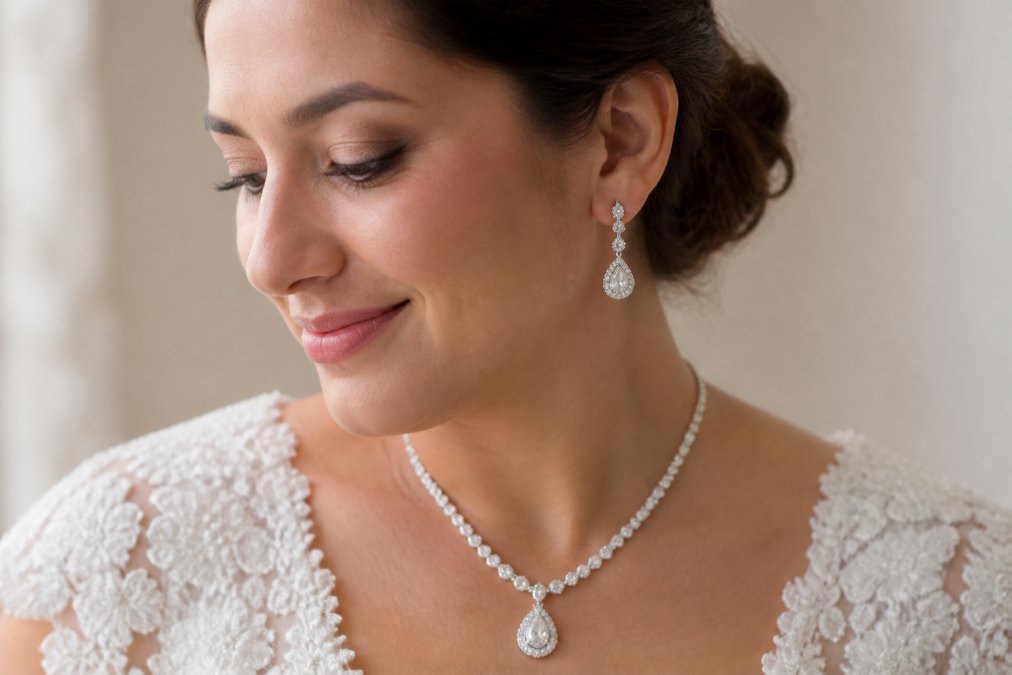
A bridal set is the most emotionally significant category of diamond jewellery. The engagement ring takes centre stage, but coordinated pieces worn on the wedding day, a pendant necklace, drop earrings, and perhaps a tennis bracelet, transform individual diamonds into a complete story.
The most common mistake with bridal jewellery sets is choosing pieces that compete with the engagement ring rather than complement it. If the ring features a halo design in white gold, a delicate pavé necklace in the same metal echoes the aesthetic without overwhelming it. The ring should always remain the focal point. A wedding band chosen to sit flush against the engagement ring's setting creates a unified look that reads as intentional. This is where bespoke design earns its value: a custom wedding band shaped to the exact profile of the engagement ring is something an off-the-shelf piece cannot replicate.
Gift Ideas for Anniversaries, Birthdays and Milestones
For gift buyers, diamond jewellery sets carry an advantage over single pieces: they feel considered. A demi-parure presented in a jewellery box signals thought and investment. Traditional anniversary gifts associate diamonds with the 60th and 75th anniversaries, but diamond jewellery sets are equally appropriate for milestone birthdays, significant career achievements, or any occasion where the giver wants to mark a moment permanently. For first-time buyers uncertain about the recipient's taste, a classic round brilliant set in white gold is the safest and most universally flattering choice. Morgan Banks offers gift cards for buyers who prefer to give the recipient the pleasure of choosing their own set.
Ethical Sourcing, Investment Value and Insurance
Ethical sourcing has moved from a niche concern to a mainstream expectation. The Kimberley Process Certification Scheme was established to prevent conflict diamonds from entering the legitimate trade. Reputable jewellers source stones with documentation confirming compliance. Lab-grown diamonds sidestep the mining supply chain entirely, appealing to buyers for whom environmental impact is a priority. For buyers who want natural diamonds, asking about country of origin and certification is a reasonable and increasingly standard request.
Resale Value and Heirloom Potential
Natural diamonds retain value better than lab-grown stones over time, largely because their supply is finite. The resale market for diamond jewellery depends heavily on the quality of the stones, the prestige of the setting, and whether the piece carries documentation such as a gemmological certificate. A certified natural diamond in a hallmarked platinum setting from a reputable jeweller will always find a secondary market more readily than an uncertified stone.
Heirloom potential differs from resale value. A bespoke diamond jewellery set made to a specific brief, with documented provenance and craftsmanship, carries emotional weight that a mass-produced set cannot replicate. The pieces become part of a family story.
Insuring and Valuing Your Diamond Jewellery
Diamond jewellery sets should be insured as soon as they are purchased. Standard home contents insurance policies often carry per-item limits that fall well below the value of a quality diamond set. A specialist jewellery insurance policy provides appropriate cover.
Valuation for insurance purposes requires a written assessment from a qualified gemmologist or a member of a recognised professional body such as the National Association of Jewellers. The valuation should describe each stone's carat weight, clarity grade, and colour grading, along with the metal type and hallmark details. Keep the valuation updated every three to five years, as diamond and precious metal values change over time.
Diamond Jewellery Care and Maintenance Tips
Diamond jewellery care is simpler than most people expect, but consistency matters. Diamonds are among the hardest natural materials, but they can chip if struck at the right angle, and the metal settings that hold them are more vulnerable than the stones themselves.
For routine cleaning, warm water with a small amount of washing-up liquid and a soft-bristled toothbrush is sufficient. Soak the pieces briefly, brush gently around the settings, rinse thoroughly, and dry with a lint-free cloth. Avoid ultrasonic cleaners for pavé-set pieces, as vibration can loosen small stones over time.
Storage matters as much as cleaning. Each piece in a diamond jewellery set should be stored separately, ideally in individual pouches or compartments of a jewellery box. This is particularly important for a tennis bracelet, where the flexible setting is more susceptible to damage from contact with other pieces. Remove diamond jewellery before swimming, gardening, or any activity involving impact or harsh chemicals. Chlorine can degrade the alloy in gold settings over time, weakening the metal at the prong tips.
Bespoke Diamond Sets: Working With a Specialist Jeweller
A bespoke diamond jewellery set is designed from the outset as a unified collection rather than assembled from existing stock. The process begins with a brief: the occasion, the wearer's style preferences, the metal and stone specifications, and the intended configuration. A skilled jeweller translates the brief into sketches and three-dimensional computer-aided design models that allow the client to see the finished piece before metalwork begins.
At Morgan Banks, our team has the experience to guide clients through every stage of the design process, from selecting matched diamonds by carat weight and clarity grade to choosing a setting style that will hold up to daily wear. Working remotely is entirely possible; detailed consultations by phone or video, combined with digital design previews, mean that distance is rarely an obstacle. The key is clear communication at the brief stage, before any metalwork begins. Bespoke sets also offer the opportunity to specify ethical sourcing requirements from the outset, whether that means a particular country of origin for natural diamonds or a preference for lab-grown stones.
=== FAQ ANSWERS (audit these too, same rules) ===
[1] Q: What is the difference between natural and lab-grown diamond sets? A: Natural diamonds form over billions of years underground and are mined, while lab-grown diamonds are created in controlled conditions using processes that replicate that environment. Both are chemically and optically identical, a gemmologist cannot tell them apart without specialist equipment. Lab-grown stones typically cost less than natural equivalents of the same carat weight, clarity grade and colour grading. The choice often comes down to budget and personal values around ethical sourcing and sustainability.
[2] Q: How should I care for and clean my diamond jewellery at home? A: Soak your diamond jewellery set in warm water with a few drops of washing-up liquid for around 20 minutes, then gently scrub with a soft toothbrush, paying attention to the setting and behind the stones where grease collects. Rinse thoroughly and pat dry with a lint-free cloth. Avoid ultrasonic cleaners if your set includes pavé or halo settings with small accent stones. Store pieces separately in a fabric-lined box to prevent scratching. Have a professional jeweller check the settings annually.
[3] Q: How do I ensure the diamonds in my jewellery set are ethically sourced? A: Ask your jeweller whether the diamonds are Kimberley Process certified, which tracks natural stones from mine to market and restricts conflict diamonds. For lab-grown stones, request documentation confirming the manufacturing origin. A reputable specialist will provide written provenance information and be transparent about their supply chain. Choosing a hallmarked set from an established jeweller adds a further layer of accountability, as hallmarking is regulated by the UK Assay Offices under the Hallmarking Act 1973.
[4] Q: What are the most popular styles for diamond jewellery sets? A: The most requested diamond jewellery sets pair a pendant necklace with matching stud earrings, a versatile combination that works for everyday wear and formal occasions. Tennis bracelet sets are popular for milestone gifts and bridal wear. Halo designs, where a central diamond is surrounded by pavé-set accent stones, remain a strong choice for engagement and bridal sets. Three-piece sets combining earrings, necklace and bracelet are frequently chosen as anniversary or significant birthday gifts.
Frequently Asked Questions
Q: What is the difference between natural and lab-grown diamond sets?
A: Natural diamonds form over billions of years underground and are mined, while lab-grown diamonds are created in controlled conditions using processes that replicate that environment. Both are chemically and optically identical, a gemmologist cannot tell them apart without specialist equipment. Lab-grown stones typically cost less than natural equivalents of the same carat weight, clarity grade and colour grading. The choice often comes down to budget and personal values around ethical sourcing and sustainability.
Q: How should I care for and clean my diamond jewellery at home?
A: Soak your diamond jewellery set in warm water with a few drops of washing-up liquid for around 20 minutes, then gently scrub with a soft toothbrush, paying attention to the setting and behind the stones where grease collects. Rinse thoroughly and pat dry with a lint-free cloth. Avoid ultrasonic cleaners if your set includes pavé or halo settings with small accent stones. Store pieces separately in a fabric-lined box to prevent scratching. Have a professional jeweller check the settings annually.
Q: How do I ensure the diamonds in my jewellery set are ethically sourced?
A: Ask your jeweller whether the diamonds are Kimberley Process certified, which tracks natural stones from mine to market and restricts conflict diamonds. For lab-grown stones, request documentation confirming the manufacturing origin. A reputable specialist will provide written provenance information and be transparent about their supply chain. Choosing a hallmarked set from an established jeweller adds a further layer of accountability, as hallmarking is regulated by the UK Assay Offices under the Hallmarking Act 1973.
Q: What are the most popular styles for diamond jewellery sets?
A: The most requested diamond jewellery sets pair a pendant necklace with matching stud earrings, a versatile combination that works for everyday wear and formal occasions. Tennis bracelet sets are popular for milestone gifts and bridal wear. Halo designs, where a central diamond is surrounded by pavé-set accent stones, remain a strong choice for engagement and bridal sets. Three-piece sets combining earrings, necklace and bracelet are frequently chosen as anniversary or significant birthday gifts.
Choosing the right diamond jewellery set involves balancing quality factors, metal choices, setting styles, and occasion requirements. Morgan Banks has offered expert guidance on exactly these decisions since 1935, with a team qualified to help buyers navigate every stage from initial brief to finished piece. Explore our bespoke jewellery service and curated diamond set collections at Morgan Banks, and get started with a consultation to find the set that suits you perfectly.
This article was written using GrandRanker