
Table of Contents
- Seeing Your Ring Before It Exists: The Power of 3D Visualization
- How 3D Visualization Benefits Your Bespoke Ring Design
- The Custom Engagement Ring CAD Process Explained
- How Long Does Bespoke Ring Design Take?
- The Step-by-Step Client Workflow for Visual Approval
- Choosing Bespoke Jewellery Design UK Craftsmen
- Conclusion: The Confidence of a Perfect Digital Preview
- Frequently Asked Questions
Last Updated: September 8, 2026
Seeing Your Ring Before It Exists: The Power of 3D Visualization
The single greatest fear when commissioning a bespoke engagement ring is the gap between imagination and reality. You describe a design, hand over a deposit, and wait weeks hoping the craftsman understood your vision. 3D visualization benefits eliminate that anxiety by showing you a photorealistic digital model of your ring before any metal is cut or any stone is set. This technology has transformed how fine jewellers like Peter George banks trading as Morgan Banks, established in Kendal since 1935, collaborate with clients on custom ring design.
The custom ring design 3d visualization benefits extend far beyond a pretty picture on a screen. A digital prototype allows you to examine every angle, zoom into the intricate detail of a pave setting, and approve the proportions before manufacturing begins. This visual preview is the bridge between your imagination and a physical piece of jewellery, ensuring the finished ring matches your expectations precisely.
Below, we'll walk through how 3D visualization works in practice, what the CAD process involves, and how long you should expect bespoke ring design to take. We'll also explore the technical limitations you should understand before you start.

How 3D Visualization Benefits Your Bespoke Ring Design
3D visualization benefits your bespoke ring design in four concrete ways: design flexibility, production accuracy, cost reduction, and buyer confidence. Unlike traditional sketching, where changes mean redrawing, a CAD model allows instant design iteration. Want to see the band wider? Prefer a different metal colour? The designer adjusts the digital mockup in minutes, not days.
The production accuracy gains are equally significant. When your ring is rendered in high-fidelity 3D, the jeweller can identify potential issues with gemstone settings or structural integrity before anything is manufactured. This design validation reduces the risk of costly errors and material waste, because the wax model and final casting are created from a verified digital file rather than guesswork.
Yet the most powerful benefit is not technical, it is psychological. Commissioning a bespoke ring is an act of faith, and uncertainty is the enemy of that faith. 3D visualization short-circuits the cognitive gap between imagination and reality by giving you a concrete artefact to react to. Instead of trying to interpret a designer's verbal description or a flat sketch, you see the ring as it will exist, on your hand, at your angle, in your light. This transforms you from a passive specifier into an active approver.
This visual confirmation triggers what behavioural psychologists call the 'endowment effect', the tendency to value something more highly once you feel ownership over it (National Library of Medicine article on endowment effect). When you see your ring rendered in photorealistic detail, your brain begins to treat it as yours. That emotional investment makes the final sign-off feel like a confirmation rather than a leap of faith. It also reduces the likelihood of post-purchase dissonance, the nagging doubt that you made the wrong choice. A client who has approved a digital twin is far less likely to experience 'buyer's remorse' when the physical ring arrives, because the physical object matches the mental image they have already endorsed.
There is also a practical confidence gain that most articles overlook: 3D visualization lets you test the ring in context. Many jewellers now provide a digital file you can view on your own device, allowing you to see the ring alongside your wedding band or against your skin tone. This contextual preview is impossible with a sketch and difficult even with a wax model. It answers the question every client secretly asks: 'Will this actually look good on me?' Seeing the answer before committing is what turns a hesitant buyer into a confident one.
For the jeweller, this psychological shift has a measurable effect on the approval process. Clients who have engaged deeply with a 3D model are more decisive at the wax model stage, because they are not seeing the design for the first time, they are verifying what they already know. This efficiency shortens the overall timeline and reduces the number of revision cycles, which is why most bespoke jewellery houses now treat photorealistic rendering as a standard part of the consultation, not a premium extra.
The Custom Engagement Ring CAD Process Explained
Computer-Aided Design, or CAD, is the technical foundation of modern bespoke jewellery. The custom engagement ring CAD process begins with your initial consultation, where the designer captures your preferences for stone shape, metal, and overall aesthetic. Using specialised jewellery design software, the designer then builds a three-dimensional model of your ring, layer by layer.

This software allows for exceptional precision. Every measurement, from the band thickness to the angle of each claw, is calculated to fractions of a millimetre. The result is a digital prototype that shows exactly how light will interact with your chosen diamond and how the ring will sit on the finger.
From Digital Prototype to Wax Model
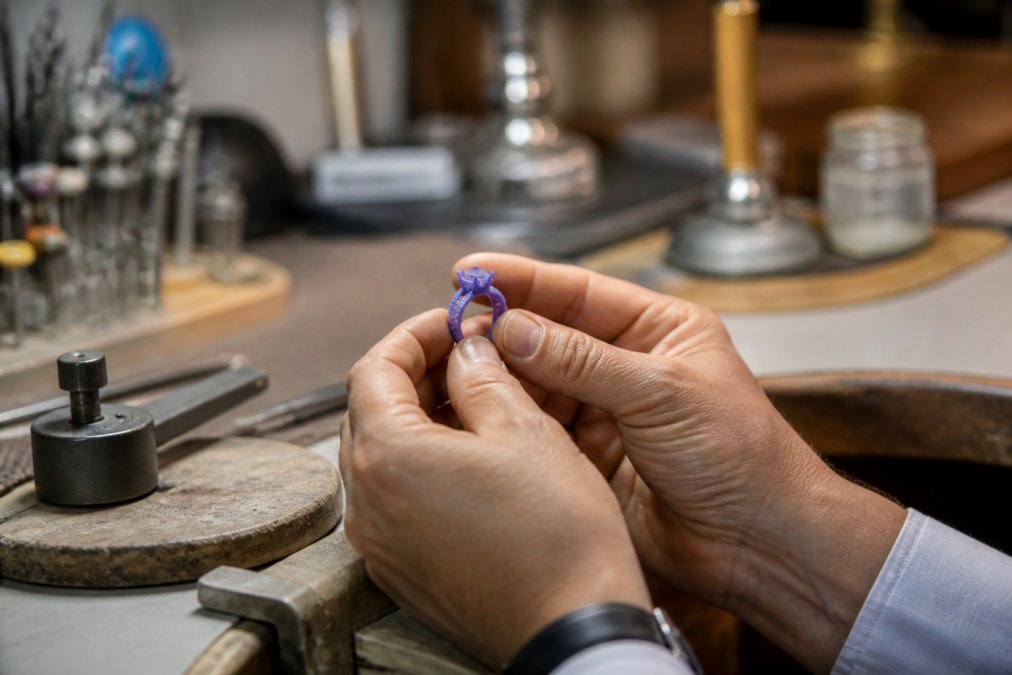
Once you approve the digital design, the file is sent to a 3D printer. This machine produces a physical wax model of your ring, replicating the digital prototype with remarkable fidelity. The wax model serves two purposes: it allows you to hold and inspect the ring's proportions in your hand, and it becomes the template for the casting process.
This step is where the custom engagement ring CAD process proves its worth. If the wax model feels too heavy or the proportions look different in three dimensions, adjustments are made to the digital file and a new wax model is printed. This iteration costs a fraction of what reworking a finished metal ring would cost.
How Long Does Bespoke Ring Design Take?
Bespoke ring design typically takes between four and eight weeks from initial consultation to final delivery (GIA information on custom engagement rings). The exact timeline depends on the complexity of the design, the availability of your chosen stone, and how quickly you approve each stage of the process.
The CAD and prototyping phase usually accounts for the first one to two weeks (Ganoksin forum on RP in jewellery). This includes creating the digital model, printing and refining the wax prototype, and finalising your approval. The remaining time is dedicated to casting, setting the stones, and the final polishing and quality inspection.
Many clients are surprised to learn that the design phase is the most interactive part of the journey. You are not waiting passively; you are actively involved in reviewing each iteration. A clear approval process keeps the project moving efficiently.
The Step-by-Step Client Workflow for Visual Approval
Understanding the workflow helps you know what to expect and what will be asked of you at each stage.
- Initial consultation: Discuss your vision, budget, and any reference images you have collected.
- Concept sketches: The designer presents initial hand-drawn or digital sketches to establish the overall direction.
- CAD modelling: Your chosen design is built in 3D software, creating a photorealistic digital prototype.
- Digital review: You receive rendered images and an interactive 3D file to examine from every angle.
- Wax model approval: A physical wax prototype is created for you to hold and assess the weight and proportions.
- Casting and setting: Upon your written approval, the ring is cast in your chosen metal and the stones are set.
- Final inspection: The finished ring undergoes rigorous quality checks before you collect it.
This structured approach ensures there are no surprises. Each sign-off point protects you and gives you complete control over the final outcome.
Choosing Bespoke Jewellery Design UK Craftsmen
Selecting the right craftsman for bespoke jewellery design UK is the most important decision you will make. Look for a jeweller with demonstrated experience in CAD design and a transparent process. Ask to see examples of their digital renderings alongside the finished pieces, so you can judge how accurately their visualisation translates to reality.
Heritage matters in this craft. A jeweller with decades of experience, like the team at Peter George banks trading as Morgan Banks, brings a depth of knowledge that newer workshops simply cannot match. When you commission a piece from a long-established house, you benefit from refined techniques and a reputation built on consistent quality.
The right craftsman will also be honest about the technical limitations of 3D rendering, and you should be equally honest with yourself about what a digital image can and cannot show you. A photorealistic render is a simulation, not a photograph. Here are the key discrepancies to understand before you approve a design:
Screen colour versus metal finish. The colour you see on your monitor depends on your screen's calibration, brightness, and colour profile. A platinum ring may appear slightly warmer or cooler on screen than it will in person. A reputable jeweller will show you physical metal samples alongside the render, so you can calibrate your expectations. Do not approve a metal colour based solely on a screen image.
Gemstone brilliance and fire. No render can fully replicate the way a diamond interacts with natural light. 3D software can simulate sparkle, but real brilliance depends on the specific stone's cut quality, proportions, and internal characteristics. The render shows you the setting and the stone's shape, but the 'life' of the diamond is something you must judge in person. Ask your jeweller to show you the actual stone, or a stone of equivalent cut quality, before you finalise the design.
Scale and weight perception. A digital model viewed on a screen looks different from a ring on your finger. The render may make a band look delicate when it would actually feel substantial, or vice versa. This is why the wax model stage is crucial; it is the only point where you can physically assess weight and proportion. A skilled jeweller will insist on this step, not offer it as an optional extra.
Surface texture and finish. Renders excel at showing polished surfaces but struggle to convey the difference between a high-polish, satin, or brushed finish. These textures are tactile qualities that a screen cannot reproduce. Ask your jeweller to show you sample pieces with the exact finish you are considering.
A trustworthy craftsman will walk you through these limitations proactively, not wait for you to discover them. This honesty is the mark of a workshop that stands behind its work. If a jeweller claims their render is a perfect representation of the final piece, treat that as a warning sign; no reputable CAD designer would make that claim, because they know the gap between simulation and reality.
Finally, ask about their revision policy. How many digital iterations are included in the quoted price? What happens if you want to change the design after the wax model is printed? A clear, written policy protects you from unexpected costs and signals that the jeweller is confident in their process. The best craftsmen welcome questions about their workflow because they know that an informed client is a satisfied client.
Conclusion: The Confidence of a Perfect Digital Preview
Commissioning a bespoke ring is an act of trust. The 3d visualization benefits give you the confidence to place that trust wisely, because you have already seen exactly what you will receive. From the first digital mockup to the final wax model, every stage is designed to eliminate guesswork and ensure your ring is precisely what you imagined.
At Peter George banks trading as Morgan Banks, our team combines decades of traditional craftsmanship with modern CAD technology to create heirloom-quality pieces. Explore our Platinum 3 stone Oval Lab Grown Diamond Ring 1.6ct D vvs for an example of our work, or visit our Kendal showroom to begin your bespoke commission. Get started with Morgan Banks and experience the confidence of a perfectly visualised ring.

Frequently Asked Questions
Can I see a 3D model of my engagement ring before it is cast?
Yes, viewing a 3D model before casting is standard practice for bespoke commissions. Your jeweller will share high-fidelity renders from multiple angles, allowing you to examine the metal colour, gemstone setting and intricate detail. This digital prototype stage is your opportunity to request design iterations, ensuring the final piece matches your vision perfectly before any metal is committed.
What is the difference between a 3D render and a finished piece of jewellery?
A 3D render is a photorealistic digital image on a screen, while the finished piece is the physical ring in your hand. The render provides a very accurate visual preview of proportions, metal colour and stone placement but cannot show real-world light refraction or the weight of the metal. Think of it as a precise blueprint that eliminates guesswork before manufacturing begins.
How long does the CAD stage add to the bespoke ring design process?
The CAD stage typically adds one to two weeks to the overall timeline for a bespoke ring. This phase involves creating the digital model, followed by your review and any requested modifications. Factoring in this design iteration time within the bespoke jewellery design UK process ensures the final wax model and cast piece meet your exact specifications without costly delays.